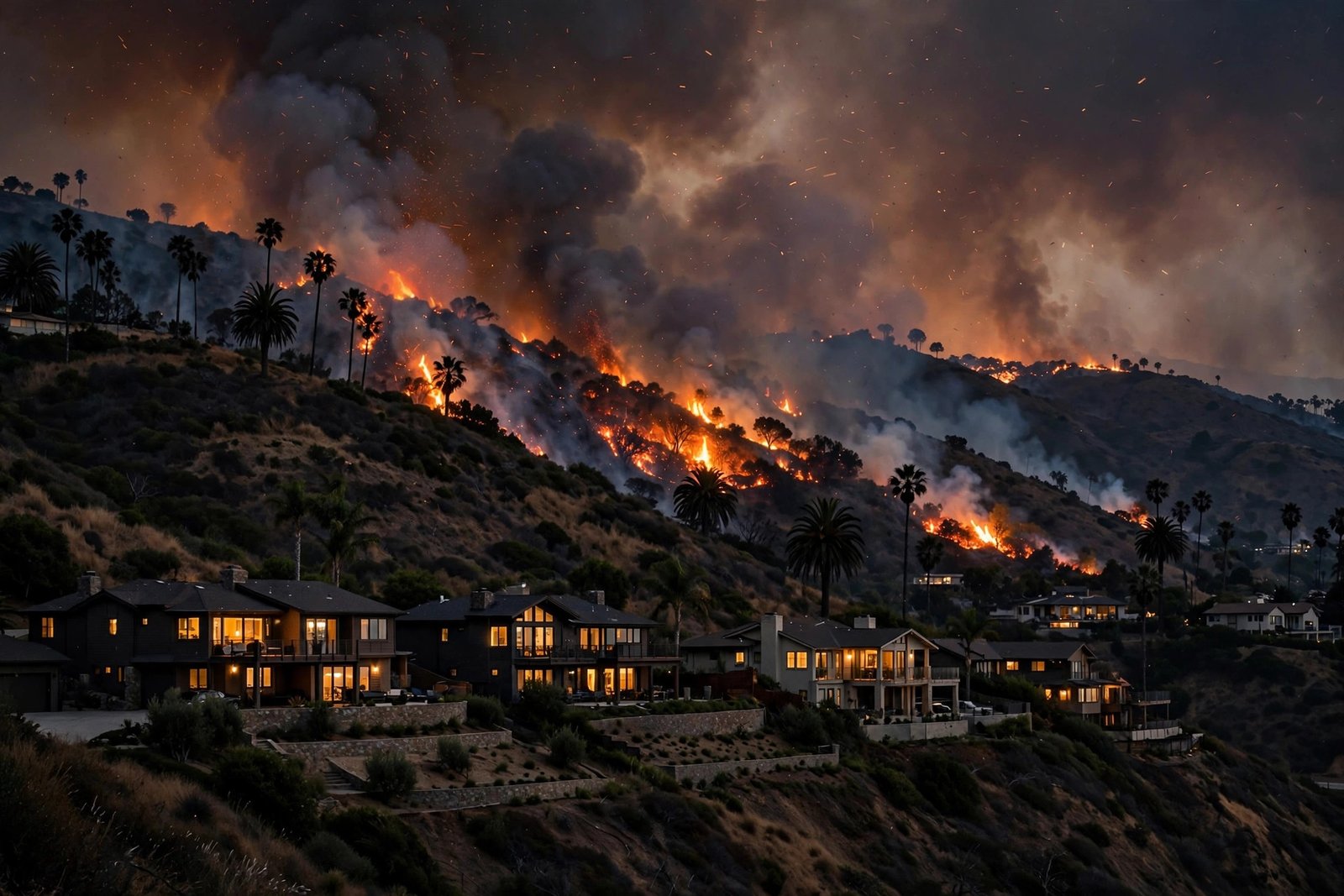
The Norte Fire turned a quiet Friday morning in coastal Orange County into a race against wind-driven flames. The wildfire ignited around 11:30 a.m. on October 16, 2026, near Portico Del Norte and Eminencia Del Norte on the northern edge of San Clemente — and within an hour it had already burned 250 acres. Fueled by fierce Santa Ana winds, the blaze tore through brush-covered hillsides, crossed into San Juan Capistrano, and by Friday night had scorched 570 acres, destroying at least six multimillion-dollar homes and forcing roughly 16,000 residents from their homes.
By Saturday evening, the picture had improved dramatically. The Orange County Fire Authority raised containment of the Norte Fire to 25% — a fivefold jump from 5% that morning — and most evacuation orders were lifted, allowing thousands of displaced families to begin returning home. Two firefighters were hospitalized with heat-related injuries while battling the blaze; one has since been released and the other is doing well. The cause of the Norte Fire remains under investigation, and officials warned that with embers and hot spots still smoldering, the danger of a rekindle is far from over.
What happened in San Clemente and San Juan Capistrano is also part of a bigger story: the Norte Fire is one of ten uncontained wildfires burning across California, as red flag warnings gripped Southern California through the weekend. Here is the complete breakdown of what we know about the Norte Fire so far.
- What Happened: The Norte Fire by the Numbers
- How the Norte Fire Started and Spread
- Evacuations: 16,000 Residents Forced to Flee the Norte Fire
- Homes Destroyed as the Norte Fire Swept Into San Juan Capistrano
- Firefighters Battling the Norte Fire Around the Clock
- Santa Ana Winds Drove the Norte Fire’s Explosive Growth
- The Norte Fire Is One of 10 Uncontained Wildfires in California
- Extra Knowledge: Why October Is California’s Most Dangerous Fire Month
- Extra Knowledge: The Power Shutoffs and Federal Aid Behind the Norte Fire Response
- What’s Next
- Additional Details
What Happened: The Norte Fire by the Numbers
The scale of the Norte Fire came into focus fast — and the official numbers tell the story of a fire that nearly doubled in size in its first hours. The wildfire burned 570 acres, or just under a square mile, straddling the border between San Clemente and San Juan Capistrano, according to the Orange County Fire Authority and Cal Fire. Containment stood at 25% as of Saturday evening, up from just 5% that morning, in what OCFA Chief TJ McGovern described as dramatic progress by ground crews.
At the peak of the emergency, evacuation orders covered roughly 6,000 homes and about 16,000 residents across the two cities. At least six homes were damaged or destroyed — most of them large coastal properties in a hillside enclave near Via La Mirada — and two firefighters were hospitalized with heat-related injuries. No civilian injuries or deaths have been reported, and the fire’s incident record lists the cause as under investigation, with the Orange County Fire Authority as the agency with jurisdiction.
The fire is one of ten uncontained wildfires in California, according to the state’s Department of Forestry and Fire Protection — a reminder that while Orange County got the most dramatic footage, the entire region was fighting fires at once.
How the Norte Fire Started and Spread
The Norte Fire was first reported around 11:30 a.m. on Friday, October 16, in the 3000 block of Eminencia del Norte in San Clemente, according to the fire-tracking app Watch Duty — and the growth curve from there was startling. Driven by strong Santa Ana winds, the blaze grew from about 10 acres to an estimated 50 to 70 acres by 12:20 p.m., and by early afternoon it had already scorched at least 465 acres. Cal Fire announced at 7:27 p.m. Friday that the fire had grown to 570 acres — a figure that held through Saturday.
Crews battled the Norte Fire on the ground and with the help of water-dropping aircraft whenever winds allowed, and additional strike teams were summoned as the blaze exploded in size. More than 400 firefighters were on the scene Saturday morning, according to CBS News’ Saturday morning account — on top of the roughly 400 deployed Friday evening with another 400 en route, and more than 1,000 firefighters committed to the wider Southern California fire response.
Fire activity had noticeably diminished by the end of Friday, with crews focused on homes that were still burning and on mopping up smoldering debris. But the OCFA cautioned against reading the progress as the end of the story. Fire crews will remain on site for “a number of days” even with evacuation orders lifted, a fire captain told reporters. “We don’t want a rekindle,” he said, pointing to the Santa Ana winds. “Right now, because there are some embers, there are some hot spots, we don’t want those embers to then catch a palm tree or some vegetation in another area or next to homes.”
Evacuations: 16,000 Residents Forced to Flee the Norte Fire
Orange County officials issued mandatory evacuation orders for thousands of residents as flames advanced on local subdivisions on Friday. Approximately 6,000 homes — encompassing roughly 16,000 residents — fell under active evacuation orders at the peak, as emergency teams worked to establish containment lines and keep escape routes clear. Emergency shelters opened at the San Juan Capistrano Community Center and the San Clemente Community Center to accommodate displaced families.
The human stories behind the orders were striking. John Zehren was evacuated twice on Friday — first while surfing at Camp Pendleton because of a different fire burning near the base, then again when he went home to San Juan Capistrano and received a text telling him to evacuate his house. On Saturday morning, he rode through road barriers on a small white e-bike to check on a friend’s house on Via La Mirada, a street where several homes were ravaged. The house was still standing — and the friend’s reaction, relayed by Zehren, was simple: “I can’t believe it. Thank God.”
Among those forced to flee was U.S. Rep. Mike Levin, whose district includes San Juan Capistrano. Levin attended a local news briefing to thank emergency crews. “This is an incredible community, and I cannot tell you how grateful my wife and my mom and our two kids are for you, chief, and for all the firefighters who worked hard today and every day,” Levin said.
Local school districts also took precautionary steps: the Capistrano Unified School District dismissed students early across at least nine campuses in the affected zones, including Bernice Ayer, Clarence Lobo, Concordia, Harold Ambuehl, Palisades, San Clemente, San Juan Hills, Shorecliffs, Truman Benedict and Vista Del Mar. Families evacuating with children should make sure their go-bags cover the essentials — see StateLineDaily’s hurricane preparedness guide for a full emergency checklist whose before-during-after framework applies to wildfire evacuations too.
The good news arrived Saturday evening. A Cal Fire update at 6:21 p.m. Saturday said evacuation orders for San Clemente and San Juan Capistrano were lifted effective 6 p.m., and the Associated Press reported that most evacuation orders were rescinded, with a single San Clemente street the only exception. Earlier Saturday lifts had already covered zones SJC10-B and SCL13 at 12:18 p.m., and repopulation details had San Clemente Zone 13 fully repopulated, with San Juan Capistrano Zone 10 partially repopulated in the Stallion Ridge community and around San Juan Hills High School, as reporting on the Cal Fire and sheriff’s updates confirmed.
Homes Destroyed as the Norte Fire Swept Into San Juan Capistrano
The Norte Fire hit hardest in the hillside neighborhoods overlooking the Pacific. At least six large coastal homes were damaged or destroyed, according to the Associated Press, Cal Fire and the Orange County Fire Authority — concentrated in a hillside enclave near Via La Mirada, with damage also reported along Avenida Calita and Via De Agua. Photos of the aftermath showed palm tree-lined streets of expensive homes now looking completely charred, with smoke and embers still rising from the properties despite firefighters’ efforts.
OCFA Division Three Fire Chief Mark Backhoff confirmed the figure of six homes “damaged or destroyed.” “Our hearts go out to the folks impacted by that,” Backhoff said. One local outlet, KTLA, reported seven homes damaged or destroyed — a figure the fire agencies have not confirmed. France 24 reported that expensive coastal properties were engulfed, and footage noted by BBC News showed blazes tearing through homes in San Clemente and San Juan Capistrano.
For longtime residents, the fire was a shock. “I’ve lived here since 1995, and this is the first time we’ve really ever had a fire in this area,” local resident Robert Morris told CBS LA, calling the Norte Fire a “wake-up call,” as reported. The Camino Capistrano off-ramp from the northbound San Diego Freeway was closed because of the fire, adding to traffic chaos around the evacuation zones.
Firefighters Battling the Norte Fire Around the Clock
Two firefighters were hospitalized with heat-related injuries while battling the Norte Fire — and their conditions became a bright spot in an otherwise grim weekend. The injuries were described as “significant” but stable, and OCFA Capt. Steve Concialdi later told reporters that one of the hospitalized firefighters had been released while the other was “doing very good.”
The heat was brutal on the fire lines. One firefighter was treated for heat exhaustion, OCFA Division Chief Backhoff said, and a second sustained heat-related injuries, Capt. Greg Barta said at an evening news conference. Temperatures in the mid-90s, combined with the exertion of fighting a wind-driven fire in heavy gear, made heat illness one of the biggest dangers crews faced — a heat advisory remained in effect until 8 p.m. Saturday for the Orange and San Diego county coasts, the National Weather Service said.
Firefighters worked through Friday night to suppress the blaze, strengthen containment lines and extinguish hot spots, the OCFA said in a Saturday morning update. On Saturday morning, Santa Ana winds had eased to 10 to 15 mph with stronger gusts, as hundreds of firefighters worked to keep the fire in its current footprint — and the OCFA said containment was expected to grow “dramatically” on Saturday. It did, climbing to 25% by evening.
Santa Ana Winds Drove the Norte Fire’s Explosive Growth
The engine behind the Norte Fire’s explosive growth was the Santa Ana winds — hot, dry gusts that blow from inland toward the coast and are notorious for turning small brush fires into disasters. Wind gusts reached 35 mph and even 40 mph in parts of the Los Angeles area on Friday, the National Weather Service reported, creating what officials described as critical conditions for fire spread: low humidity, dry vegetation, and unseasonably high temperatures.
The National Weather Service issued red flag warnings across several counties and warned that dangerous fire conditions would persist into Saturday morning. While winds were expected to peak on Friday, the NWS said the threat would linger — and the OCFA urged residents whose evacuation orders were lifted to stay cautious, citing the still-active fire line, the wind, and the heat advisory.
The wind also grounded or limited aircraft at the worst moments. Water-dropping helicopters and air tankers assisted ground crews only when the gusts allowed — a familiar frustration in Santa Ana-driven fires, where the same winds that make the fire most dangerous also make aerial attack most difficult.
The Norte Fire Is One of 10 Uncontained Wildfires in California
The Norte Fire did not burn in isolation. It was one of ten wildfires that remained uncontained across California over the weekend, stretching the state’s firefighting resources thin. The closest fires were the Peak Fire, which started in Azusa, and the Bryson Fire in Malibu, which had burned 147 acres and was 52% contained.
To the south, the Henderson Fire in San Diego County was the larger monster: it had reached more than 3,100 acres, including areas around Marine Corps Base Camp Pendleton, and the blaze forced officials to close Interstate 5 twice. The freeway shutdowns around Camp Pendleton are a reminder of how quickly a wildfire can sever the corridors millions of Californians depend on — see StateLineDaily’s US infrastructure 2026 report on the race to rebuild the country’s roads and bridges.
With multiple counties under red flag warnings simultaneously, the weekend became a regional fire crisis — the kind of multi-front event that tests evacuation logistics, mutual-aid agreements, and the power grid all at once.
Extra Knowledge: Why October Is California’s Most Dangerous Fire Month
Here is the context most coverage of the Norte Fire skips — and it explains why a fire of this intensity broke out in mid-October. Southern California’s fire season does not peak in the hottest months of summer. It peaks in the fall, when the Santa Ana winds arrive.
The Santa Anas are a textbook example of foehn winds: high pressure builds over the Great Basin, and air is forced down the Sierra Nevada and through the mountain passes and canyons of Southern California. As the air descends, it compresses and warms dramatically while its humidity plummets. The result is a blast-furnace wind that arrives at the coast hot, fast and bone-dry — typically strongest from September through November, right after the long dry summer has turned every hillside into tinder.
That timing is what makes October so dangerous. By mid-fall, vegetation moisture is at its annual low after months without rain, while the first Santa Ana events of the season bring the year’s strongest offshore winds. Add temperatures in the mid-90s — well above seasonal norms — and a single spark near a canyon mouth can do exactly what the Norte Fire did: run from 10 acres to 570 acres in a single afternoon. Firefighters call these “wind-driven” fires for a reason; the wind, not the fuel load, decides how fast and how far the fire goes.
The pattern also explains the geography. The Norte Fire ignited on the northern edge of San Clemente, where canyon winds funnel straight toward the coast — the same corridor that has historically funneled fire into coastal communities. Resident Robert Morris’s observation that nothing like this had happened in his area since 1995 is telling: Santa Ana-driven fires are intensely local, striking wherever the wind, the canyons and the ignition point align.
Extra Knowledge: The Power Shutoffs and Federal Aid Behind the Norte Fire Response
The second piece of context competitors are likely to miss is what happened behind the scenes of the Norte Fire response: the power grid was deliberately shut down, and the federal government stepped in within a day.
As the Norte Fire spread, Southern California Edison initiated Public Safety Power Shutoffs — precautionary blackouts that left tens of thousands of customers without electricity. Utilities use the shutoffs to prevent their own equipment from sparking new fires during red flag conditions, a practice that has become standard in California’s fire playbook. The trade-off is real: the same shutoffs that reduce ignition risk also cut power to homes, traffic signals and evacuation infrastructure during an active emergency. See StateLineDaily’s explainer on why outages happen and what’s being done about the US power grid for background on how the grid handles exactly these moments.
At the same time, California moved fast on federal help. Cal Fire announced early Saturday that the state had secured a Fire Management Assistance Grant from the Federal Emergency Management Agency — a grant that unlocks federal cost-sharing for firefighting resources during major incidents. The speed matters: the grant was approved while the fire was still at 5% containment, ensuring that the surge of strike teams, aircraft and personnel could keep flowing without the state carrying the full cost alone.
Together, the shutoffs and the FEMA grant show how California’s wildfire response has become a two-front operation — fighting the fire on the ground while managing the grid and the money that make the fight possible.
What’s Next
Will the evacuation orders stay lifted?
Most orders were rescinded Saturday evening, but officials warned that rekindles are the main threat. With hot spots and embers still active and Santa Ana winds capable of returning, residents should expect fire crews in the area for days and should keep roads clear for emergency vehicles. Repopulation does not mean the emergency is over — it means the immediate danger has passed for now.
What caused the Norte Fire?
The cause remains under investigation, with the Orange County Fire Authority as the agency with jurisdiction. No official determination has been announced, and investigators will be working the origin area near Eminencia Del Norte even as suppression continues.
When will the Norte Fire be fully contained?
Containment jumped from 5% to 25% on Saturday, and the OCFA expected it to grow “dramatically” through the day — which it did. Full containment will depend on weather: if the Santa Ana winds stay down and crews can methodically extinguish hot spots, the fire could be boxed in within days. If the winds return, all bets are off.
What should returning residents watch for?
Officials urged returning residents to stay out of burned areas, watch for smoldering debris and damaged power lines, and to leave immediately if conditions change. The OCFA’s message was blunt: cooperate, heed the advice, and stay out of the active fire areas — the heat advisory and the wind mean the risk is still real.
What about the other fires?
With ten uncontained wildfires across California, including the 3,100-acre Henderson Fire near Camp Pendleton, the regional crisis is not over. Red flag warnings and heat advisories will determine whether the weekend’s gains hold — or whether Southern California faces another round of evacuations.
Additional Details
Description: The Norte Fire is a wind-driven wildfire that ignited October 16, 2026, near San Clemente, California, burning 570 acres across San Clemente and San Juan Capistrano. The Santa Ana wind-fueled blaze destroyed at least six homes, forced the evacuation of roughly 16,000 residents, injured two firefighters, and reached 25% containment by Saturday evening, October 17. It is one of ten uncontained wildfires burning across California during a weekend of red flag warnings.
- Fire name: Norte Fire
- Location: San Clemente and San Juan Capistrano, Orange County, California
- Ignition: ~11:30 a.m. PDT, Friday, October 16, 2026, near Portico Del Norte and Eminencia Del Norte
- Size: 570 acres (just under one square mile)
- Containment: 25% as of Saturday evening, October 17 (up from 5% that morning)
- Homes: At least six damaged or destroyed; KTLA reported seven (unconfirmed)
- Evacuations: ~6,000 homes / ~16,000 residents at peak; most orders lifted Saturday 6 p.m.
- Injuries: Two firefighters hospitalized with heat-related injuries; no civilian injuries or deaths
- Cause: Under investigation
- Jurisdiction: Orange County Fire Authority
- Federal aid: FEMA Fire Management Assistance Grant secured October 17
1 thought on “Norte Fire: Orange County Wildfire Destroys 6 Homes, Forces 16,000 Evacuations Amid Santa Ana Winds”