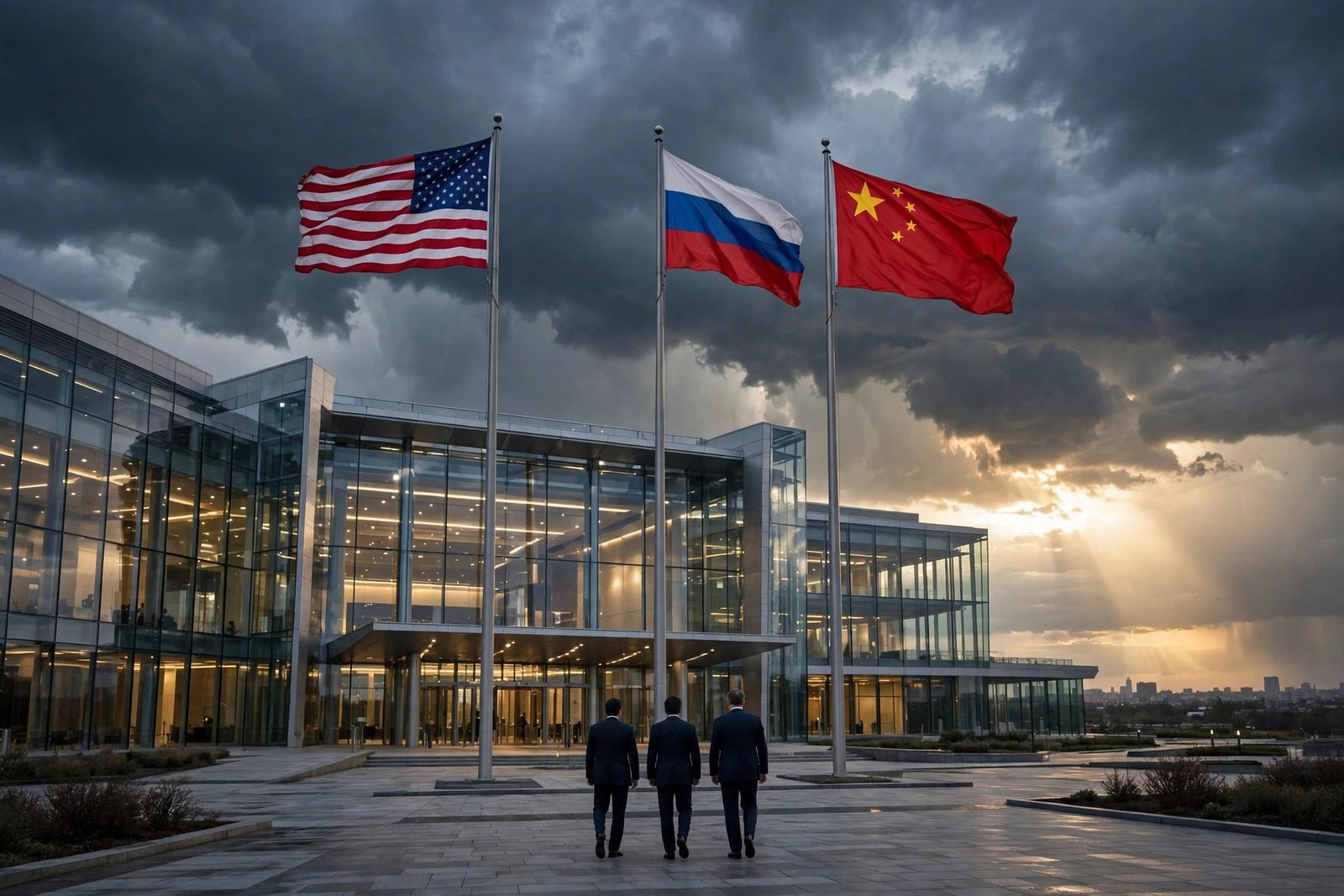
Russian President Vladimir Putin has proposed a summit with U.S. President Donald Trump and Chinese leader Xi Jinping to negotiate an end to the war in Ukraine — without Ukrainian President Volodymyr Zelensky at the table. The proposed Putin Trump Xi summit, first reported by The Wall Street Journal on Sunday, October 18, 2026, would seek a settlement on terms favorable to Moscow, according to people familiar with the discussions.
Putin floated the three-way meeting during an October 9 telephone call with Trump, the same conversation in which the two leaders agreed on a deal for the United States to purchase Russian diesel fuel. The Kremlin has suggested staging the talks on the sidelines of the Asia-Pacific Economic Cooperation summit in Shenzhen, China, scheduled for November 18–19, where all three leaders are expected to be present. If it happens, the Putin Trump Xi summit would be an unprecedented gathering: three of the world’s most powerful leaders deciding the fate of a European war without the country under invasion even being invited.
Kremlin spokesman Dmitry Peskov confirmed that discussions about the meeting are underway, telling the Journal that “all three parties acknowledge the hypothetical possibility of such a meeting taking place,” though he cautioned there is no agreed agenda yet. A senior U.S. official told the Journal that Trump has not agreed to attend but could be receptive, given his long-stated desire to end the war. The White House and the Chinese Embassy in Washington did not respond to requests for comment, according to the report.
- What the Wall Street Journal Report Says
- The Sidelines at APEC Shenzhen: Where the Putin Trump Xi Summit Could Happen
- Why Putin Picked This Moment
- Zelensky Cut Out: Kyiv’s Fierce Reaction
- Trump Receptive but Uncommitted: Where the White House Stands
- Europe’s Alarm Over a Three-Way Deal
- The September Prelude: Moscow Floated the Same Idea Weeks Earlier
- Spheres of Influence: Why Historians Say This Moment Echoes 1945
- What’s Next
- Additional Details
What the Wall Street Journal Report Says
The Journal’s exclusive, published late Sunday and based on accounts from people familiar with the discussions, describes a deliberate Kremlin strategy. Citing a former Russian intelligence officer briefed on the matter, the paper reports that Putin used the October 9 call — the one that produced the diesel arrangement — to plant the idea of a trilateral gathering of the leaders of Russia, the United States, and China.
The proposal is not a peace process in any conventional sense. There is no ceasefire framework attached, no Ukrainian representation envisioned, and no European allies consulted. Instead, the Putin Trump Xi summit as described by the Journal is a top-down negotiation in which the three great powers would set the terms for ending Europe’s largest land war since 1945, with Kyiv presented the result. Analysts quoted in the reporting noted that such a format on Chinese soil would also be a significant step for Xi in his long effort to elevate China as a global diplomatic power broker.
Peskov’s carefully worded confirmation — acknowledging discussions while stressing “no clear understanding yet” about the meeting or its agenda — follows the Kremlin’s pattern of floating trial balloons while preserving deniability. Notably, Moscow proposed the trilateral talks to Beijing through diplomatic channels first, and the Chinese side indicated it would not object if Trump were on board, according to the Journal.
The Sidelines at APEC Shenzhen: Where the Putin Trump Xi Summit Could Happen
The Kremlin has suggested convening the three leaders on the sidelines of the APEC leaders’ gathering set for November 18–19 in Shenzhen, China. APEC — the Asia-Pacific Economic Cooperation forum — is the rare multilateral stage where all three men are expected to appear at the same time this year, making it the natural cover for a private trilateral conversation.
All three leaders are regular APEC attendees, and the Shenzhen summit was already shaping up as one of the most closely watched diplomatic gatherings of the year. A private Putin-Trump-Xi meeting in its corridors would turn a trade-focused forum into the venue for deciding a war’s end — an irony that has not been lost on European diplomats, several of whom have privately described the idea as a “steal” of the APEC stage.
The timing also matters for Trump’s calendar. With the midterm elections on November 3 behind him by then, a November summit would give the president a freer hand internationally. The Journal’s reporting notes that Trump has not committed, but the mere fact that his administration is publicly acknowledging the proposal — through a senior U.S. official’s comment to the paper — suggests it is being taken seriously inside the White House.
Why Putin Picked This Moment
The proposal arrives at what may be the warmest point in the Trump-Putin relationship since the war began. Days before the Journal’s report, Trump signed an executive order on Friday waiving key Russia sanctions and tariffs under the Sanctioning Russia and Iran Act of 2026 — the Graham Act — just before an October 18 enforcement deadline. Reuters noted that the summit proposal “comes amid warming ties between Trump and Putin especially after the US President announced a deal to buy Russian diesel and signed an order on Friday waiving key sanctions on Moscow.”
See StateLineDaily’s coverage of the Trump Russia sanctions waiver for the full background on how that executive order landed just days before the deadline.
Trump has simultaneously intensified public pressure on Kyiv. As summarized in regional reporting on the story, Trump wrote on Truth Social that Zelensky “doesn’t want to end this war” and demanded that Ukraine stop attacking Russian oil refineries — the same drone campaign Kyiv has used to strike deep inside Russia. Read StateLineDaily’s full timeline of Ukraine’s defiant drone strikes on Russian refineries here.
That convergence — concessions to Moscow paired with pressure on Kyiv — is precisely the opening Putin is seeking to exploit. By proposing the Putin Trump Xi summit now, while the sanctions enforcement is delayed and the diesel deal is fresh, the Kremlin is betting that Trump’s desire to deliver on his long-repeated promise to end the war quickly will outweigh the objections of Ukraine’s defenders in Washington and Europe.
It is also no accident that China is the third chair. Xi has spent years positioning Beijing as a would-be peacemaker, and a summit hosted in effect on Chinese territory would hand him enormous prestige. The Journal reported that Chinese officials told Moscow they would not oppose the idea if Washington agreed — a signal that Beijing sees diplomatic upside in the proposal even as it keeps its options open.
Zelensky Cut Out: Kyiv’s Fierce Reaction
The most explosive detail of the reported proposal is what it leaves out: Ukraine itself. The proposed Putin Trump Xi summit would negotiate the end of the war in Ukraine without the Ukrainian president in the room — a format Kyiv has consistently rejected.
Zelensky has warned that Trump’s recent moves will embolden Moscow. According to Reuters’ reporting, the Ukrainian leader cautioned that the diesel deal and the sanctions waiver would “embolden Putin and prolong the war.” On Saturday, Zelensky said the sanctions decision would encourage Russia to keep attacking Ukraine, per The Jerusalem Post’s account of his remarks.
Kyiv’s nightmare scenario is a deal struck above its head. Ukrainian officials have long insisted on the principle of “nothing about Ukraine without Ukraine,” and any settlement negotiated by Moscow, Washington, and Beijing would inevitably involve questions of Ukrainian territory, sovereignty, and long-term security guarantees. To be excluded from those decisions — in a meeting held on the other side of the world — would be a humiliation Ukraine’s government would almost certainly reject, raising the question of whether any deal could stick at all.
The proposal also lands just as Zelensky has been publicly sparring with Trump over sanctions relief, making the personal dynamic between the two leaders particularly strained. Trump’s Truth Social attack — accusing Zelensky of not wanting the war to end — signals a White House increasingly willing to blame Kyiv for the lack of a settlement, a shift that Moscow is now actively encouraging.
Trump Receptive but Uncommitted: Where the White House Stands
The Trump administration’s position, as described to the Journal by a senior U.S. official, is deliberately ambiguous: the president has not agreed to the Putin Trump Xi summit, but he might be receptive given his stated desire to settle the war. That phrasing — receptive, but not committed — keeps every option on the table while inviting Moscow to keep talking.
The White House’s silence on the record has been deafening. Neither the White House nor the Chinese Embassy in Washington responded to the Journal’s or Reuters’ requests for comment on the proposal, per the Reuters account. In diplomatic terms, the absence of a denial is itself a signal: administrations that want to kill a proposal usually do so quickly.
Trump’s calculus is visible. He campaigned on ending the war rapidly — once promising it would be settled on “day one” of his new term — and is now approaching two years in office with the conflict grinding on. A headline summit with Putin and Xi, even one that produced only a framework, would let him claim a diplomatic breakthrough. The risk is equally obvious: a deal seen as dictated to Ukraine could fracture the transatlantic alliance and draw intense bipartisan criticism at home, as bipartisan critics of the recent sanctions waiver have already warned.
Europe’s Alarm Over a Three-Way Deal
The Journal reported that the proposed Putin Trump Xi summit would be “unprecedented and send alarm bells ringing in European capitals and beyond” — and European leaders have good reason for the anxiety. A settlement negotiated by the U.S., Russia, and China would bypass NATO, the European Union, and Ukraine itself: the very institutions and alliances that have managed Europe’s security for eighty years.
European diplomats privately fear a scenario in which Washington and Moscow agree on territorial terms — most plausibly freezing the conflict along current lines or recognizing Russian gains — with Beijing’s blessing and Brussels’ absence. Such an outcome would confirm Europe’s deepest worry about the Trump era: that the United States is willing to negotiate over European security without Europe.
The timing compounds the alarm. With Brent crude prices elevated and energy markets jittery over the Strait of Hormuz situation, Europe can ill afford a new rupture in its security architecture. The prospect of a three-power deal that trades away Ukrainian territory for an end to hostilities is the exact outcome European leaders have spent the year trying to prevent.
The September Prelude: Moscow Floated the Same Idea Weeks Earlier
What competitors covering the Journal’s exclusive have largely missed is that Putin’s proposal did not come out of nowhere. The Kremlin began seeding the idea of a trilateral Putin-Trump-Xi meeting more than six weeks ago — well before the October 9 phone call.
On September 2, Kremlin aide Yuri Ushakov publicly stated that Putin, Trump, and Xi might hold a trilateral meeting on the sidelines of the November APEC summit in Shenzhen, according to reporting on his remarks after a Shanghai Cooperation Organization gathering. Ushakov said the possibility had been discussed and that all three leaders were expected to attend the summit. At the time, the White House said there was no announcement on Trump’s attendance.
Earlier still, on August 23, Ushakov had discussed the possibility of Putin-Trump talks if both attended APEC, noting that Washington had not sent any signals. And on October 1, Putin publicly said the conflict should end on terms acceptable to Russia. Taken together, the September statements reveal a deliberate Kremlin campaign: plant the trilateral concept early, let it normalize, then formalize it in a leader-level phone call when the political conditions ripen.
The sequencing matters. Moscow floated the venue and the format in September, deepened the personal channel with the October 9 call and the diesel arrangement, then — days after the sanctions waiver — pushed the proposal into the press via the Journal. It is a textbook example of how the Kremlin builds diplomatic momentum, and it suggests the APEC meeting is not a casual suggestion but the centerpiece of a months-long Russian plan.
Spheres of Influence: Why Historians Say This Moment Echoes 1945
The deeper worry — one that most news coverage of the proposal has not spelled out — is what a Putin Trump Xi summit would mean for the rules of the international system itself. Historian Heather Cox Richardson, writing in her widely read Letters from an American, argued this weekend that a summit replacing the post–World War II order would amount to dividing the globe into spheres of influence, as summarized in the weekend’s press digest. A former Russian intelligence officer quoted by the Journal made a parallel point: such a summit would dismantle the system established by the United States and its allies after 1945.
The historical echo is hard to ignore. In 1945, Roosevelt, Churchill, and Stalin met at Yalta to divide up the postwar world — a conference whose name became shorthand for great powers carving up smaller nations’ fates. A Shenzhen trilateral would be, in effect, a Yalta for the 21st century: three leaders, one room, and Ukraine’s future decided in its absence.
That is precisely why the format matters as much as the substance. Even if no deal emerges, the act of convening a Putin-Trump-Xi summit to discuss Ukraine without Zelensky normalizes the idea that great powers can settle smaller nations’ wars over their heads. For the Baltic states, for Taiwan, for every country whose security rests on the principle that borders cannot be changed by force, that precedent is the real danger — whatever the communique says.
What’s Next
Will Trump accept the summit? He has not agreed, but a senior U.S. official told the Journal he could be receptive. With the midterms over by November, the political calendar would allow him to attend the APEC summit in Shenzhen with a freer hand — watch for White House signals about his November travel plans in the coming days.
What does Zelensky do now? Kyiv’s “nothing about Ukraine without Ukraine” principle is directly challenged. Expect intensified Ukrainian diplomacy with European capitals and a renewed push to be included in any settlement format — alongside continued long-range strikes designed to deny Russia a battlefield victory before any talks.
Can a deal without Ukraine stick? Almost certainly not. Any settlement that Ukraine rejects would simply not be implemented on the ground. But the Kremlin’s goal may not be a signed deal at all — it may be to legitimize the trilateral format itself, making Moscow an equal arbiter of Europe’s future with Washington’s tacit consent.
How does Congress respond? The sanctions waiver that preceded this proposal already drew bipartisan criticism. If Trump moves toward accepting a Putin-Trump-Xi summit, expect renewed legislative pressure — including possible action on the Graham Act sanctions the administration just waived — from lawmakers in both parties.
What about China? Beijing’s quiet signal that it would not oppose the meeting if Trump agrees shows Xi sees diplomatic upside. But Chinese officials are also reportedly concerned that such a meeting could overshadow APEC’s regional agenda — watch whether Beijing nudges the idea toward a smaller, quieter format.
Additional Details
The Asia-Pacific Economic Cooperation summit is scheduled for November 18–19, 2026, in Shenzhen, China. The Putin Trump Xi summit proposal was first floated during an October 9 phone call between Putin and Trump, reported exclusively by The Wall Street Journal on October 18, 2026. Kremlin spokesman Dmitry Peskov confirmed discussions were underway. A senior U.S. official said Trump had not agreed but might be receptive. The same October 9 call produced a U.S.-Russia diesel purchase agreement, and Trump signed an executive order on Friday, October 16, waiving key Russia sanctions under the Sanctioning Russia and Iran Act of 2026. The White House and the Chinese Embassy in Washington did not respond to requests for comment.
Description: Vladimir Putin has proposed a Putin Trump Xi summit in China to negotiate an end to the Ukraine war on Moscow’s terms — with Volodymyr Zelensky excluded. StateLineDaily breaks down the WSJ exclusive: the APEC Shenzhen venue, the October 9 call and diesel deal, Kyiv’s reaction, Europe’s alarm, and what happens next.
1 thought on “Putin Trump Xi Summit: Russia Floats Three-Way Ukraine Talks in China as Zelensky Is Cut Out”