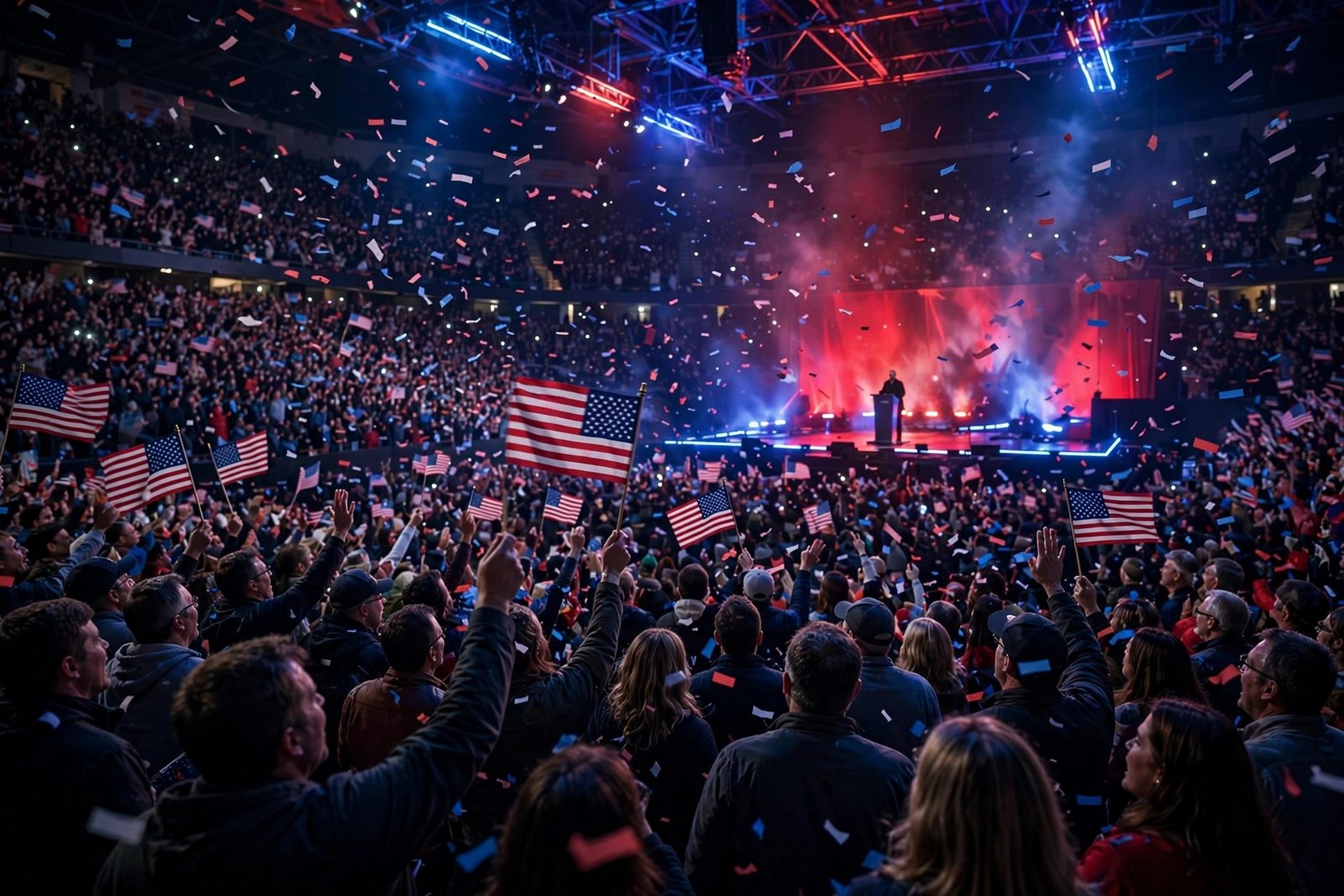
HIGHLAND HEIGHTS, Ky. — President Donald Trump brought his midterm blitz to Kentucky on Saturday night, using a rally at Truist Arena in Highland Heights to tell thousands of supporters that his second presidency has given him powers he never had in his first term — and urging voters to “pretend I’m on the ballot” when they vote on Nov. 3.
The Trump Kentucky rally marked the president’s 13th rally in the last month, according to Yahoo News, as Republicans fight a brutal midterm environment. Trump campaigned for Senate nominee Andy Barr and House candidate Ed Gallrein, repeated his pledge to send Americans $5,000 checks if Republicans keep control of Congress, and warned that a Democratic victory would bring economic ruin.
“I can do stuff that is unbelievable,” Trump declared — a line that, like so many moments on the night, was aimed as much at firing up the arena as at unsettling Democrats who are closing in on a House majority. Coverage of Trump’s Kentucky rally quickly spread through national outlets, with the Associated Press-style framing noting that Trump’s self-proclaimed power clashes with voter frustration over prices and the economy.
Before the rally, Trump teased the crowd on Truth Social: “Heading to Kentucky! Will be landing soon. Big Crowd. I’m watching it now on RSBN. The coverage is spectacular. In fact, it’s so good, that I don’t want to leave Air Force One. Vote for Andy Barr for U.S. Senate!” The appearance came one day after he rallied in Dalton, Georgia, for Senate candidate Mike Collins — two Southern swing stops in 24 hours as the GOP scrambles to hold Congress.
- The Trump Kentucky Rally: Highland Heights in the Final Stretch
- “A Much More Powerful Term”: Google, the Gulf of America and Lake America
- The Barr-Booker Senate Race for McConnell’s Open Seat
- The Gallrein House Race and the Thomas Massie Split
- $5,000 Checks, a Drug Plant and Promises for Kentucky
- The Counter-Programming: “No Kings: Vote Early” Rallies
- Extra Knowledge: What the Polls Actually Say About the Midterms
- Extra Knowledge: The Most Expensive House Primary in U.S. History
- What’s Next
- Additional Details
The Trump Kentucky Rally: Highland Heights in the Final Stretch
Trump took the stage at Truist Arena in Highland Heights — home of Northern Kentucky University — on Saturday evening, October 17, 2026, in a state he carried with 64.5% of the vote in 2024. Kentucky is not a battleground presidential state, but this year it hosts two races the national parties are watching: the open Senate seat of retiring Mitch McConnell and the House race of Trump-backed Ed Gallrein.
The Trump Kentucky rally was billed as a get-out-the-vote event, and Trump leaned hard into that frame. “Pretend I’m on the ballot,” he told the crowd, according to The Daily Letter — an acknowledgment that in this midterm, his name will not appear on any ballot, but his presidency is the referendum. The strategy mirrors his broader midterm approach: Trump has put himself at the fore for voters even as Republicans privately worry he is a liability, as StateLineDaily’s recent midterm coverage has tracked — from the prediction-market models giving Democrats roughly 90% House odds to the Fox News poll showing his approval at a new low of 36%.
The rally followed a familiar Trump rhythm: a 90-plus-minute meandering address touching on immigration, the economy, foreign policy and grievances, punctuated by applause lines and attacks on Democrats. But this one carried a sharper edge of urgency. With control of both chambers of Congress on the line — and with it the prospect of Democratic-led investigations of his administration if they win — Trump warned the arena that a Democratic victory would bring “a depression,” and claimed Democrats want to abolish the Senate and the Supreme Court, neither of which is part of the Democratic Party platform.
“A Much More Powerful Term”: Google, the Gulf of America and Lake America
The most-quoted moment of the Trump Kentucky rally came early, when Trump riffed on his decision to change how the U.S. government refers to the Gulf of Mexico to the Gulf of America. “I don’t think I could have done this in my first term. This is a much more powerful term,” Trump said. “Google wouldn’t have taken my call in the first. Now, they kiss my ass.”
Trump was referring to the executive order renaming the Gulf, which Google Maps adopted by displaying “Gulf of America” for U.S. users. He has repeatedly pointed to the change as proof that powerful institutions now bend to him. Then he went further: “Well, I also changed the name of a lake in Canada to the Lake America,” he said, referring to Lake Ontario — a claim that drew widespread attention and that, as of press time, had no accompanying executive order or official government action behind it.
He used the same theme to argue that this term is different in kind, not just degree. “I can do stuff that is unbelievable,” he said. The boast landed awkwardly against the backdrop of voter frustration: tariffs and the nearly eight-month Iran war have driven up prices, and more Americans say they view the president as looking out for his own interests rather than the country’s. Trump also nominated one of his personal lawyers to serve as attorney general, ordered military strikes on boats accused of drug smuggling, is trying to put his name on the Kennedy Center, and has enriched himself and his family while in office — all facts he framed onstage as evidence of a presidency unbound.
At the Trump Kentucky rally, Trump touched on gas prices while meandering through topics, saying the war with Iran was going to end soon — an assertion he has made many times over the course of the conflict — and that gas prices will drop to lower than previously. The crowd cheered.
The Barr-Booker Senate Race for McConnell’s Open Seat
The centerpiece of the Trump Kentucky rally was the Senate race: Rep. Andy Barr, the Republican nominee, against Democrat Charles Booker. It is a seat with historic weight. Sen. Mitch McConnell, who has held it since 1985 and led Senate Republicans longer than anyone in history, is retiring — making this the first open race for the seat since 1984, per The Daily Letter’s Kentucky midterm guide. McConnell won the seat’s last election in 2020 with 57.8% of the vote.
Barr, who has represented Kentucky’s 6th Congressional District since 2013, spent much of his primary campaign leaning on his Trump endorsement — though WEKU reported he has since stripped references to the president from his website as Trump’s approval ratings slipped. Booker, who served as a Kentucky state representative from 2019 to 2021 and later led Gov. Andy Beshear’s Office of Faith-Based Initiatives, is trying to do what no Kentucky Democrat has done since 1992: win a Senate seat.
The race’s two candidates are scheduled to meet in a televised debate on October 19, hosted by Gray Media stations and the League of Women Voters of Kentucky — a debate that could sharpen the contrast on military intervention, tariff authority, Ukraine and fiscal questions that have gone unanswered in the campaign.
The Gallrein House Race and the Thomas Massie Split
Trump also brought Ed Gallrein onstage — the Republican candidate for Kentucky’s 4th Congressional District — and used the moment to bury his feud with the man Gallrein defeated: seven-term Rep. Thomas Massie. Trump called Massie a “loser”, and praised Gallrein as a more loyal replacement.
The crowd’s reaction at the Trump Kentucky rally was telling. About half the arena applauded while the other half remained silent — a visible reminder that Massie retains support among some conservatives for taking positions against his own party’s leadership. Massie had angered Trump by pressing for the release of the Jeffrey Epstein files and opposing the Iran war.
Gallrein, a 68-year-old fifth-generation farmer from Shelbyville and a former Navy SEAL officer who served from 1984 to 2014, defeated Massie in the May 19 primary and now faces Democrat Melissa Strange, Libertarian Jeremy Todd and an independent write-in candidate on Nov. 3. He has run on a message of greater border security, lower taxes and law and order, telling Kenton County Rotarians this month that the election is a choice “of the Constitution that is rooted in religion” versus “the Communist Manifesto that is deeply atheist and godless,” LINK nky reported.
$5,000 Checks, a Drug Plant and Promises for Kentucky
On the economy — the issue voters consistently rank first — Trump offered a concrete promise to the crowd at the Trump Kentucky rally. He repeated his proposal to give Americans a $5,000 payment if Republicans secure victories in both chambers of Congress. The Daily Letter also reported that Trump promised a drug-manufacturing plant investment for the state if Republicans keep Congress.
The pledge is a reprise of the “DOGE dividend” concept Trump has floated before — a check for American households drawn from claimed government savings — now repurposed as an explicit electoral incentive tied to Republican control of the House and Senate. With no real wage growth on average since the start of Trump’s second term, according to Bureau of Labor Statistics data released this week and reported by the Washington Post, the promise is aimed squarely at voters feeling the pinch of inflation that hit 3.7% in September.
Whether Congress could actually pass $5,000 checks is another matter — especially if Democrats win the House, as most forecasters now expect. Trump himself acknowledged the stakes: keep Republicans in charge, and the checks flow; hand Democrats the gavels, and expect investigations of his administration and political allies instead.
The Counter-Programming: “No Kings: Vote Early” Rallies
While Trump rallied in Highland Heights, the other side of American politics was in the streets. Saturday marked the fourth nationwide “No Kings” day of action, rebranded this round as “No Kings: Vote Early” — a pivot from mass protest to voter mobilization. NPR reported more than 3,000 “No Kings: Vote Early” marches and events planned for Saturday, in all 50 states and Washington, D.C., with Philadelphia alone hosting 10 gatherings at City Hall and satellite election offices.
But the energy looked different this time. The New York Times reported that the demonstrations were more subdued and in many cases smaller than past “No Kings” gatherings — and that they drew few of the Democrats running in the country’s most closely watched races. The Associated Press described the rallies as urging early voting ahead of the midterms. As Indivisible co-founder Ezra Levin put it, the first three No Kings days were designed to send a message — and the group, he says, is done sending a message. Now, the goal is votes.
That contrast defined October 17: a president filling an arena at the Trump Kentucky rally to make the midterm about his power, and a protest movement deliberately trying to make the same election about something quieter — ballot plans, registration checks and turnout.
Extra Knowledge: What the Polls Actually Say About the Midterms
Competitors have covered the Trump Kentucky rally’s applause lines; fewer have put hard numbers next to them. Here is what the data says about the two Kentucky races Trump was campaigning for.
The Kentucky Senate forecast is blunt: Pollsmax’s model, updated October 17, gives Andy Barr a 98.2% chance of defeating Charles Booker, projecting Barr at 60.5% of the vote to Booker’s 39.5% — a 21-point Republican margin rated “Solid Republican.” The polling average (based on just two polls, last updated Aug. 27) is narrower: Barr 50.7%, Booker 37.7%, a 12.9-point margin. Booker’s campaign released an internal Global Strategy Group poll on Sept. 9 showing him trailing 49% to 40%, but Republican operatives dismissed it — Kenton County GOP chairman Shane Noem told The Northerner that Booker “is so far out of alignment with a vast majority of Kentuckians’ views” and called the campaign a “joke.”
The money gap is wider still. Barr’s FEC Q3 2026 report shows he raised $2.07 million from July through September and ended with $2.73 million cash on hand; Booker raised $614,752 — nearly all from individual donors — and had $343,925, while carrying $140,000 in debts. Eight times the cash on hand. Booker is pitching an affordability message — “The bottom has fallen out for a lot of people,” he said, citing tariffs and rising prices — but he is running in a state where Trump took 64.5% of the vote in 2024 and where Kentucky has not elected a Democratic senator since 1992.
Nationally, the picture is the inverse of Kentucky. StateLineDaily’s midterms forecast coverage found prediction markets giving Democrats roughly 90% House odds with 18 days to go, with polls and the Cook Political Report agreeing. Trump rallied in Kentucky precisely because it is safe territory — a red-state show of strength while the national map tilts against his party.
Extra Knowledge: The Most Expensive House Primary in U.S. History
The Ed Gallrein story has a backstory that most national coverage skipped: the primary that made him. Gallrein defeated Thomas Massie 55% to 45% in the May 19 Republican primary — 57,822 votes to 47,539 — in what became the most expensive congressional primary in American history. The campaigns and aligned super PACs spent roughly $30 million to $37 million on the race, depending on the count (WLWT reported more than $30 million in spending; LINK nky put the combined total at about $37 million).
That leaves nearly 48,000 Massie Republicans who voted against Gallrein — and both Democrat Melissa Strange and Libertarian Jeremy Todd are openly courting them. Strange told LINK nky she has heard personally from former Massie voters considering a Democrat for the first time, citing shared concerns about affordability, housing, Flock surveillance cameras and data-center construction. In a district that has “strongly favored Republicans in recent cycles,” it is likely a long shot — but it explains the mixed applause at Truist Arena when Trump praised the man who beat Massie.
There is also a national angle competitors have missed. The Kentucky primary has become, as one analysis put it, one of the clearest examples of how the 2026 Republican primaries are reshaping the party around loyalty, money and nationalized political fights — a template Trump has repeated in race after race this cycle.
What’s Next
Will Trump keep up the rally pace? Saturday’s Trump Kentucky rally was his 13th rally in the last month, and the Georgia stop the night before makes two rallies in 24 hours. With early voting windows opening — Kentucky’s early in-person voting runs Oct. 29 through Oct. 31, per the Boone County Clerk — expect the pace to accelerate, not slow.
Will the Barr-Booker debate matter? The two Senate nominees meet in a televised debate on October 19, hosted by Gray Media stations and the League of Women Voters of Kentucky. In a race rated Solid Republican with a 21-point projected margin, it is Booker’s last best shot at narrowing the gap.
Will the $5,000 checks happen? Trump tied the pledge explicitly to Republicans holding both chambers — a condition most forecasters now rate as unlikely, with Democrats favored to take the House. The promise is an electoral incentive, not a bill; there is no legislation behind it yet.
Will the “No Kings” vote-early push move turnout? The movement’s pivot from protest to voter mobilization — registration checks, ballot plans, poll-watcher training — will be tested on Nov. 3. The subdued turnout on Oct. 17 raises questions about whether the energy of the first three rounds can convert into votes.
Additional Details
- Description: President Donald Trump rallied in Highland Heights, Kentucky on Oct. 17, 2026 — his 13th rally in a month — boasting of a “much more powerful term,” campaigning for Senate nominee Andy Barr and House candidate Ed Gallrein, promising $5,000 checks if Republicans hold Congress, and slamming Thomas Massie, as “No Kings: Vote Early” rallies unfolded nationwide the same day.
- Venue: Truist Arena, Highland Heights, Kentucky (Northern Kentucky University)
- Date: Saturday, October 17, 2026
- Key quotes: “I can do stuff that is unbelievable”; “This is a much more powerful term”; “Google wouldn’t have taken my call in the first. Now, they kiss my ass.”; “Pretend I’m on the ballot”
- Races: Andy Barr (R) vs. Charles Booker (D) for the open Senate seat; Ed Gallrein (R) vs. Melissa Strange (D) vs. Jeremy Todd (L) for Kentucky’s 4th House District; election Nov. 3, 2026
- Category: Politics