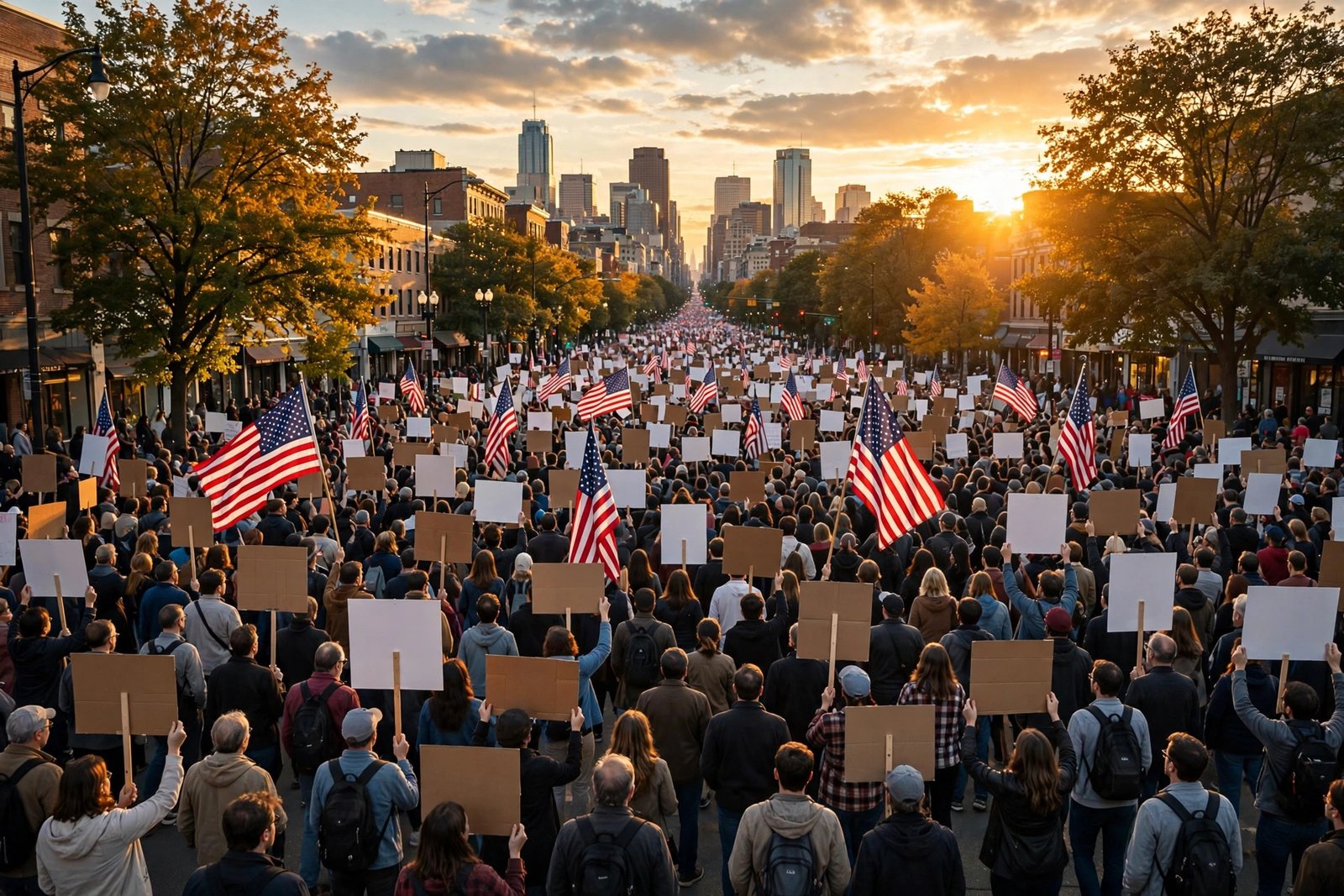
The fourth No Kings protest 2026 unfolded across the United States on Saturday, October 17, 2026 — and this one looked different from the three that came before it. Instead of rallying only against President Donald Trump and his administration, organizers rebranded the day as “No Kings: Vote Early,” a coordinated nationwide push to turn protest crowds into early voters just 17 days before the November 3 midterm elections that will decide control of Congress.
From the steps of the Lincoln Memorial to rallies in Atlanta, Dallas, Los Angeles, New York and Oklahoma City, demonstrators carried signs reading “Vote early,” “Your vote is your voice” and “Hands off my vote,” marching under the banner of a simple instruction: vote now, not later. Organizers announced more than 3,000 events nationwide — a scale that, if accurate, would make this one of the largest single-day civic actions of the 2026 election cycle.
But the day also sharpened the political battle lines. The White House dismissed the movement as a Democratic turnout operation, Trump-friendly observers taunted marchers on the sidelines, and underneath the chanting ran a deeper fight over mail-in voting, voter data and who gets to run American elections. With polls showing Democrats positioned to win the House while the Senate remains too close to call, both parties are treating early voting as the decisive battlefield — and the No Kings protest 2026 was the loudest bid yet to claim it.
- A Fourth ‘No Kings’ Protest in 2026 — This Time, a Turnout Machine
- From Arlington to Atlanta: How October 17 Played Out
- The ‘Vote Early’ Message: Organizers’ Strategy for the Nov. 3 Midterms
- White House Pushback: ‘They Should Change Their Name’
- Extra: How the Network Pulled Off 3,000+ Simultaneous Events
- Extra: The Mail-In Voting Fight Underneath the March
- What’s Next
- Additional Details
A Fourth ‘No Kings’ Protest in 2026 — This Time, a Turnout Machine
DW English confirmed that Saturday’s demonstrations were the fourth “No Kings” protest since President Trump returned to office — but the framing had shifted decisively. Previous rounds were billed as demonstrations against the administration; this round, dubbed “No Kings: Vote Early,” was organized as a get-out-the-vote operation. As DW reported, organizers aimed to fire up Americans to vote early in the midterms, which will determine which party controls Congress, “rather than protest against President Donald Trump and his administration.”
USA Today noted that the more than 3,000 actions “focused on early voting and turnout rather than protesting like the previous three No Kings events, which drew millions of Americans into the streets at rallies in large cities and small towns nationwide.” That pivot — from street protest to ballot-box mobilization — is the defining feature of this No Kings protest 2026, and it drew deliberate commentary from the movement’s own leaders. Indivisible co-founder Ezra Levin, in an interview carried by NPR, described the movement converting itself into a turnout machine — the line one media audit called “the pivot the whole corpus circles,” since every major newsroom’s account of the day carried the same conversion: street energy being deliberately rechanneled into votes.
The timing was no accident. The Hill described the day as a nationwide action timed for the early-voting period, with PBS NewsHour, Deutsche Welle, The Japan Times and the South China Morning Post all linking the events to the push for early ballots ahead of November 3. Early voting had already begun weeks earlier in many states, and with prediction markets and polls pointing toward a Democratic House and a coin-flip Senate, both parties see the early vote as potentially decisive.
From Arlington to Atlanta: How October 17 Played Out
The centerpiece demonstration marched from Virginia into the nation’s capital. Protesters gathered in Arlington, near the proposed site of the Trump administration’s triumphal arch, then crossed the Arlington Memorial Bridge toward the Lincoln Memorial — a route that turned the geography of federal Washington into a stage for political expression. States Newsroom photographer Baya Burgess captured participants making their way toward the U.S. Capitol as part of the Umbrella Walk 4 Change, one of thousands of the day’s events. The march ended on the steps of the Lincoln Memorial with a brief rally featuring singing and dancing.
The New York Times reported that several hundred people gathered outside the Lincoln Memorial to appeal for votes, marching with placards reading “Vote early,” “Your vote is your voice” and “Hands off my vote.” Slogans aimed directly at the president — “Trump must go” and “We elect presidents, not kings” — were visible at many sites as well, a reminder that the movement’s anti-Trump roots remain intact even as its tactics pivot toward the ballot box.
The action was genuinely national. Similar events unfolded in New York, Atlanta, Dallas, Los Angeles and other major cities, with participants saying democracy was under attack and urging people to criticize the administration’s policies and vote as soon as possible. At the Atlanta rally, civil rights attorney Gerald Griggs gave the crowd a plain instruction: “vote first, then call five friends and tell them to vote early,” according to the Times. In Oklahoma City, participants said voting in the midterms matters as much as voting in a presidential race — a notable message in a country where midterm turnout has historically lagged presidential turnout.
Even the counter-demonstrators were small in number. In battleground-state Virginia, two pro-Trump observers watched from the outskirts of the crowd in Richmond. Jacob Seivers, a 20-year-old from Bedford County, called the speakers’ rhetoric about Republicans “hilarious” and “nonsense” — but notably added that he believes Congress will flip blue after November, conceding the very premise the marchers were acting on.
The ‘Vote Early’ Message: Organizers’ Strategy for the Nov. 3 Midterms
The strategic logic of the No Kings protest 2026 is straightforward: convert enthusiasm into counted ballots. One participant in Washington’s suburbs — a 66-year-old retired teacher named Carlson, described in the South China Morning Post’s account — captured the movement’s stated discipline by placing voting above the expression of anger or the listing of complaints. The Post’s account presents her emphasis as an illustration of the movement’s intent: a protest audience turned into an electorate.
At the D.C. event, 25-year-old Octavia Clapp of Maryland told States Newsroom that her right to vote “especially matters as Trump attempts to wield authority over voting.” For younger voters like Clapp, the No Kings day was not a substitute for campaigning but a complement to it — public events promoting ballot casting, with the specific instruction to vote early.
The choice of framing also answers a long-standing criticism of mass protest: that marches generate energy without generating votes. By building the entire day around early voting — something tangible, measurable and immediately actionable — organizers gave participants an assignment that survives the news cycle. The events were billed as nonpartisan by the Associated Press, though the corpus of reporting shows the newsrooms split on whether a turnout drive that grew out of anti-Trump protests can genuinely carry that label. DW’s account put it plainly: Republicans face tough races to retain control of Congress, and the “No Kings” organizers are urging Americans to vote early in elections that will decide that control.
That framing is the campaign both sides understand. Polls cited in reporting on the march suggested Democrats were positioned to win the House while the Senate remained too close to call — the same picture StateLineDaily’s midterm forecast coverage laid out earlier this week. In a cycle where the margins may come down to a handful of races, a movement claiming 3,000 local events aimed at early voting is not a sideshow; it is a ground-game asset, and both parties are reading it that way.
White House Pushback: ‘They Should Change Their Name’
The Trump administration did not let the day pass quietly. Lauren Bis, a White House spokesperson, fired back in remarks carried by the Washington Examiner: “The fact that the ‘No Kings’ organizers are talking about voting in the upcoming election proves they should change their name. This November, Americans have a clear choice between President Trump and Republicans’ commonsense policies or the extreme Democrats’ radical socialist, open-border policies.”
The response tells its own story: the White House chose to frame the events as a Democratic turnout operation rather than dismiss them as fringe. That is a concession of significance — administrations ignore protests they believe are harmless. The Bis statement instead met the No Kings protest 2026 on its own turf, competing for the same electorate with a counter-frame about open borders and the economy.
Conservative media went further. Fox News Digital, describing what it called a 300-organization, $2.5 billion-a-year network behind the protests, highlighted chapter signs reading “Vote Blue Nov. 3” — undercutting the movement’s nonpartisan billing. The messaging war over the day was, in miniature, the messaging war of the midterms themselves: one side warning that democracy is under attack and urging early ballots, the other dismissing the organizers as a well-funded arm of the Democratic machine.
That dispute — about whether a turnout drive born of anti-Trump protests can be called nonpartisan — is one of two questions where the day’s press coverage noticeably split. The other was arithmetic: organizers claimed more than 3,000 events, while the wire services variously reported “hundreds.” Both claims can be true at once if “events” includes every small registered local action, and the organizers’ network model was built for exactly that kind of long tail. Which brings us to the part of the story most coverage barely touched: how a decentralized protest network pulled off a synchronized nationwide action at all.
Extra: How the Network Pulled Off 3,000+ Simultaneous Events
Here is what competitors covering the No Kings protest 2026 largely missed: the day’s most remarkable feature is not the crowd sizes but the organizational model behind them. Rather than drawing large crowds to a handful of marquee locations — the classic mass-march playbook of the previous three rounds, which drew millions into the streets of big cities and small towns — this action was organized locally and independently across the country. Organizers themselves described the model as thousands of local actions rather than a single national rally.
That design choice explains the split in the press. When the Associated Press reports “hundreds of planned events” while organizers claim 3,000+, the gap likely reflects counting: the wire counts confirmed major gatherings, while the network counts every registered local action — the Umbrella Walk 4 Change in D.C., a sign-waving in Oklahoma City, a voter-education table in New Hampshire. Both numbers describe the same phenomenon from different altitudes, and the phenomenon itself — a protest movement learning to behave like a distributed field operation — is arguably the real news of October 17.
The march geography also carried a deliberate message most reports underplayed. The Arlington-to-Lincoln-Memorial route began near the proposed site of the Trump administration’s triumphal arch — a physical reminder of the “kingship” theme — and ended at the memorial to the president who preserved the republic through its deadliest internal war. It is the kind of stagecraft that turns a walk into a statement, and it shows a movement thinking in images as carefully as it is thinking in ballots.
Finally, the participant profile is worth noting. Coverage consistently described an older-skewing crowd — even the pro-Trump observer in Richmond noted the protesters were “toward the baby boomer side” — alongside young organizers like the 25-year-old Clapp. A movement anchored by retirees with flexible schedules and long voting histories is, from a campaign perspective, an unusually valuable turnout asset: these are people who actually show up on Election Day, and who are now being deployed to bring five friends each.
Extra: The Mail-In Voting Fight Underneath the March
The second story most coverage left half-told is the election-law war humming underneath the marches. The No Kings day’s core demand — vote early — lands in the middle of an administration that has spent more than a year trying to reshape how Americans vote. States Newsroom reported that the Trump administration “has spent more than a year in court battles with dozens of states and voting rights groups seeking to force states to provide sensitive voter data and curb voting by mail.” That is the policy backdrop the marchers were walking through: an executive and legal campaign to restrict mail-in voting even as organizers urge voters to use every available early-voting channel.
The skirmish lines are already visible on this site. Just days ago, the NAACP sued the Department of Justice to block the administration’s plan to deploy 1,000 federal poll monitors nationwide, warning of voter intimidation and “interrogation rooms” at polling places — a lawsuit filed on the Friday before the No Kings marches. The collision is plain: one side organizes millions to vote early; the other prepares an unprecedented federal presence at the polls and fights states over voter rolls and mail ballots.
This is why the movement’s “nonpartisan” billing drew such skepticism from conservative outlets — and why the White House treated the day as a campaign event rather than a protest. When the rules of voting themselves are the contested terrain, a march for early voting is inherently a political act, whatever its organizers call it. The No Kings protest 2026 did not resolve that contradiction; it staged it, in thousands of locations at once, with 17 days left on the clock.
What’s Next
Will the ‘Vote Early’ push actually move the needle on turnout? That is the unanswered question. Previous No Kings rounds drew millions into the streets without a vote-conversion mechanism; this round has the mechanism but not yet measurable results. Early-vote tallies over the next two weeks will be the first real test of whether the movement is a turnout machine or just a loud Saturday.
What will the administration do about the early-vote surge? The White House has already signaled its posture: frame the movement as a Democratic operation, attack mail-in voting, and prepare federal poll monitors. Expect further legal skirmishes over voter data and mail-ballot rules as November 3 approaches — and watch the polling trajectory, which currently shows a president under water heading into the midterms.
Is there another No Kings day coming before Election Day? Organizers have not announced one, but the decentralized model makes a fifth round easy to trigger. With 17 days left, the network’s local chapters can mobilize again with days of notice — a capability the two campaigns, and not just the marchers, are now factoring in.
Additional Details
Description: The fourth No Kings protest 2026 on October 17, 2026 shifted from anti-Trump street demonstrations to a “No Kings: Vote Early” turnout drive, with 3,000+ local events nationwide urging early voting ahead of the November 3 midterms — from an Arlington-to-Lincoln-Memorial march to rallies in Atlanta, Dallas, LA and New York — as the White House dismissed the movement as a Democratic operation and the fight over mail-in voting and poll monitors intensified.
Meta description (Rank Math): The No Kings protest 2026 went national on October 17 as “No Kings: Vote Early” rallies pushed early voting in 3,000+ events ahead of the November 3 midterms. Here’s what happened — and what it means for control of Congress.
Focus keyword: No Kings protest 2026