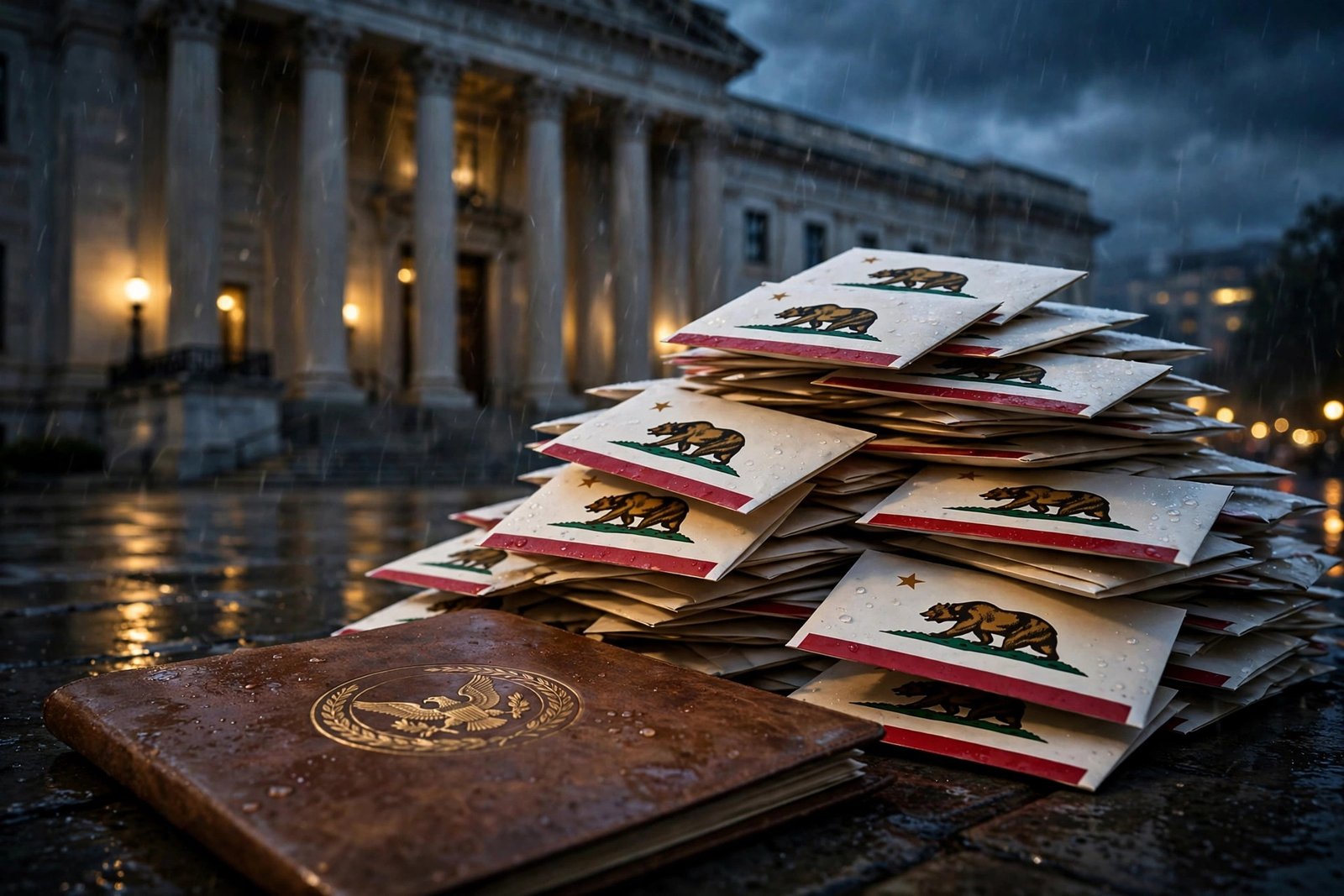
The Trump sues California showdown escalated into open legal warfare on Thursday, October 15, 2026, when the Trump administration filed a federal lawsuit asking a judge to bar California from counting mail-in ballots cast by 20,000 people the federal government claims are “likely” noncitizens. The Justice Department wants those ballots set aside in next month’s midterm elections until each voter’s citizenship can be confirmed, a move California’s top election officials are calling unprecedented, baseless, and a direct threat to the voting rights of thousands of Californians.
The lawsuit caps a week of rapidly intensifying pressure from Washington on the nation’s most populous state. Just days earlier, a top Justice Department official sent California a letter threatening legal action if the state did not comply with a 48-hour deadline to review a password-protected thumb drive containing the 20,000 names. When that deadline passed, the administration went to court in Sacramento, turning an administrative standoff into one of the most consequential election lawsuits of the 2026 cycle.
California officials are refusing to budge. Secretary of State Shirley Weber says the federal government has provided no evidence to support its claim that 20,000 noncitizens are on the state’s voter rolls, while Attorney General Rob Bonta accuses the Trump administration of operating in “unprecedented, baseless, lawless territory.” With voting already underway and control of the U.S. House potentially hanging on a handful of competitive California congressional races, the fight over who gets to count which ballots is about to become the defining legal battle of the midterms.
- What the DOJ Lawsuit Demands
- The Thumb Drive With 20,000 Names
- California Fights Back: Weber and Bonta Reject the Demands
- Why Election Experts Call the Case Frivolous
- The Nevada Precedent the Headlines Are Missing
- How California’s Mail-In Voting System Actually Works
- What’s at Stake for the House Majority
- What’s Next
What the Trump Sues California Lawsuit Demands From the Court
At the heart of the Trump sues California case is a request for emergency-style relief: the Justice Department wants a federal judge to order California to stop “presently tabulating” vote-by-mail ballots from voters the government labels likely noncitizens in the upcoming federal election, holding those ballots aside until each person’s citizenship status can be determined. The lawsuit frames this as “commonplace election relief when a ballot is called into question,” language designed to make an extraordinary request sound routine.
The complaint, as described in the Associated Press’s reporting, says the federal government tried to “work collaboratively” with California to identify noncitizens on the state’s voter rolls, and that “California made no serious effort to do so.” That claim is the lawsuit’s foundation — and California officials flatly reject it.
The timeline matters. The lawsuit follows a letter sent earlier this week by acting Deputy Attorney General Trent McCotter, who gave the state 48 hours to research the 20,000 names. For any voter whose citizenship could not be independently verified, California was instructed to tell local election officials to segregate their mail-in ballots until immigration status could be determined — and to stop providing ballots to anyone on the list who had not yet received one. When the state refused, the DOJ followed through on its threat and sued.
Bill Essayli, the first assistant U.S. attorney for the Central District of California, defended the move publicly, writing in a post on X: “This is not political or controversial. We will not allow California to dilute the votes of American citizens.” Read StateLineDaily’s full coverage of the FBI’s pre-midterm election probes here for the broader backdrop of federal election enforcement this cycle.
The Thumb Drive With 20,000 Names — and a Password on a Sticky Note
Perhaps the most striking detail in the Trump sues California dispute is how the federal government delivered its evidence. The Justice Department sent a password-protected thumb drive containing the list of 20,000 names directly to Los Angeles County Registrar Dean Logan on Tuesday, October 13 — accompanied by a handwritten note providing the password, which the secretary of state’s office later said was written “on a sticky note.”
Logan, whose office confirmed receipt of the drive in a statement, said he did not consider the thumb drive a secure device. The list, he noted, contained voters from throughout California, not just Los Angeles — even though Logan is the only county election official named as a defendant in the lawsuit, and he has no jurisdiction over ballots outside Los Angeles County. In a statement Thursday, Logan said his office could not withhold ballots or refuse to count them “based solely on unverified allegations.”
Election security experts were blunt about the delivery method. David Becker, who heads the Center for Election Innovation and Research, said most election officials’ cybersecurity protocols would never allow them to plug in a thumb drive received this way. “Election offices do not just stick thumb drives into their technology, for very good reason,” Becker said — a reality that makes the DOJ’s 48-hour compliance demand look less like collaboration and more like a setup for a lawsuit.
The federal government never said where the 20,000 voters were concentrated, nor did it explain the methodology used to identify them. California mails ballots to all registered voters, so the list is best understood as an allegation about registrations, not a documented instance of fraudulent voting.
California Fights Back: Weber and Bonta Reject the Federal Demands
California’s top officials responded to the Trump sues California lawsuit with defiance rather than compliance. Secretary of State Shirley Weber, who is named in the lawsuit, wrote to the Justice Department that the federal government had not provided evidence to support its allegation about the 20,000 names — and she pointed to a precedent that should make Washington cautious: a previous federal claim that nearly 16,000 possible noncitizens were on Nevada’s voter rolls, which the state investigated and determined were all U.S. citizens.
Weber, a Democrat, said the Justice Department was “demanding unprecedented measures that threaten thousands of Californians’ right to vote, based on unverifiable information or methodology that you still fail to explain or provide.” She noted that voting is already underway in the state, and that California’s elections are in “full compliance” with federal law.
Attorney General Rob Bonta went further at an unrelated press conference Thursday morning, saying state officials would not carry out the federal requests to withhold ballots. He seized on a revealing detail: over the summer, the Department of Homeland Security had claimed California had 190,000 noncitizens on its voter rolls — but now the Justice Department’s figure is 20,000. “What happened to those 170,000? They just got those wrong,” Bonta said. Weber added that when her office asked DHS for the methodology or data sources behind the 190,000 figure, the department refused to provide them.
Bonta also argued the administration is violating the federal law that prohibits states from changing voter rolls within 90 days of an election — a quiet-period protection under the National Voter Registration Act designed to prevent exactly this kind of last-minute purge. “They are in unprecedented, baseless, lawless territory,” he said. In her letter Thursday, Weber called the whole confrontation “an emergency of the DOJ’s creation.”
Why Election Experts Call the Trump California Case Frivolous
David Becker’s assessment of the Trump sues California lawsuit was withering: he called it “fairly frivolous.” His reasoning was practical. “If they were seeking to work in good faith to clean up the voter list that they believed had issues, they would have done this months ago in a much different fashion,” Becker said. “However, it does raise questions as to whether or not the sole purpose of this is to set the stage for false claims about elections.”
The numbers support his skepticism. The Trump administration has made the hunt for noncitizen voters a priority this year even though the problem is exceptionally rare, the Associated Press reported. The Justice Department has charged about 90 people for various types of election misconduct so far this year — including 50 alleged to have voted as noncitizens — out of more than 227 million registered voters nationwide during the 2024 presidential election. That is a microscopic fraction of the electorate, which is why experts describe noncitizen voting as vanishingly rare rather than systemic.
Legal observers also note the structural mismatch in the Trump sues California lawsuit: the only county election official named is LA County’s Dean Logan, who cannot order anything about ballots in the other 57 counties. A court order aimed at him would not produce the statewide relief the DOJ claims to want — a sign, critics say, that the case is aimed at the headlines and the legal precedent rather than at any actual ballots. See StateLineDaily’s coverage of Trump’s sagging approval numbers for background on the political pressure behind the administration’s midterm-year moves.
The Nevada Precedent the Headlines Are Missing
Buried in Secretary of State Weber’s response to the Trump sues California demands is an episode that deserves far more attention than it has received. Weber referenced an instance in which the federal government initially alleged that nearly 16,000 possible noncitizens were listed on Nevada’s voter rolls. Nevada investigated — and determined that every single one of the people flagged was, in fact, a U.S. citizen.
This is the pattern that should worry anyone watching the California fight. Federal citizenship-matching against state voter rolls is notoriously error-prone: people who naturalize after registering, name changes, data-entry mismatches, and outdated federal databases all generate false positives. When the federal government’s own lists have produced a 100 percent false-positive rate in a recent state-level check, a demand to segregate ballots based on an unverified list — delivered on a thumb drive with a sticky-note password — looks less like election integrity and more like voter suppression with extra steps.
How California’s Mail-In Voting System Actually Works
To understand why the Trump sues California lawsuit is so explosive, it helps to understand what it is attacking. Since 2021, California has operated a universal vote-by-mail system: every active registered voter is automatically mailed a ballot, no request required. More than 23 million people are registered statewide, which means the state moves an enormous volume of paper through the mail in every election — and it has built the machinery to verify it.
Counties can begin processing ballots — opening envelopes and preparing them for counting — weeks before Election Day, though results cannot be released until polls close. Ballots postmarked by Election Day can still arrive days later and be counted, which is why California’s final tallies famously take weeks to complete.
This is the system the DOJ’s Trump sues California lawsuit wants to interrupt midstream. With voting already underway, asking counties to cross-reference registrations against a federal list whose methodology the state has never seen — during the busiest weeks of the election cycle — is why Logan and Weber say the demand is impossible to fulfill responsibly, and why a judge may view the lawsuit’s timing as a problem of the DOJ’s own making.
What’s at Stake for the House Majority in the Midterms
The Trump sues California fight is not happening in a vacuum. Over 23 million people are registered statewide, and a handful of competitive congressional races in California districts could determine which party controls the U.S. House for the final two years of President Donald Trump’s term. California’s swing seats have decided House control before, and both parties are treating the state’s battleground districts as must-win territory.
That is what gives the Trump sues California lawsuit its edge. Even if the DOJ never wins the case, filing it plants a seed of doubt about the legitimacy of California’s results — precisely the dynamic David Becker warned about when he said the suit could “set the stage for false claims about elections.” A lawsuit alleging 20,000 noncitizens on the rolls becomes a talking point on election night, especially in districts where margins are measured in hundreds of votes and counting takes days.
The White House has every incentive to keep election-integrity fights in the headlines as the midterms approach. See StateLineDaily’s coverage of Elon Musk’s $276 million GOP rescue mission here for how much outside money is flooding into the same battlegrounds. Between the lawsuits, the spending, and the polls, the 2026 midterms are shaping up to be the most legally contested congressional elections in modern American history.
What’s Next
Will a judge actually block California from counting the ballots?
Legal experts are skeptical. The DOJ is asking for extraordinary relief — segregating ballots mid-election based on an unverified list — from a judiciary that has been wary of last-minute changes to election procedures. The 90-day quiet-period argument and the Nevada precedent both cut against the government, and courts generally disfavor disrupting voting that is already underway.
What happens to the 20,000 names on the thumb drive?
The list now sits at the center of the lawsuit, but its credibility is already damaged. Weber says the federal government has never explained its methodology, and Bonta’s 190,000-to-20,000 arithmetic raises obvious questions about how the numbers keep changing. Expect California to challenge the list’s provenance aggressively in court.
Could this spread to other states?
It already has, in milder form. The administration’s voter-roll audit campaign has targeted multiple states this year, and a California filing gives the DOJ a template — and a set of talking points — it can deploy elsewhere. Watch for copycat demands in other blue states with competitive House races.
What should California voters do?
Nothing different. State officials say the election is proceeding normally, ballots are being mailed and counted under existing procedures, and no voter’s ballot is being withheld. Voters can track their mail ballots through their county registrar as usual.
Additional Details
- Published: October 16, 2026
- Category: Politics
- Tags: Trump, California, DOJ, mail-in ballots, midterm elections, voter rolls, election lawsuit
- Description: The Trump administration sued California on Oct. 15, 2026, asking a federal judge to bar the state from counting mail-in ballots from 20,000 alleged noncitizens in the midterms. California officials call the case baseless and unprecedented. Here’s what the DOJ lawsuit demands, why experts call it frivolous, and what’s at stake for the House majority.