East Potomac Golf Course Showdown: Judge Grills Trump DOJ After 500 Trees Felled as Trump Calls Her a ‘Crazed Lunatic’
The fight over the East Potomac golf course erupted into open conflict this week, as a federal judge spent six hours on Monday grilling Justice Department lawyers over the surprise felling of nearly 500 trees at the public East Potomac golf course in Washington, D.C. — hours after President Donald Trump called her a “crazed lunatic” online and ordered tree work to resume “IMMEDIATELY.”
The daylong preliminary injunction hearing before U.S. District Judge Ana C. Reyes in 1:26-cv-00477-ACR — brought in February 2026 by the D.C. Preservation League and two longtime golfers who regularly play the East Potomac golf course — turned into one of the most contentious courtroom clashes of Trump’s second term. Inside the courtroom, career Interior Department officials admitted that renovation “renderings” arrived on a senior official’s personal phone from Trump allies outside government. Outside, the president attacked the judge, dismissed her authority, and insisted the work needs no one’s approval.
Reyes issued no ruling Monday but signaled she is leaning toward an injunction barring further tree-cutting at the East Potomac golf course, plus strict advance-notice requirements — while remaining unlikely to halt Trump’s broader redevelopment altogether, the Washington Post reported. She also suggested she may question Interior Secretary Doug Burgum directly.
- Why the Trees Came Down — and Why the Judge Doesn’t Believe It
- Hearing Day 1: Renderings, Signatures, and a Standoff at the East Potomac Golf Course
- The Failed Recusal Bid and Trump’s ‘Crazed Lunatic’ Posts
- The APA Battleground: Is a ‘World Class Championship Golf Course’ a Final Agency Action?
- A 104-Year-Old Public Treasure: The History of the East Potomac Golf Course
- Separation of Powers: ‘Ambition Should Check Ambition’
- Witnesses Take the Stand — and the Judge Reports Death Threats
- What’s Next for the East Potomac Golf Course
- Additional Details
Why the Trees Came Down — and Why the Judge Doesn’t Believe It
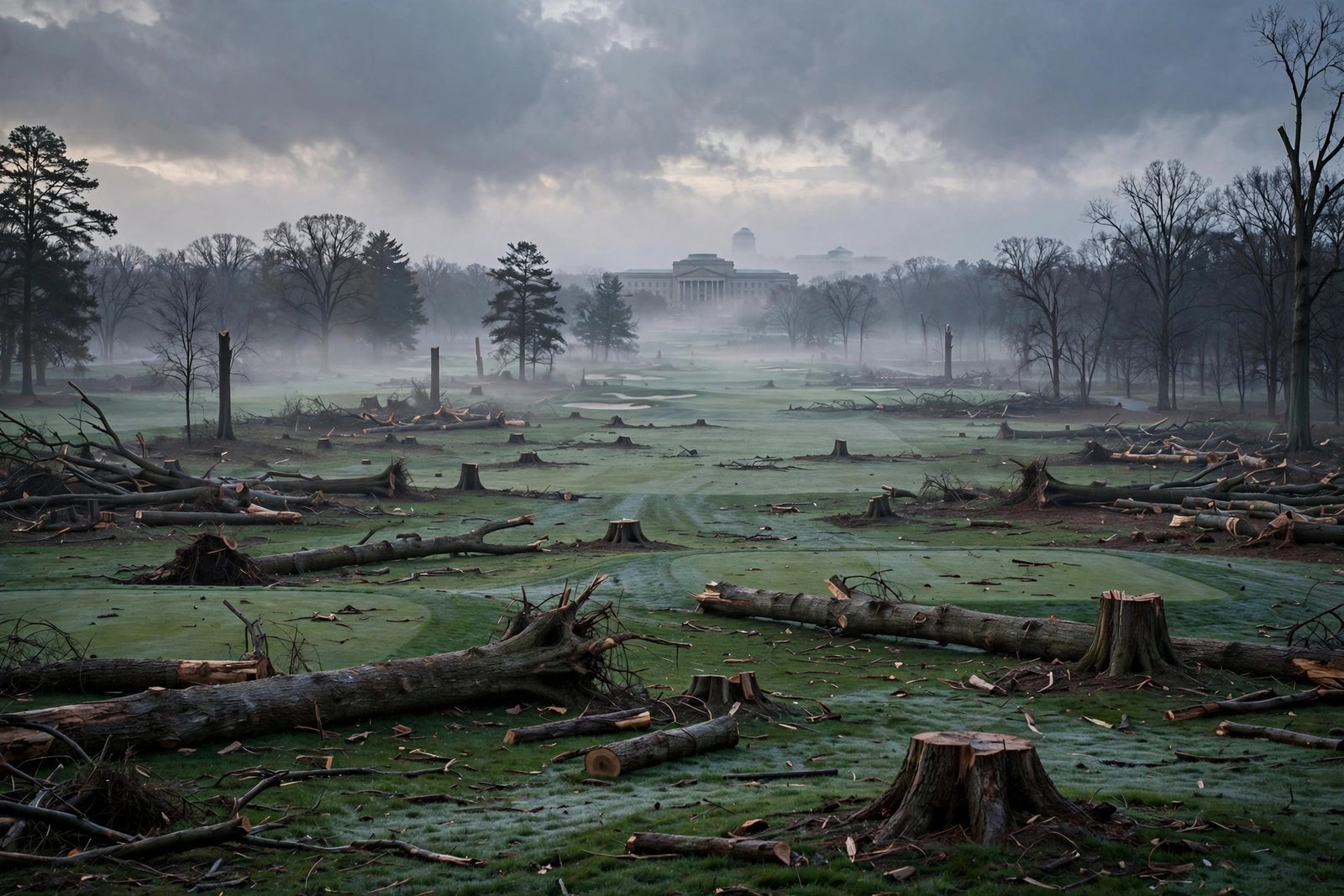
The trouble started the evening of Friday, Oct. 9, when the Justice Department notified the court — at roughly 4:55 p.m., on the eve of the Columbus Day holiday weekend — that tree-cutting at the East Potomac golf course would begin the next morning. Starting Saturday, Oct. 10, crews felled an estimated 430 to 500 trees at East Potomac Golf Links, the public course on Hains Point in the nation’s capital that sits within the National Park System.
The government’s explanation: the work flowed from a 2019 National Park Service Cultural Landscape Report covering Washington’s three public golf courses. Judge Reyes rejected that framing outright. “There is no universe in which all of this happened as a coincidence,” she said, according to the Law Dork legal newsletter, which covered the proceedings closely.
The timing was not lost on the plaintiffs. The notification arrived as courts and much of Washington were emptying for the holiday weekend, and an emergency hearing was convened on Monday, Oct. 12, in a tense holiday session. The next day, Oct. 13, Reyes granted a temporary restraining order blocking any further tree-felling through Monday, Oct. 26, and requiring the government to give three business days’ written notice before any irreparable change to the East Potomac golf course. See StateLineDaily’s coverage of the White House ballroom donor fight for background on how aesthetic-injury fights around federal landmarks have been playing out this year.
Hearing Day 1: Renderings, Signatures, and a Standoff at the East Potomac Golf Course
Monday’s six-hour hearing produced a string of remarkable moments. Gregory Wischer, Interior’s deputy chief of staff, acknowledged under oath that he had received renovation “renderings” for the East Potomac golf course on his personal phone — sent by Trump allies who hold no government position. The admission fed the plaintiffs’ core argument: that the tree-felling was never routine maintenance, but the opening move in a presidential redesign of a federal park.
Early in the day, Reyes ordered the Justice Department to refile its Sunday brief — signed only by Associate Attorney General Stanley Woodward, the department’s third-ranking official — with the signatures of career attorneys willing to sign it. When Woodward said doing so would place those attorneys in an “incredibly untenable” position, Reyes shot back: “I don’t care what you think.”
But in a striking reversal that afternoon, the judge withdrew the order herself. “We’ve all got better things to be spending our time on,” Reyes said, adding that withdrawal was “the proper course.” The Law Dork newsletter reported both exchanges as emblematic of the day’s volatile tone.
The Failed Recusal Bid and Trump’s ‘Crazed Lunatic’ Posts
The hearing followed a bruising weekend off the bench. On Friday, Oct. 16, DOJ’s Woodward moved for Reyes — a Biden appointee to the D.C. district court — to recuse herself, alleging bias and “histrionics.” On Sunday evening, Oct. 18, Reyes denied the motion as “baseless”, per the Washington Post.
That same weekend, the president escalated in his own way. On Oct. 18, Trump posted on Truth Social that Interior Secretary Doug Burgum, together with famed golf course architect Tom Fazio, had developed a plan for a “World Class Championship Golf Course” at the East Potomac golf course — calling the existing trees “falling, dangerous, and disease infested,” and declaring that restoration would begin Nov. 15, when the old course closes to play. Trump had toured the course with Tom Fazio and his son Gavin back on June 28.
Then came the Monday-morning post, published around 6:08 a.m., just hours before the hearing opened: Trump declared that Interior has “an absolute right” to carry out the renovation, called Reyes a “crazed lunatic” judge, said the experts “do not need an approval,” and announced, “Work is scheduled to begin IMMEDIATELY!” — read StateLineDaily’s reporting on the DOJ investigations and press-pool fights for how the administration’s pressure campaigns on judges have landed before.
The APA Battleground: Is a ‘World Class Championship Golf Course’ a Final Agency Action?
The case’s legal linchpin is the Administrative Procedure Act — specifically whether turning a public course into a “World Class Championship Golf Course” counts as “final agency action” that courts can review.
The DOJ argued that even a wholesale renovation is not final agency action, a position that drew open skepticism from the bench. Reyes pushed back by noting that the government’s own earlier filings had described the redesign as a “major federal action.” “This wasn’t just DOI on a bender was it?” she asked, according to the Law Dork’s account.
Deputy Associate Attorney General Robert Stander cited two D.C. Circuit cases to support his narrow reading of the APA — but stumbled when Reyes pressed him on the cases’ fact patterns. Asked to describe one, Stander conceded: “I don’t have the fact pattern.” The exchange undercut the government’s most important doctrinal argument in front of the judge who will decide it.
DOJ’s fallback position was more subtle: no contract with the Fazios has been finalized, no final plan exists, and the course will NOT close on Nov. 15, Woodward clarified. In the government’s telling, Trump’s “IMMEDIATELY” and the Nov. 15 date are like an executive order — aspirational declarations that are not justiciable. They pointed to an August shadow-docket decision in which the Supreme Court found that commands embedded in an election-“integrity” executive order were not justiciable.
That framing matters beyond golf. Back on Aug. 31, the Supreme Court granted the DOJ a stay of an injunction on the new White House ballroom construction — another aesthetic-injury claim — giving the administration a template for arguing that presidential directives about federal property are beyond judicial review. For more on the ballroom saga, see StateLineDaily’s coverage of the Trump ballroom donor leak involving Apple and Nvidia.
A 104-Year-Old Public Treasure: The History of the East Potomac Golf Course
What makes this fight resonate far beyond Washington’s golf circles is what the East Potomac golf course is. The course at Hains Point — the island where the Potomac and Anacostia rivers meet — traces its roots to the early 1920s, making it one of the oldest public golf courses in the United States.
For more than a century the East Potomac golf course has served as an accessible, affordable place for everyday D.C. golfers to play, operating inside the National Park System as a public recreation asset rather than a private club. The land itself is federal parkland managed by the National Park Service, which is why a presidential plan to remake it into a championship-caliber course — with renderings circulating from private allies — raised such immediate alarms among preservationists.
The plaintiffs’ argument, at its heart, is that the East Potomac golf course, a century-old public course inside the national parks, cannot be gutted over a holiday weekend on the strength of a 2019 landscape report — especially when the president’s own allies were simultaneously shopping a full redesign. That is the story the hearing’s evidence appeared to support: NPS acting director Jessica Bowron testified that the Park Service was “seeking to protect East Potomac’s historic landscape,” while, in the Washington Post’s words, Trump’s rendering “depicts an entirely new course.”
Separation of Powers: ‘Ambition Should Check Ambition’
When Stander argued that separation-of-powers principles favor denying the injunction, Reyes answered with a civics lecture. She invoked Alexander Hamilton and James Madison, quoting the Federalist Papers’ famous formulation: “ambition should check ambition.” Courts, she said, are one of “three coordinate branches” — not subordinate to the executive.
The line captured the day’s deeper stakes. The administration’s position, carried to its logical end, is that the executive can fell hundreds of trees on the protected federal parkland of the East Potomac golf course and announce a full redevelopment — and that no court can intervene because nothing it has done is yet “final.” Reyes’s retort was that judicial review exists precisely for moments like this: when one branch acts first and declares the others powerless to respond.
Trump’s polling backdrop makes the political stakes visible too. His approval has been sliding for months — see StateLineDaily’s coverage of the record-low 33 percent approval rating in a Washington Post poll — and courtroom clashes with the judiciary have defined his second term.
Witnesses Take the Stand — and the Judge Reports Death Threats
Monday’s testimony came from two key witnesses: Bowron, the acting NPS director, and Wischer, the Interior deputy chief of staff who received the renderings on his personal phone. Their testimony framed the central contradiction the plaintiffs want the court to resolve: the Park Service’s stated mission of protecting a historic landscape versus a renovation plan — promoted by the president himself — that would erase the East Potomac golf course.
The day also carried a darker note. Reyes acknowledged from the bench that she has received death threats in this case — “over a golf course,” as she put it. “I don’t think that’s what our founders intended,” she said. The admission underscored how a local land-use dispute has become another front in the national campaign of pressure against federal judges.
Reyes also floated the possibility of questioning Interior Secretary Doug Burgum directly — a rare move that would put a sitting Cabinet secretary under oath about the renovation’s origins. Burgum’s name is on the plan Trump announced, but Woodward’s testimony insisted no final plan exists at all.
What’s Next for the East Potomac Golf Course
Q: Did the judge rule on Monday?
A: No. The six-hour hearing ended without a ruling. Reyes signaled she is inclined to grant a preliminary injunction barring further tree-cutting, with strict advance-notice requirements, but is unlikely to halt Trump’s broader redevelopment altogether, according to the Washington Post.
Q: Can any more trees be cut right now?
A: No. The Oct. 13 temporary restraining order blocks further tree-felling at the East Potomac golf course through Monday, Oct. 26, and requires three business days’ written notice before any irreparable change to the course. That order remains in effect while Reyes weighs the injunction.
Q: Will the course close on Nov. 15 as Trump announced?
A: According to the Justice Department’s own courtroom testimony — no. Woodward clarified that no contract with the Fazios has been finalized, no final plan exists, and the East Potomac golf course will not close Nov. 15. The government treats Trump’s announcement as non-justiciable, like an executive order’s aspirational language.
Q: Could the Supreme Court get involved?
A: Possibly. The administration has repeatedly turned to the Supreme Court’s shadow docket in fights over federal property — most recently the Aug. 31 stay of the White House ballroom injunction. If Reyes issues a broad injunction, expect an emergency appeal. The DOJ’s APA argument is plainly built for that audience.
Q: What should golfers and D.C. residents watch for?
A: Reyes’s written ruling, which could come within days; whether she questions Secretary Burgum under oath; and whether the government gives the required three-business-day notice before any new work. The next hard deadline is Oct. 26, when the current TRO expires.
Additional Details
The case is D.C. Preservation League v. Burgum, No. 1:26-cv-00477-ACR, in the U.S. District Court for the District of Columbia, filed in February 2026 — months before any tree was cut. The plaintiffs are a local preservation organization and two regular players of the course. The TRO runs through Oct. 26; Reyes may also require the government to notify the court before it finalizes any contract with the Fazio family.
Description: Judge Ana Reyes spent six hours grilling Trump DOJ lawyers over the surprise felling of ~500 trees at the East Potomac golf course, hours after Trump called her a “crazed lunatic” and demanded work begin “IMMEDIATELY.” Key moments: renovation renderings sent to an Interior official’s personal phone, a recusal bid denied as “baseless,” a withdrawn order to refile the DOJ brief, and a separation-of-powers clash over the Administrative Procedure Act. No ruling yet — but an injunction barring more tree-cutting looks likely.