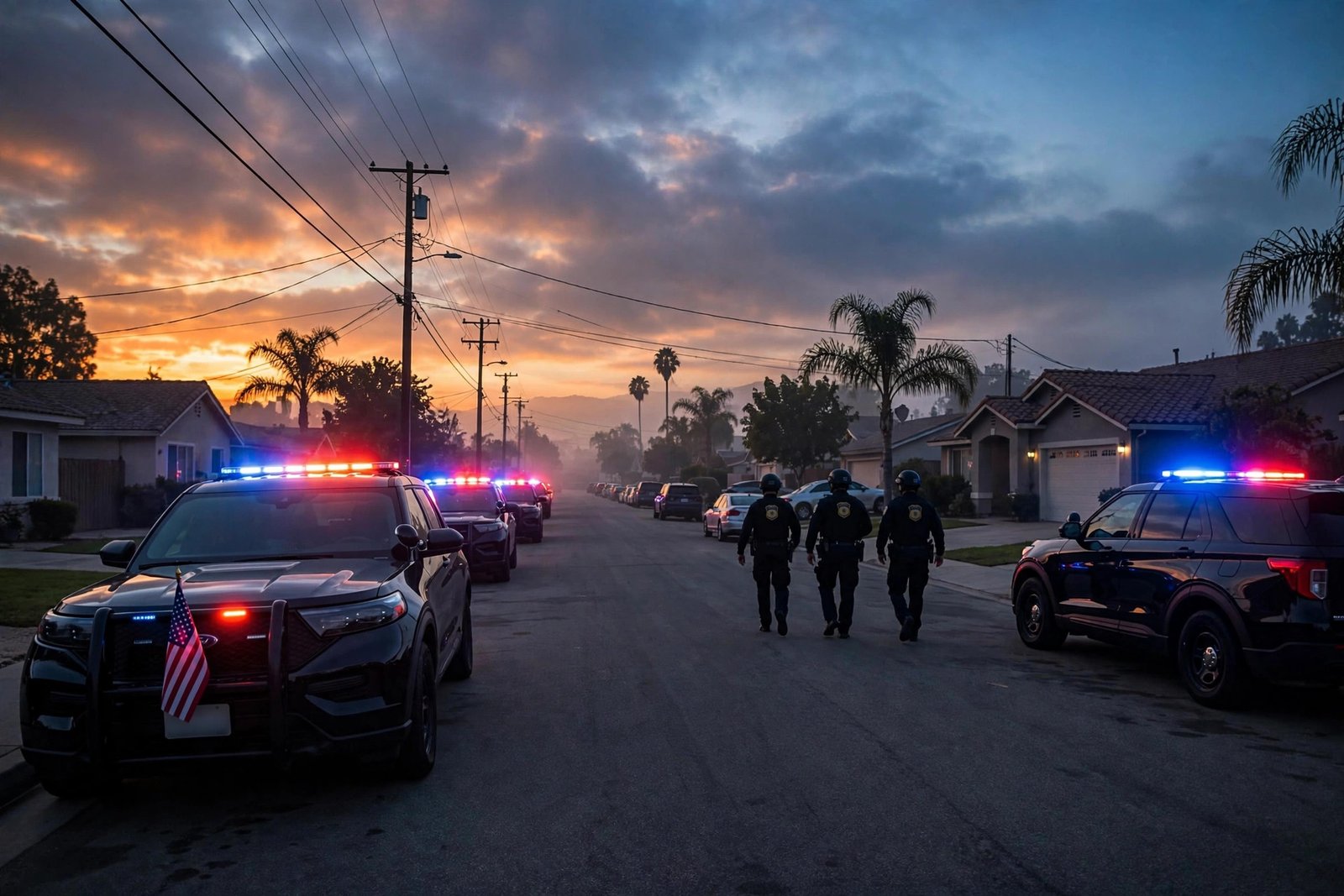
Federal agents fanned out across California in the predawn hours of Monday, October 19, 2026, in the largest California voter fraud enforcement action the state has ever seen. Under an effort dubbed “Operation Protect the Vote,” Homeland Security Investigations agents pounded on doors from Los Angeles to San Diego to the Bay Area, arresting foreign nationals accused of registering to vote and casting ballots in U.S. elections. By Monday afternoon, the Justice Department had charged 28 people with voting and registration crimes — and prosecutors said it was only the beginning.
The California voter fraud crackdown landed exactly fifteen days before the November 3 midterm elections, and it detonated instantly into the fiercest voting-integrity fight in the country. First Assistant U.S. Attorney Bill Essayli, the top federal prosecutor in Los Angeles, said the arrests confirmed what the Trump administration has been warning for weeks: “Noncitizens are voting in California elections which is unconstitutional and illegal.” The Justice Department also filed an emergency motion asking a federal judge to segregate more than 20,000 mail-in ballots tied to suspected noncitizens until their citizenship can be verified.
California’s leaders are calling the whole thing a political ambush. Governor Gavin Newsom blasted the operation as “a sad, desperate attempt by Trump to use his politicized Justice Department to try to suppress California voters just three weeks before Election Day.” With early voting already underway in California and the state refusing to verify a list of 20,000 names the feds handed over last week, the collision between Sacramento and Washington over who gets to police the voter rolls is headed straight for a federal courtroom — and it is happening in real time.
In this article:
- 🔵 “Operation Protect the Vote”: Inside the California Voter Fraud Raids
- 🔵 Who Was Arrested: The Cases Behind the 28 Charges
- 🔵 Essayli’s Case in the California Voter Fraud Fight: “Attest, Don’t Prove”
- 🔵 The Emergency Motion: 20,000 Ballots in the Balance
- 🔵 California Pushes Back: Newsom Cries Voter Suppression
- 🔵 The Escalation Timeline: From Ultimatum to Lawsuit to Raids
- 🔵 Why California Can’t Demand Proof: The Supreme Court Rule Behind the Fight
- 🔵 Who Is Bill Essayli — and What the Nationwide Numbers Say
- 🔵 What’s Next
- 🔵 Additional Details
Operation Protect the Vote: Inside the California Voter Fraud Raids
It started at around 6 a.m. in the City of Commerce, a working-class suburb east of Los Angeles. Homeland Security Investigations agents, watched by the California Post’s photographers, pounded on the front door of the home of Omar Alexander Muñoz, 72, ordering him to come out. He emerged and was taken into custody as a family member jeered at the armed, uniformed agents leading him away. “You all need to get a job,” the relative said, as the New York Post reported from the scene.
Muñoz’s arrest was the most visible moment of a coordinated sweep the Justice Department calls “Operation Protect the Vote” — a joint effort by all four of California’s U.S. attorneys’ offices. The targets were drawn from a list of more than 20,000 suspected noncitizens on California’s voter rolls, a password-protected list the feds delivered to state officials on a thumb drive the week before, demanding a review within 48 hours.
At a press conference Monday, Acting Deputy Attorney General Trent McCotter announced that 28 foreign nationals had been charged with “various voting and registration crimes, among others.” As USA Today reported, McCotter said the defendants face “some combination of unlawful voting by an alien, a false claim of U.S. citizenship in order to vote or register to vote, and knowingly depriving the residents of California of a fair and impartial election process.”
Eleven of the 28 were in custody as of Monday, according to Essayli, with the rest to be “taken into custody in the near future.” The charged individuals live in Long Beach, Rancho Palos Verdes, Sacramento, San Jose and other California cities, according to the Washington Examiner. All 28 are lawful permanent residents — green card holders — who allegedly claimed to be U.S. citizens to get on the rolls.
Who Was Arrested: The Cases Behind the 28 Charges
Prosecutors painted a detailed picture of three defendants, each accused of the same core pattern: register as a citizen, vote, then lie about it again when seeking naturalization.
Omar Alexander Muñoz, 72, a Belizean national from Commerce, allegedly registered to vote in September 2019 by falsely claiming to be a U.S. citizen — then voted in the 2020 presidential election, twice in the 2022 midterms, and again in 2024. When he applied to become a naturalized citizen, investigators say, Muñoz swore under oath that he had never claimed to be a citizen. He now faces felony charges including making false statements in a naturalization application, and he has prior U.S. convictions for grand theft and narcotics possession, per the New York Post.
José Probitsado Amaro, 51, a citizen of the Philippines living in National City in San Diego County, allegedly registered by falsely claiming U.S. citizenship and then cast a ballot in the November 2024 general election. Investigators say he later made false statements during his naturalization interview, denying he had ever claimed citizenship and misrepresenting his voting history.
Moe Thida Lwin, 57, a Myanmar national living in Daly City outside San Francisco, allegedly registered in 2024 and then illegally voted in a U.S. election. Like the others, Lwin also allegedly made false statements on naturalization paperwork.
The YouTube description of the Justice Department’s own “Operation Protect the Vote” announcement event confirmed that federal complaints charged 11 foreign nationals living in the United States with crimes including fraudulently registering to vote in U.S. elections — contests “in which most of them cast illegal and fraudulently obtained ballots.” The other 17 of the 28 were charged but not yet in custody Monday.
One number puts the operation in perspective: California has more than 23 million registered voters, and more than 154 million Americans cast ballots in the 2024 presidential election, USA Today noted. The 28 charged in this California voter fraud case represent a tiny fraction of the electorate — a fact both sides are now weaponizing. Prosecutors say 28 arrests prove the problem is real; California officials say 28 arrests out of 23 million voters prove it is negligible.
Essayli’s Case in the California Voter Fraud Fight: “Attest, Don’t Prove”
The rhetorical engine of the California voter fraud operation is Bill Essayli, and he did not mince words Monday. “Today’s arrests confirm what we suspected and what we put California on notice for: Noncitizens are voting in California elections which is unconstitutional and illegal,” he said.
Essayli’s central charge is procedural: California requires voter registrants only to attest to U.S. citizenship — to check a box and sign — without asking for any documentary proof, leaving the ballot rolls “open to fraud.” State election officials’ claims that they check for citizenship are false, he insisted: “There’s a lot of misinformation and disinformation being spread by the deceivers up there in Sacramento. The governor and the Secretary of State, and the Attorney General. They’re lying.”
The prosecutor had already put Sacramento on notice the week before. Essayli warned California election workers that they could face criminal liability under federal aiding-and-abetting laws if they knowingly processed unlawful ballots — arguing the state would be facilitating a violation of federal law. And on Friday, President Trump issued his own warning on Truth Social, advising California election officials they could face lengthy prison sentences if they count ballots cast by suspected noncitizens: “They will all go to jail for a long period of time!!!”
Read StateLineDaily’s coverage of the DOJ’s broader election-law battles here, on the NAACP lawsuit to block 1,000 federal poll monitors in the midterms, which sits on the opposite side of the same voting-fight fault line.
The Emergency Motion: 20,000 Ballots in the Balance
The raids were only the visible half of Monday’s California voter fraud action. In court, the Justice Department filed a motion for emergency relief in the U.S. District Court for the Central District of California, asking the court to grant a temporary restraining order and a preliminary injunction — and to set aside and segregate the ballots of the 20,000+ individuals on the feds’ suspected-noncitizen list until their citizenship can be determined.
“They are on California’s voter roll, and therefore already have, or soon will receive a mail-in ballot,” McCotter told reporters, as reported. California mails a ballot to every active registered voter, so anyone on the list who remains registered will automatically receive one.
The emergency motion is the courtroom companion to the bombshell lawsuit the DOJ filed Thursday, October 15, asking the court to stop California from counting vote-by-mail ballots from likely noncitizens until citizenship can be verified. The suit came two days after Justice Department officials ordered state election bosses to review the thumb-drive list within 48 hours. In a separate two-page letter sent Friday and made public Monday, McCotter warned Los Angeles County officials that knowingly tabulating ballots cast by people federal agencies identified as noncitizens “could expose those officials to criminal investigation and prosecution”: “Noncitizen voting in a federal election is a federal crime — and knowingly facilitating such conduct is equally unlawful.”
That letter went to the Los Angeles County Counsel’s Office and was copied to California Secretary of State Shirley Weber and County Registrar Dean Logan. A representative for Logan confirmed receipt. Read StateLineDaily’s account of the DOJ’s other high-stakes confrontation with news organizations here, on the antitrust “group boycott” probe of ABC, CBS, CNN, Fox News and NBC.
California Pushes Back: Newsom Cries Voter Suppression
Governor Gavin Newsom wasted no time framing Monday’s California voter fraud operation as election interference. “This is a sad, desperate attempt by Trump to use his politicized Justice Department to try to suppress California voters just three weeks before Election Day,” Newsom wrote on X. “Courts have made clear the federal government has no role in running state elections.”
State officials also challenged the reliability of the feds’ data — the list of 20,000 names built from federal databases — saying eligibility decisions must rest on verifiable information, not a drive of names. California questioned how the list was compiled and whether it contains lawful voters wrongly flagged as noncitizens, a dispute the emergency TRO hearing will now have to resolve.
Attorney General Todd Blanche defended the federal intervention. “State-facilitated voter fraud is unacceptable in the United States of America,” Blanche said. “If found responsible in a court of law, the State of California will have seriously undermined confidence in our electoral system.”
The clash mirrors a wider national fight. See StateLineDaily’s coverage of the No Kings “Vote Early” movement here, which is pushing the opposite direction — a turnout surge in the same early-voting window the DOJ’s crackdown is policing.
The Escalation Timeline: From Ultimatum to Lawsuit to Raids
Monday’s California voter fraud raids were the fourth step in a pressure campaign that escalated across five days:
- Tuesday, Oct. 13: DOJ officials sent letters to Secretary of State Shirley Weber and LA County Clerk Dean Logan with the password-protected thumb drive naming 20,000 suspected noncitizens — giving them 48 hours to review the list.
- Thursday, Oct. 15: With the deadline blown, the Justice Department sued California in federal court to block counting of suspected-noncitizen mail ballots.
- Friday, Oct. 16: McCotter sent the warning letter to Los Angeles County; Trump posted his “go to jail” warning to California election officials on Truth Social.
- Monday, Oct. 19: Operation Protect the Vote raids across California; 28 charged, 11 in custody; emergency TRO motion filed to segregate 20,000+ ballots.
Each step has raised the stakes fifteen days out from November 3. What began as a records dispute is now a criminal enforcement campaign with ballot boxes in the crosshairs — and a federal judge will soon decide whether the 20,000 ballots get set aside before they are even counted.
Why California Can’t Demand Proof: The Supreme Court Rule Behind the Fight
Here is the legal twist most coverage of the California voter fraud raids is missing: Essayli is right that California asks for no documentary proof of citizenship — but the state may not be allowed to ask.
In 2013, the U.S. Supreme Court ruled 7-2 in Arizona v. Inter Tribal Council of Arizona that the National Voter Registration Act of 1993 preempts state laws demanding documentary proof of citizenship from people registering with the federal voter registration form. Justice Antonin Scalia wrote the majority opinion holding that the NVRA’s command to “accept and use” the federal form means states cannot impose extra citizenship-verification requirements beyond what the form asks — which is an attestation of citizenship under penalty of perjury, not a birth certificate or passport, as the National Conference of State Legislatures’ case summary explains.
That ruling is the quiet foundation of the whole dispute. California’s registration system — check the citizenship box, sign under penalty of perjury — follows the federal-form model the Supreme Court upheld. The Trump administration’s answer to the California voter fraud problem is to work around the states rather than through them: use federal databases to build its own list of suspected noncitizens, then demand states act on the list — or face lawsuits, criminal warnings and now predawn raids. Critics say that inverts the system Congress and the Court designed; the DOJ says existing federal criminal law against noncitizen voting (which applies regardless of how registration works) gives it all the authority it needs.
Whichever side prevails, the TRO hearing will put the question before a judge in days, not months — a speed that reflects just how close the midterms are. Watch for the ruling to cite Inter Tribal Council either way: it is the controlling precedent on what states can and cannot demand at registration.
Who Is Bill Essayli — and What the Nationwide Numbers Say
The face of the California voter fraud operation is one of the most combustible figures in California law enforcement. Bilal Ali “Bill” Essayli, 40, is the First Assistant U.S. Attorney for the Central District of California — the largest federal judicial district outside Washington, D.C., covering seven counties and roughly 20 million people, with a team of 500 lawyers, agents and staff, according to the Justice Department.
Essayli’s path there was anything but quiet. A Republican, he was the first Muslim American elected to the California State Assembly (63rd District, 2022–2025), where he became a right-of-center firebrand who frequently clashed with the Democratic supermajority, Wikipedia’s biography notes. He left Sacramento in April 2025 for a 120-day interim appointment as U.S. Attorney — and after the interim period lapsed, a federal judge ruled he had unlawfully served as acting U.S. Attorney, disqualifying him from the top post and landing him in the First Assistant role he holds now.
Before politics, he was a Riverside County deputy district attorney and an Assistant U.S. Attorney from 2014 to 2018, where he prosecuted accessories to the 2015 San Bernardino terror attack.
The other number to know: Essayli said Monday that in the last seven weeks alone, the Justice Department has charged 113 foreign nationals across twenty states with illegal voting and registration offenses — and is “investigating thousands more similar cases throughout the nation.” Since the start of the Trump administration, the DOJ has charged 156 people with voter fraud-related offenses, per reports on Monday’s press conference. Whether those numbers grow into a national enforcement wave or stall in the courts, the California voter fraud cases are the opening salvo.
What’s Next
Will the 20,000 ballots be segregated? A federal judge in the Central District of California will rule within days on the DOJ’s emergency TRO motion in the California voter fraud case. If granted, ballots tied to the suspected-noncitizen list get set aside until citizenship is verified — a first-of-its-kind intervention fifteen days before a federal election.
Will the other 17 defendants be arrested? Essayli said the remaining charged individuals will be taken into custody “in the near future.” Expect more 6 a.m. raids and more booking photos this week.
Will California comply with the 20,000-name review? State officials question the list’s reliability and insist eligibility decisions need verifiable data. The lawsuit and the TRO motion are the feds’ answer to “no” — but a judge, not Sacramento, now decides.
Will this spread beyond California? With 113 charged across twenty states in seven weeks and “thousands more” cases under investigation, Operation Protect the Vote looks like a template. Other states with universal mail voting should expect similar lists, similar ultimatums and similar raids.
What happens on November 3? Early voting is already underway. If the TRO is granted, some California mail ballots could sit uncounted while citizenship is checked — setting up postelection litigation over whether segregated ballots get counted at all.
Additional Details
Operation: “Operation Protect the Vote” — coordinated effort by California’s four U.S. attorneys’ offices; announced Monday, October 19, 2026.
Charges: 28 foreign nationals (all lawful permanent residents) charged with voting and registration crimes — unlawful voting by an alien, false claim of U.S. citizenship to register/vote, and depriving residents of a fair and impartial election process.
In custody: 11 as of Monday; remaining 17 to be arrested “in the near future,” per First Assistant U.S. Attorney Bill Essayli.
Named defendants: Omar Alexander Muñoz, 72 (Belize, Commerce — voted 2020, twice 2022, 2024; felony false-statements charge); José Probitsado Amaro, 51 (Philippines, National City — voted Nov 2024); Moe Thida Lwin, 57 (Myanmar, Daly City — voted after 2024 registration).
Court action: DOJ motion for TRO and preliminary injunction filed Monday in the U.S. District Court for the Central District of California to set aside/segregate 20,000+ mail ballots pending citizenship verification; DOJ lawsuit against California filed Thursday, October 15, 2026.
Key figures: Acting Deputy AG Trent McCotter; First Assistant U.S. Attorney Bill Essayli; NDCA U.S. Attorney Craig Missakian; HSI San Diego SAC Kevin Murphy; AG Todd Blanche; Gov. Gavin Newsom; Secretary of State Shirley Weber; LA County Registrar Dean Logan.
National context: 113 foreign nationals charged across 20 states in the last seven weeks; 156 voter-fraud-related charges since the start of the Trump administration; “thousands more” cases under investigation.
Description: Federal agents arrested 28 foreign nationals in California on October 19, 2026, in “Operation Protect the Vote,” the biggest California voter fraud bust in state history. First Assistant U.S. Attorney Bill Essayli says the arrests prove noncitizens are voting in California elections, while the DOJ asked a federal judge to segregate 20,000+ mail ballots. Governor Newsom calls it voter suppression fifteen days before the midterms.