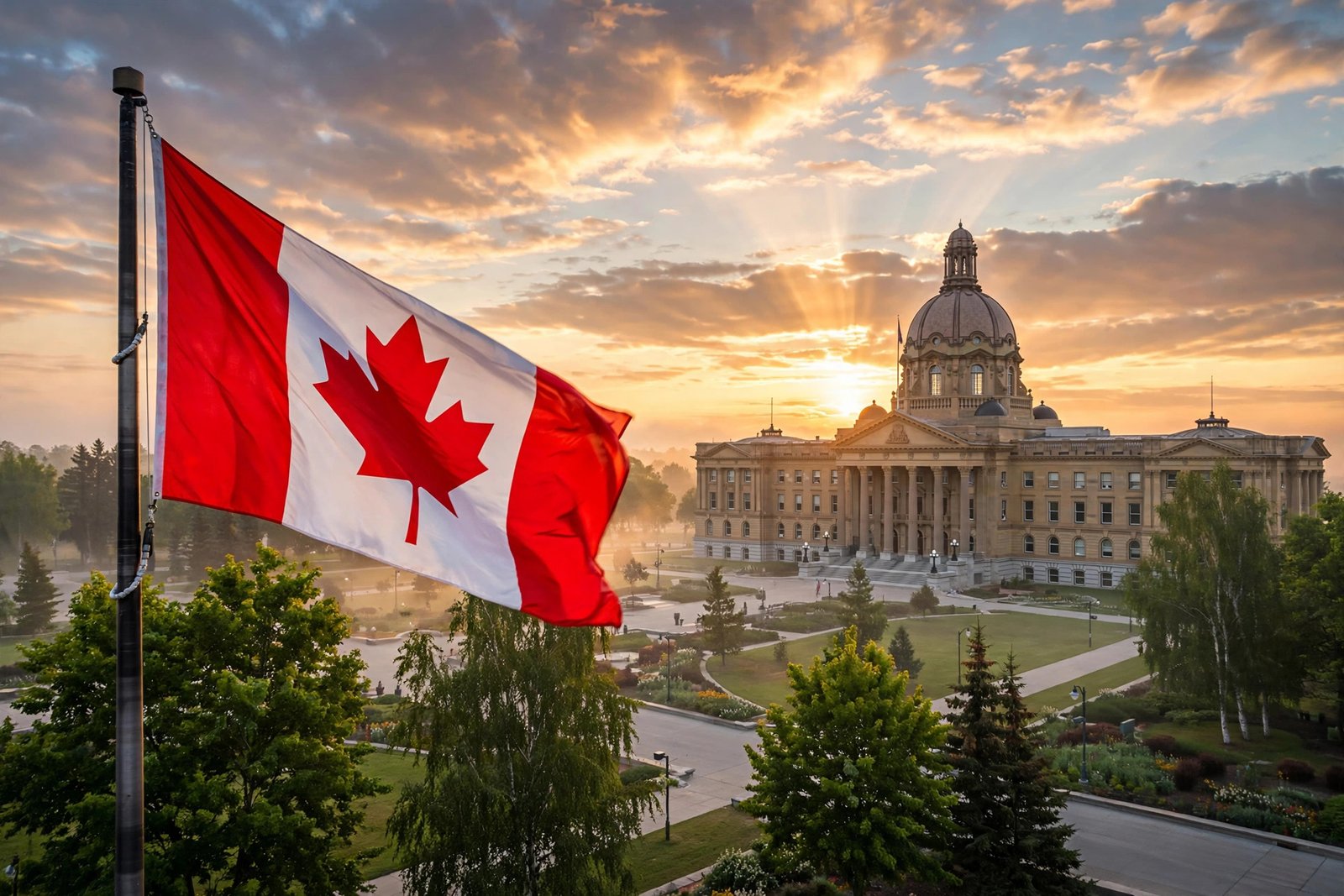
Alberta has voted decisively to stay in Canada. In a historic referendum held Monday, October 19, 2026, roughly 76 percent of Albertans chose to remain a province of Canada, while only about 24 percent backed starting the legal process toward a future binding referendum on separation, according to unofficial results projected by CBC News and reported by the Associated Press. The Alberta referendum results deliver a major political victory for Prime Minister Mark Carney — and a stinging defeat for the separatist movement that spent months arguing the province would be richer on its own.
The vote was the first-ever referendum on Alberta’s place in Canada, and its timing could hardly have been more charged: it unfolded against the backdrop of a grinding trade war with the United States and repeated threats from President Donald Trump to make Canada America’s “51st state.” For Carney, who campaigned personally across Alberta urging voters to reject the separatist path, the result is a powerful validation of his national-unity pitch — and, as early returns tallied more than 1.4 million votes, a signal that even in the country’s most pro-American province, the appetite for breaking up the federation is far smaller than the separatists claimed.
One important caveat runs through everything: Question 10 — the separation question — was non-binding. Even a separatist victory would not have changed Alberta’s constitutional status overnight. But the margin, roughly three-to-one, leaves little doubt about where the province stands today. StateLineDaily reported ahead of the vote how Carney accused Washington of trying to “break” Canada; now he can point to a verdict from the ballot box.
- The Results: 76% Choose Unity
- Carney: Reading the Alberta Referendum Results as a Unity Victory
- Danielle Smith Addresses the Province
- Election Night: What Delayed the Alberta Referendum Results
- Record Turnout and the Other Nine Questions
- Separatists: “Tonight Isn’t the Finish Line”
- Extra Knowledge: Why 24% Could Never Have Split Canada Overnight
- Extra Knowledge: Quebec’s Ghost — 1995’s 50.58-49.42 Nail-Biter
- What Trump’s “51st State” Talk Had to Do With It
- What’s Next After the Alberta Referendum Results
- Additional Details
The Results: 76% Choose Unity in the Alberta Referendum Results
CBC News, Canada’s national public broadcaster, called the result late Monday night after just 33 percent of the vote had been counted — a sign of how uncompetitive the contest was. At the time of the call, 76 percent of tallied votes backed the “remain” side versus 23 percent for moving toward a binding separation vote, Sky News reported.
As the count continued overnight, the numbers barely moved. With about 34.5 percent of polls reporting, Elections Alberta’s unofficial tally showed 901,447 votes — 76.2 percent — for remaining, against 281,342 votes, 23.8 percent, for commencing the legal process required under the Constitution to hold a binding separation referendum, Profilo Politics reported. A later check by Okay News put the remain figure at 76.32 percent — 1,079,074 votes — versus 23.68 percent for the separation process. Another tally carried the remain share at 76.4 percent.
The numbers confirm what pre-vote polls had been predicting: a large remain victory. A Leger survey taken October 2–4 found 70 percent backing remain and 22 percent backing the separation process, while Ipsos polling for Global News in mid-September found 70 percent to 20 percent, Declassified Now reported. If anything, the final result came in stronger for unity than the polls suggested.
The figures are unofficial; Elections Alberta said ballots would be hand-counted, with Question 10 reported first, and official results are due October 29, 2026.
Carney: Reading the Alberta Referendum Results as a Unity Victory
“Albertans made a clear choice,” Carney said in a statement after the result became clear. “They chose unity, to build together, and to take care of each other.” He added: “Canada is greater than the sum of its parts.”
The prime minister — who grew up mostly in Alberta — had thrown himself into the campaign. At a rally in Calgary last week he warned that voting to begin the separation process would be a “dangerous bluff that will lead to years of deep division,” and he appealed to Albertans to “vote like Canada depends on it,” per Sky News. He also acknowledged that Albertans have often felt slighted by Ottawa, pointed to his government’s approval of a proposed new pipeline, and argued that Alberta is critical to helping Canada reduce its dependence on the United States.
For Carney, the Alberta referendum results are the clearest political win of his young premiership. The referendum landed squarely in the middle of his effort to unify the country as Trump escalates tariff pressure and keeps annexation rhetoric alive — and the voters of the province most sympathetic to American-style conservatism just told him, resoundingly, that unity is what they want.
Danielle Smith Addresses the Province
Alberta Premier Danielle Smith, who announced the referendum back in May, said late Monday that she was “very pleased” that early results showed widespread support for remaining in Canada, and said she would address Albertans on Tuesday to discuss the results and “where our province goes from here,” Sky News reported.
Smith’s position has always been awkward. She personally says she wants Alberta to stay in Canada — she described adding Question 10 as a response to citizen petitions on both sides of the debate and called the vote a way to “have a vote, understand the will of Albertans on this subject, and move on.” Yet she leads the United Conservative Party, where polling showed a majority of past UCP voters supported the separation-process option, according to the Angus Reid Institute — and the institute noted she had “already begun the legwork to unite the party post referendum.”
Her Tuesday address will be watched closely for how she threads that needle: celebrating the unity verdict while keeping a hold on the roughly quarter of Albertans who want Ottawa to treat the province better.
Election Night: What Delayed the Alberta Referendum Results
Results arrived hours later than anyone planned. On Monday, 106 polling stations across the province opened late, and because no results could be released until every station had closed, the first numbers were held back until the last station — Edmonton’s Westminster School, scheduled to close at 8 p.m. — shut its doors at 10 p.m. Mountain time, midnight Eastern, citing CBC News.
The delays pushed the Alberta referendum results back by more than two hours. Voters reported real frustration: Steve Koristka in Calgary waited over an hour for his polling station to open, while Myrna Doiron in Edmonton arrived at 9:30 a.m. only to find her station temporarily closed until noon. In Maskwacis, polling stations ran out of ballots under heavy turnout, and Elections Alberta had to send couriers with additional ballots.
Elections Alberta hired 47,000 election officers — short of the 60,000 it aimed for — and spokesperson Maia Hanrahan insisted that was sufficient for the voting process. Question 10 was counted first at every station, ahead of the nine other questions on the ballot, with counting set to begin at 5 p.m. and CBC carrying live coverage from 7 p.m. Mountain.
Record Turnout and the Other Nine Questions
The headline figures mask just how engaged Albertans were. Before referendum day even arrived, 43.1 percent of the province’s 3,148,343 eligible voters had already cast advance or special ballots — compared with 27.5 percent at the advance stage in the 2023 provincial election, CP24 reported. Elections Alberta was anticipating overall turnout of 80 percent or more, which would far outpace the 55 percent average of the past five provincial elections, per the Angus Reid Institute.
Meanwhile, the other nine questions on the ballot — added before the separation question in February — covered immigration and constitutional powers. Five asked about immigrants’ access to health care, education and citizenship, and four concerned Alberta’s constitutional and judicial authority. CTV reported that early results were split, with the immigration questions drawing slightly higher support than the constitutional ones; official figures for those questions were expected Wednesday morning. Notably, Carney had urged Albertans to vote “no” on all nine, while the province spent $4 million on advertising focused mostly on those questions.
Separatists: “Tonight Isn’t the Finish Line”
The mood was somber among independence organizers tracking the returns in Edmonton, but the movement’s leaders made clear they are not going away. “Tonight isn’t the finish line,” said Mitch Sylvestre of the Alberta Prosperity Project, per Profilo Politics. “We’ve awoken something in this province and that spirit isn’t going anywhere.”
Jeffrey Rath, another leader within the Alberta Prosperity Project, argued the campaign had turned a fringe cause into a movement that will persist. And Keith Wilson, a leader of the separatist movement, found a silver lining in the rout: “We don’t have the final results. I think the numbers are going to fluctuate, but it is fair to say that at least a quarter of Albertans feel that Alberta needs to be treated better,” he told the Associated Press.
In the Alberta referendum results, the quarter figure is real political capital. Angus Reid’s pre-vote polling found the “remain” side outnumbered separation supporters two-to-one, but also that support for Option 2 was strongest outside Calgary and Edmonton and among older Albertans, especially men. One voter, Dustin Degenhardt of Wainwright, gave voice to the grievance fueling the movement: Alberta has “essentially been treated as, you know, a colony,” he told the AP after voting Monday. “They want to take and take and take from us and not return anything.”
Extra Knowledge: Why 24% Could Never Have Split Canada Overnight
Here’s the detail many quick-take headlines are missing: no Alberta vote — not even a landslide “yes” — could have separated the province from Canada on its own. The ballot was non-binding by design. As Karmactive explained, the question asked voters only whether the provincial government should “commence the legal process required under the Canadian Constitution to hold a binding provincial referendum” — a process, not a divorce.
The reason goes back to Canada’s constitutional trauma of the 1990s. In 1998, the Supreme Court of Canada ruled in the Reference Re Secession of Quebec that no province can secede unilaterally. A clear majority on a clear question would oblige the rest of Canada to negotiate, but the vote itself would have no legal effect — separation would still require a constitutional amendment, per Canadian legal analysis.
And that amendment bar is formidable. Parliament then codified the Court’s framework in the Clarity Act of 2000, which sets out what negotiations must cover — division of assets and liabilities, border changes, Indigenous peoples’ territorial claims, minority protections — before any minister may even propose the amendment that separation requires, Declassified Now reported. The general constitutional amendment formula needs identical resolutions from Parliament and seven provinces representing at least half of Canada’s population — a threshold that makes any unilateral walkout a legal fantasy.
In other words, Alberta’s 24 percent was never a countdown to independence. It was a protest vote against Ottawa — one that even the premier who called the referendum says she wants to “move on” from now.
Extra Knowledge: Quebec’s Ghost — 1995’s 50.58-49.42 Nail-Biter
To understand why Ottawa and Carney are exhaling, look at the last time Canada faced a real breakup vote. Quebec has held two referendums on separation — in 1980 and 1995 — and the second one came within a whisker of fracturing the country. The “No” side won in 1995 with just 50.58 percent of the vote against 49.42 percent for sovereignty, per Canadian history accounts — a margin so thin it haunted federal politics for a generation and triggered the Supreme Court reference and the Clarity Act.
Alberta’s 76-24 split in the Alberta referendum results was nothing like that. It was closer to the 1980 Quebec result, when 60 percent voted “No.” And yet the separatist story in Canada is not finished. Earlier this month, the Parti Québécois won 59 seats in Quebec’s provincial election, and its leader Paul St-Pierre Plamondon has promised an independence referendum in his first term, Declassified Now noted.
Carney’s win in Alberta, then, is best read as a battle won in a longer war over Canadian unity — one where Quebec, not Alberta, remains the front line.
What Trump’s “51st State” Talk Had to Do With It
No honest reading of the Alberta referendum results can ignore the American elephant in the room. Trump has spent 2026 hitting Canada with punishing tariffs while openly musing that the country should become America’s 51st state — and Alberta, whose political culture has more in common with the American West than with much of Canada, was supposed to be the province most receptive to that pitch.
Instead, the opposite appears to have happened. Carney built his entire campaign on the argument that a vote for the separation process would be read as weakness in the face of American pressure — and the deep resentment many Albertans feel toward Trump’s trade war seems to have channeled separatist energy into nationalism rather than away from it. As Sky News observed, the result is a boost for Carney’s unity push “amid a trade war with the US.”
The irony is rich: Trump’s annexation rhetoric, designed to peel Canada apart, may have helped glue it together. It is the same dynamic StateLineDaily documented before the vote, when Carney accused Washington of trying to “break” Canada — a charge that evidently landed far beyond the Ottawa press gallery. With tariffs now the central instrument of Trump’s trade policy against allies and adversaries alike, Canada’s unity vote reads as a direct rebuke of the coercion strategy itself.
What’s Next After the Alberta Referendum Results
When will the results be official?
Elections Alberta will publish official results on October 29, 2026, after hand-counting all ballots. The overnight figures are unofficial.
What about the other nine questions?
Results for the immigration and constitutional-power questions — expected to be closer — were still being counted, with official figures anticipated Wednesday morning.
What will Danielle Smith say Tuesday?
The premier plans to address Albertans on Tuesday evening about the results and “where our province goes from here.” Expect her to celebrate the unity vote while promising Ottawa a tougher negotiation posture — her party’s separatist wing will demand no less.
Is Alberta separatism dead?
No. Leaders like Jeffrey Rath and Mitch Sylvestre are already framing the 24 percent as a foundation, and a quarter of a province is a potent political force. But the movement lost its strongest argument — that a silent majority secretly wants out.
Does this affect Quebec?
Indirectly. The Parti Québécois’s promised independence referendum is a separate fight with deeper roots. But Carney now walks into it with a fresh mandate for unity — and a case study in how to win one.
Additional Details
Description: Alberta referendum results show 76% of voters chose to stay in Canada, rejecting a separation process in the province’s first-ever independence vote. This report breaks down the official numbers, Mark Carney’s unity victory, Danielle Smith’s response, record turnout, the delayed election night, why the non-binding vote could never have split Canada, and what Trump’s “51st state” pressure had to do with the landslide.