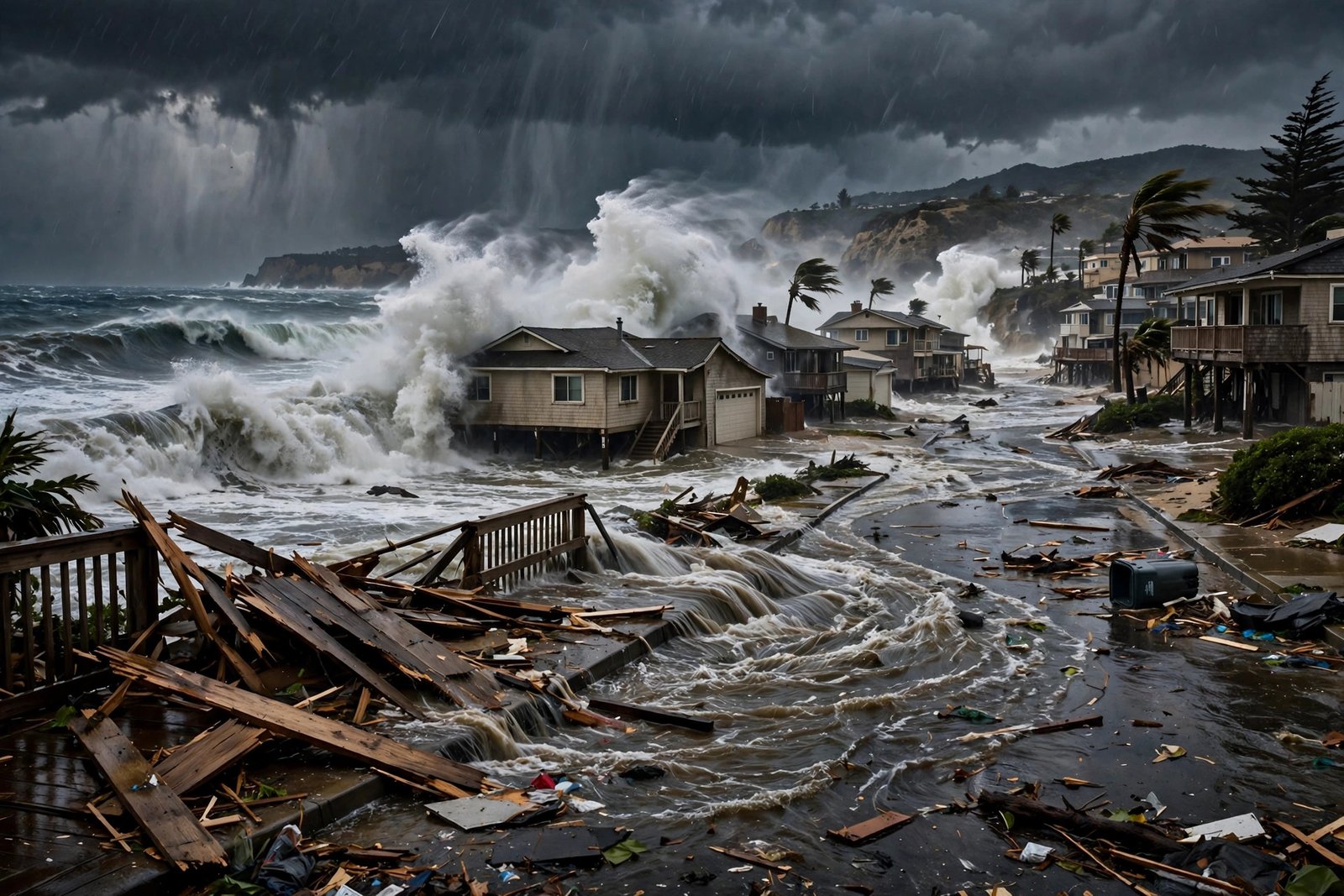
Tropical Storm Rachel turned Southern California’s coastline into a disaster zone on Sunday, October 11, 2026, as powerful waves from Tropical Storm Rachel tore through beachfront homes on Long Beach’s Alamitos Peninsula, ripped apart a century-old boardwalk, and forced emergency evacuations along some of the city’s most expensive shoreline property.
The destruction was the worst many residents had ever witnessed. At least eight buildings covering 13 addresses were red-tagged as unsafe to enter, while another was yellow-tagged, allowing residents only limited access to retrieve belongings, according to Long Beach Mayor Rex Richardson. Mandatory evacuation orders along Seaside Walk between 64th and 66th places remain in effect until noon Tuesday, and city officials warned that another unusually high tide could bring even more damage in the coming days.
Table of Contents
- Tropical Storm Rachel: How the Storm Hit Long Beach
- Homes Red-Tagged After Waves Batter the Peninsula
- Residents Describe the Worst Storm in Decades
- Mandatory Evacuations on Seaside Walk
- Newport Beach Declares Local Emergency
- A King Tide Threatens Even More Damage
- What Comes Next for Long Beach
Tropical Storm Rachel: How the Storm Hit Long Beach
The storm began its assault as the remnants of Tropical Storm Rachel, which made landfall in northern Baja California, north of Ensenada, before pushing inland and spreading heavy rain and flash-flood concerns across parts of the Southwest. By Sunday morning, Tropical Storm Rachel’s powerful ocean swells had zeroed in on Long Beach’s Alamitos Peninsula, where the damage unfolded with stunning speed.
This was not Southern California’s first beating this season. Tropical Storm Rachel arrived as the third major storm to slam the region’s coastline in recent weeks, following Hurricane Marie over the Labor Day weekend and Hurricane Polo in the weeks after. Each storm has left the shoreline weaker and more vulnerable than the last, with protective sand already stripped away before Tropical Storm Rachel’s waves even arrived.
Along the peninsula, Tropical Storm Rachel’s massive waves tore through wooden sections of the historic waterfront boardwalk, sending seawater rushing into homes and streets. On Seaside Walk, the pounding surf breached the protective bulkhead — the wall meant to hold back the ocean — and exposed beachfront properties to further erosion. Video captured a large crack running from the foundation to the roof of one waterfront home, while other footage showed powerful waves crashing directly into structures along the shoreline.
By Saturday evening, parts of the damaged boardwalk had become inaccessible, with officials posting no-trespassing signs as emergency crews scrambled to reinforce the coastline with heavy equipment and massive sandbags.
Homes Red-Tagged After Waves Batter the Peninsula
Tropical Storm Rachel’s toll on buildings has been severe. At least eight buildings representing 13 addresses were red-tagged as unsafe to enter, while another home was yellow-tagged, permitting residents only limited access to retrieve personal belongings, according to Mayor Rex Richardson.
The city took emergency steps to manage the crisis. Vehicle access to the peninsula was restricted to residents only, allowing emergency crews to move heavy equipment and supplies into the hardest-hit areas without traffic getting in the way. Long Beach officials distributed 7,600 sandbags to residents during Tropical Storm Rachel, bringing the total handed out across the three recent storms to approximately 15,000.
To hold back Tropical Storm Rachel’s relentless surf, crews also deployed massive sandbags and heavy machinery to reinforce damaged sections of the seawall and prevent additional properties from collapsing. The race against the ocean is far from over — officials say damaged areas remain unstable, and the next high tide could undo much of the emergency repair work.
Residents Describe the Worst Storm in Decades
For the people who live on the peninsula, Sunday’s devastation from Tropical Storm Rachel was personal — and unlike anything they had seen before.
Natalie Cabrera, 59, had lived on the peninsula for just a year and a half, renting a beachfront bungalow she called her dream home. Tropical Storm Rachel destroyed her home’s foundation and caused severe water damage throughout. “The floor is squishy. Because the ocean just kept hitting and hitting my home, and the water went underneath,” she said. “Water didn’t come through my front door. It came up from the ground.”
Cabrera said neighbors who had lived in the area for decades had never witnessed anything like Tropical Storm Rachel. With her home uninhabitable, she plans to move to Ontario, where her son and daughter-in-law live.
“I don’t want to leave. At all. Ever. This was my dream,” she said. But she also described how complete strangers rushed to help protect her property — including a young college student who had been fishing nearby when he saw waves rushing through her front door. “Everybody just came together, total strangers. As fast as the water came, they’re shoveling the sand out.”
Robert Wells, 80, whose family has owned a summer home on the peninsula since 1962, said he had never witnessed such severe destruction. “It’s never happened like this before. Yesterday, and this morning, the water came right over here. And just took everything out,” he said. Wells blamed the city’s own protective efforts, arguing that a sand berm constructed to hold back the ocean actually made the damage worse by funneling water toward homes.
“There are more greater chances than not that if they hadn’t put that berm there, that the damage would be minor. And now the damage is major,” he said. He also claimed that residents were preparing legal action against the city, saying a class action lawsuit is forming.
John Fernando, who has lived on the peninsula for more than a decade, evacuated his property as the tide began rising around 9 a.m. Sunday amid Tropical Storm Rachel’s pounding surf. He described how the powerful waves stripped away layers of sand, exposing rocks and structural stakes that had been buried beneath the beach for years. “No one’s ever seen the rocks and the extra stakes in the sand until now when the ocean just ripped it out,” he said.
Fernando said residents had been working around the clock to protect their homes and help neighbors. “We’re all in this together. We’ve all been protecting our own properties. And then when we could provide support, we’d help each other out at the same time. This is definitely like 100% a group effort.”
Dave Uff, who has lived in the neighborhood for 12 years, said his home on 63rd Place was spared after he surrounded it with sandbags — but several of his neighbors were not as fortunate. “On Seaside Walk, some of the fronts of the homes have been destroyed. On 63rd Place, a lot of water and sand intrusion, that’s going to be hard to mitigate,” he said.
“This is the worst anybody’s ever seen it. The people that have been here for 60 years say this is the worst they’ve seen it.” Despite the losses, Uff said the community remained determined. “We’re a very tight community here, and what affects one affects all. Some of our neighbors have lost their homes. We’re all hurting for them. We’re all helping out. We’re heartbroken, but we’re steadfast, and we’re doing what we can to keep things normal, as normal as possible, and waiting to rebuild.”
Mandatory Evacuations on Seaside Walk
Tropical Storm Rachel forced mandatory evacuation orders for residents along Seaside Walk between 64th and 66th places, with the orders scheduled to remain in effect until noon Tuesday, subject to changing conditions. Officials emphasized that the timeline could be extended if the forecast worsens or if inspections reveal additional structural damage.
The evacuation zone sits in the area where the damage was most severe — where waves breached the bulkhead and the boardwalk took the heaviest hits. Emergency crews have been working in the zone to reinforce the coastline, but officials warned residents that reentry could be delayed if buildings are found to be structurally unsound.
The restriction of vehicle access to the peninsula to residents only remains in force, and officials urged the public to stay away from the damaged boardwalk sections, which have been posted with no-trespassing signs.
Newport Beach Declares Local Emergency
Long Beach was not the only community hit by Tropical Storm Rachel. In Newport Beach, officials declared a local emergency Friday after coastal flooding inundated streets along the Balboa Peninsula, prompting crews to construct protective sand berms and deploy pumps. The city temporarily closed its beaches and shut down the Newport Pier, Balboa Pier and the Wedge as officials worked to prevent additional damage.
Orange County officials coordinated the distribution of tens of thousands of sandbags, while public works crews used bulldozers to reinforce vulnerable stretches of shoreline. The scale of the response reflects how unusual this storm season has become for a region more associated with sunshine than storm surge.
Tropical Storm Rachel’s reach extended well beyond the coast. In the Inland Empire, powerful winds reached far enough to cause damage inland, where footage showed a structure being ripped from the ground as two people desperately attempted to hold it down. Flash-flood concerns stretched across parts of the Southwest as Tropical Storm Rachel moved inland after its Baja California landfall.
For a comparison with another major storm event this season, see our coverage of Hurricane Isaias slamming the Gulf Coast, which left hundreds of thousands without power.
A King Tide Threatens Even More Damage
Residents and officials alike fear the worst from Tropical Storm Rachel may not be over. Another unusually high tide is expected, and a king tide — an especially high tide that occurs when the sun, moon, and Earth align — is forecast for the coming days, threatening to push even more water into the already-battered coastline.
“There’s tomorrow, there’s the king tide, so this is just the beginning, it’s not over,” John Fernando said, reflecting the anxiety shared across the peninsula. With the boardwalk already damaged, the seawall compromised, and protective sand stripped away, even a normal high tide could cause fresh destruction — let alone an extreme one.
Residents can monitor official tide and surf forecasts through the National Weather Service, which issues coastal flood warnings and high surf advisories for Southern California.
What Comes Next for Long Beach
The road to recovery from Tropical Storm Rachel will be long. Crews continue to shore up the seawall and boardwalk, and building inspectors will need to assess every red-tagged property before residents can begin repairs — a process that could take weeks. The potential class action lawsuit against the city over the sand berm could add a legal battle to the physical one.
For now, the peninsula remains a landscape of sand, debris, and damaged homes. But the spirit residents described Sunday suggests the community will fight to come back. As Dave Uff put it: “We’re heartbroken, but we’re steadfast.”
The storm season has now battered Southern California three times in a matter of weeks — Hurricane Marie, Hurricane Polo, and now Tropical Storm Rachel — raising serious questions about how coastal communities will prepare for what appears to be a new pattern of extreme coastal weather. Emergency officials say planning for the next storm is already underway, even as the cleanup from this one has barely begun.