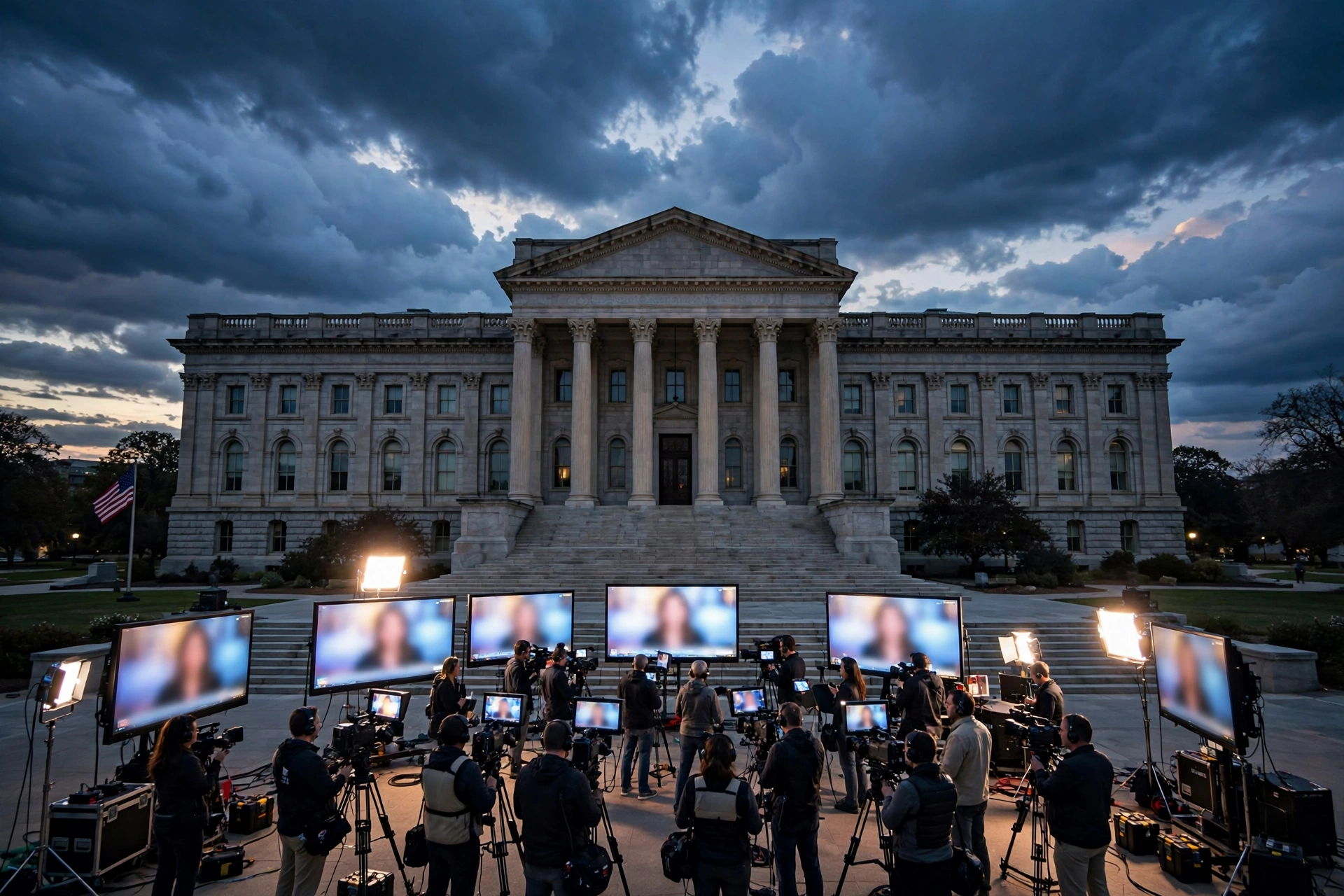
A federal judge blocks taxpayer-funded ads promoting President Donald Trump’s agenda, ordering the administration to pull the controversial spots off the air Sunday evening in a sharp rebuke of one of the most unusual government ad campaigns in modern American history. The judge blocks taxpayer-funded ads ruling marks a rare judicial intervention into government advertising.
U.S. District Judge Jennifer Rochon granted a temporary restraining order on October 11, 2026, halting any further airings of the ads that have blanketed television networks over the past several weeks. The ruling caps a dramatic weekend legal battle over nearly $20 million in taxpayer money that the Trump administration spent promoting the president’s record — money watchdog groups say was used for partisan propaganda in violation of federal law.
Table of Contents
- What the Ruling Means for the $19 Million Ad Campaign
- Judge Blocks Taxpayer-Funded Ads: Inside the Court Order
- Inside the 13 Campaign-Style Ads
- The White House Response
- What Happens Next: The Two-Week Freeze
- Bipartisan Backlash to the Ad Spending
- The Bigger Legal Questions
What the Ruling Means for the $19 Million Ad Campaign
The court order means the ads must stop immediately. Judge Rochon ordered the government to cancel any further airings of the taxpayer-funded spots as of 6:45 p.m. ET on Sunday, just as the administration’s own media-buy schedule was set to expire at midnight. The ruling, in which a judge blocks taxpayer-funded ads, took effect just hours before the administration’s own deadline.
The timing mattered. The Justice Department had told the judge late Saturday that the ad push was already scheduled to end Sunday night, arguing that the case was effectively over and the lawsuit was moot. Rochon disagreed. She ruled that the administration’s self-imposed deadline did not end the legal dispute, and she barred the government from buying any more airtime for the ads. The decision, in which a judge blocks taxpayer-funded ads, rejected the government’s claim that the case was moot.
The numbers behind the campaign are staggering. Government filings in the case revealed that the administration has already spent approximately $19 million of the $20 million allocated for the ads — taxpayer dollars drawn from the budget of U.S. Customs and Border Protection, the border security agency that sits inside the Department of Homeland Security. The scale of the spending is part of why the case — in which a judge blocks taxpayer-funded ads — has drawn national attention.
An advertising company, LMD Agency Inc., placed the media buys under the terms of a government order that ran through Sunday, October 11, 2026, at a cost of roughly $19 million, according to a sworn declaration from senior DHS official Holly Mehringer. In the same declaration, Mehringer told the court that the department had instructed the agency not to make any additional media buys past October 11 and that there were “no plans” to purchase more ads.
Judge Blocks Taxpayer-Funded Ads: Inside the Court Order
The lawsuit that forced the issue was brought by Common Cause, the nonprofit, nonpartisan government watchdog group, which filed its challenge in federal court in New York. The group argued that the ad campaign was a clear violation of appropriations law — the federal rules that restrict the use of government funding for propaganda or partisan communications. The ‘judge blocks taxpayer-funded ads’ ruling is expected to be cited in future challenges to government promotional spending.
The judge blocks taxpayer-funded ads ruling landed as a temporary restraining order, the kind of fast-acting court intervention issued when a judge believes there is enough evidence of legal harm to freeze the status quo while the case plays out. Rochon’s order blocks any further ad buys for two weeks. That means if the administration wants to resume the taxpayer-funded ad campaign at any point, Justice Department lawyers would first have to persuade the court to lift the order — a tall task given how the judge described the case.
The Justice Department had tried to short-circuit the litigation. In a filing late Saturday, government lawyers argued that the effort to halt the spending should be denied because the ads “will not continue past tomorrow.” But Rochon was not convinced that the administration’s promise to stop voluntarily was enough, noting that the government had previously continued the campaign even after public backlash. The ‘judge blocks taxpayer-funded ads’ ruling signals that courts will not defer to voluntary promises when public money is at stake.
Notably, this was not the only legal challenge to the ads. The Democratic National Committee separately sued the Trump administration over the same ad campaign, making it a two-front legal war for the White House.
Inside the 13 Campaign-Style Ads
What exactly did taxpayers pay for? According to reporting on the campaign, the Trump administration created at least 13 campaign-style video ads, some of which aired on major television networks including CBS, CNN, MS NOW, Fox News, and Fox. The ‘judge blocks taxpayer-funded ads’ ruling came after weeks of growing scrutiny of the spots.
The ads promoted President Trump and his agenda, and the president himself was deeply involved in their creation. Trump personally drove the production of the video spots, including helping select the imagery and footage used, according to a source familiar with the process. Two Trump advisers said the ads were produced in-house by the White House video team — part of the communications operation responsible for the administration’s public messaging — though at least one spot was produced by a pro-Trump meme group.
The government’s own description of the ads raised eyebrows. In a court filing, DHS official Mehringer described the spots as “depicting the President of the United States and his administration’s various efforts related to protecting America’s borders, including enhancements of border security by combating drug trafficking” — though that description did not match the actual content of many of the ads obtained by news organizations.
The Justice Department, for its part, conceded in court that the ads attacked “a generic list of ‘villains,'” while insisting they did not target any specific race, electoral candidate, or political party. Watchdog groups found that distinction unconvincing. Common Cause and other critics said the spots amounted to taxpayer-funded promotion of the president’s political brand — exactly the kind of propaganda that federal appropriations law is meant to prevent.
The White House Response
The administration’s public defense of the ads has been defiant. Homeland Security Secretary Markwayne Mullin was pressed on Sunday on CBS News’ “Face the Nation” about whether the taxpayer dollars would be refunded. Mullin spoke hours after a judge blocks taxpayer-funded ads ruling ordered the spots off the air.
“Anytime we can do a public service announcement and brag about America, I’m all about it,” Mullin said, pointing to what he described as success in securing the border and lowering fentanyl-related deaths. “We should be bragging about what’s happening inside America,” he added, commending the president for the opportunity.
But a White House spokesperson acknowledged that Trump did not plan to reimburse the government for the money already spent on the ad buys. Neither Mehringer nor other officials indicated any plans for a refund, meaning the $19 million in taxpayer funds spent on the campaign appears to be gone for good.
Trump himself had tried to defuse the controversy a week earlier. On October 5, amid mounting criticism, he said he had decided to pay for the ads personally: “I have decided to do the Patriotic Ads, among others, and pay for them myself, and with money I raised for MAGA, Inc.,” his super PAC, he said at the time. Yet six days later, the taxpayer-funded ads were still airing — a fact that did not escape the judge’s notice. The episode underscores why the judge blocks taxpayer-funded ads ruling resonated well beyond the courtroom.
For more on how this fits into the broader political landscape ahead of the midterm elections, see our coverage of the Trump Tennessee rally, where the president’s campaign-style messaging has also drawn national attention.
What Happens Next: The Two-Week Freeze
The immediate effect of the ruling is a two-week freeze. Under the temporary restraining order, the government cannot purchase any additional airtime for the ads. If the administration wants to revive the campaign, its lawyers will have to return to court and ask Judge Rochon to dissolve the order — and explain why taxpayer money should be used for the ads after all. During the freeze, the judge blocks taxpayer-funded ads order bars any new media buys.
The legal fight is far from over. The Common Cause lawsuit continues, and the Democratic National Committee’s separate case adds pressure. Court filings could force the administration to disclose more details about how the ads were created, who approved the spending, and whether other federal funds were redirected in similar ways. Whatever comes next, the judge blocks taxpayer-funded ads ruling has already forced unprecedented disclosures about the spending.
The Justice Department’s own defense may also create problems down the line. The government’s concession that the ads attacked “villains” could be cited by challengers as evidence that the spots were political rather than informational — exactly the line that appropriations law forbids the government from crossing.
Legal experts say temporary restraining orders in cases like this often become the basis for longer preliminary injunctions, which could keep the ads off the air for months while the full case is litigated. If the administration defies the order or finds a workaround, it could face contempt proceedings. Experts say the judge blocks taxpayer-funded ads ruling could become the template for a longer preliminary injunction.
For readers following the legal system, the U.S. Department of Justice publishes official court filings and statements related to cases like this one.
Bipartisan Backlash to the Ad Spending
One of the most striking aspects of the controversy is that the criticism has not come only from the president’s opponents. Lawmakers on both sides of the aisle expressed concerns about the unprecedented ad campaign when it began late last month. That bipartisan unease helped build the record behind the judge blocks taxpayer-funded ads ruling.
The unusual nature of the spending is what set off alarm bells. The White House Office of Management and Budget last month allocated $20 million in taxpayer money from Customs and Border Protection for what it called “OBBBA commemorative events.” OBBBA is an abbreviation for the One Big Beautiful Bill Act, the sweeping legislation Trump signed into law in 2025. Critics cited the episode as a textbook case for why a judge blocks taxpayer-funded ads when appropriations law is implicated.
Using border-enforcement money to buy television airtime for ads promoting the president was, by all accounts, without precedent in modern government. The money, Mehringer emphasized in her sworn declaration, “did not fund the creation or production of any videos or media” and “only funded the airing of preexisting media” — a distinction that critics say misses the point entirely.
The ads were classified as “public service announcements,” a label that watchdog groups called misleading. True public service announcements typically inform the public about health, safety, or civic matters — not celebrate a sitting president’s record with campaign-style production values.
The Bigger Legal Questions
The case raises questions that go well beyond one ad campaign. At its core is a long-standing principle of American government: taxpayer money is not supposed to be used to promote the politicians who happen to be in office.
Federal appropriations law has for decades restricted the use of federal funds for propaganda or publicity that aggrandizes individual officials. The rule exists precisely to prevent the kind of campaign the Trump administration ran — using the machinery and money of the state to polish a political brand.
Whether the ads crossed that legal line will ultimately be decided in court. But the judge blocks taxpayer-funded ads decision on Sunday was an early and unmistakable signal of how the judiciary views the case. By granting the restraining order even as the administration insisted the campaign was over, Rochon made clear that the court takes the alleged misuse of taxpayer funds seriously. For now, the judge blocks taxpayer-funded ads decision stands as the judiciary’s early answer.
The ruling also puts the administration in a difficult political position. With midterm elections approaching and polls showing voter unease about government spending, the image of $19 million in border-security money spent on television ads promoting the president is a liability — one the White House will have to answer for long after the ads have gone dark.
As the legal battle continues, one thing is certain: the era of the taxpayer-funded “Patriotic Ads” is over, at least for now. The court’s order ensures that the campaign ends not with the administration’s own announcement, but with a judge’s gavel. With a judge blocks taxpayer-funded ads order now on the books, the administration would face contempt proceedings if it tries to defy the court.
This is a developing story. Check back for updates as the judge blocks taxpayer-funded ads case moves through the courts.
For more on the legal fight, see our related coverage of the judge blocks taxpayer-funded ads ruling and the broader debate over taxpayer-funded government messaging.