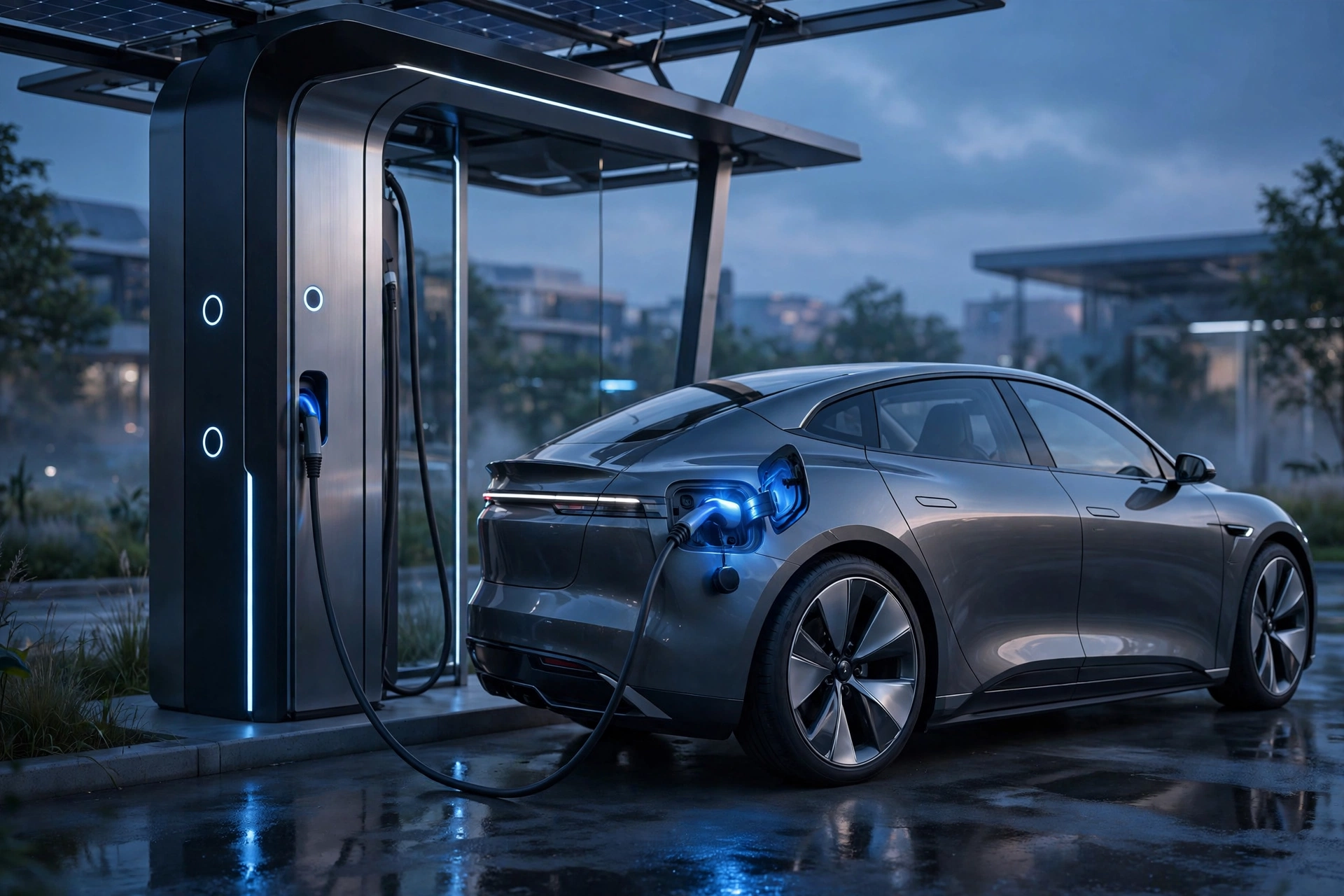
Electric vehicles have moved from niche curiosity to mainstream choice. In 2026, American drivers face more EV options, better range, expanding charging networks, and shifting incentives than ever before. Whether you are EV-curious or ready to buy, this complete guide to electric vehicles 2026 covers everything you need to know.
The State of Electric Vehicles 2026
EV adoption in America has grown dramatically, though the pace varies enormously by region. Coastal states and major metros lead, with EVs representing a substantial share of new sales in places like California. Heartland adoption lags but is accelerating as prices fall and charging spreads.
The market has matured beyond early adopters. Mainstream buyers — families needing three-row SUVs, commuters wanting low running costs, truck owners eyeing electric pickups — now find models built for them. Dozens of EV models compete across every major segment, from affordable compacts to luxury flagships.
The Real Cost: Beyond the Sticker Price
Purchase Price
EV sticker prices have fallen significantly as battery costs declined and competition intensified, making electric vehicles 2026 models more affordable than ever. Several models now price competitively with comparable gasoline vehicles before incentives — and the used EV market offers remarkable values, as early models depreciate faster than their gas counterparts.
Incentives and Tax Credits
Federal tax credits for qualifying EVs can reduce the effective price by thousands, though eligibility rules around assembly location, battery sourcing, and buyer income are complex and change periodically. Many states add their own rebates, HOV lane access, or reduced registration fees. Always verify current incentives before buying — they meaningfully change the math.
Running Costs: Where EVs Shine
Electricity costs a fraction of gasoline per mile — typically equivalent to paying $1-2 per gallon. Maintenance is dramatically lower: no oil changes, no transmission service, regenerative braking that spares brake pads, and far fewer moving parts to fail. Over a typical ownership period, total cost of ownership often favors EVs even when the purchase price is higher.
Insurance and Depreciation
Insurance can run slightly higher for EVs due to repair costs, particularly battery-related repairs. Depreciation was steep for early models but is stabilizing as the technology matures and buyers gain confidence. Research specific models — variation is wide.
Range and Charging: The Practical Reality
How Much Range Do You Actually Need?
The average American drives under 40 miles daily. Even modest-range EVs cover this several times over. Range anxiety fades quickly with experience — most owners charge at home overnight and start every day with a "full tank." Long road trips require planning but are entirely feasible on major corridors.
Buy the range you need, not the maximum available. Extra battery capacity you rarely use is money spent on weight you always carry.
Home Charging
Home charging transforms the EV experience. A standard 240V outlet (like a dryer outlet) or installed Level 2 charger replenishes overnight what most drivers use daily. Installation costs vary widely — from a few hundred dollars for simple setups to several thousand for panel upgrades. Renters should investigate workplace charging or nearby public options before committing.
Public Charging Networks
Fast-charging networks along highways now make cross-country EV travel routine, though reliability varies by network and location. Urban public charging serves apartment dwellers. Charging speeds differ enormously — from slow Level 2 to ultra-fast DC charging adding hundreds of miles in 20-30 minutes. Apps showing real-time station availability are essential road-trip tools.
Choosing the Right EV: A Buyer's Framework
- Define your use case: Daily commute distance, road-trip frequency, passenger/cargo needs, towing requirements
- Set total budget: Include purchase price minus incentives, insurance, home charging installation
- Test drive electrics specifically: Instant torque, one-pedal driving, and silence surprise first-timers — make sure you enjoy the experience
- Research reliability: EV-specific reliability data is still maturing; owner forums and independent ratings help
- Check charging at your regular destinations: Home, work, and frequent routes
Battery Life and Longevity: What the Data Shows
Early fears of rapid battery degradation proved overblown. Modern EV batteries typically retain strong capacity after 100,000+ miles, with most manufacturers warranting batteries for 8 years or 100,000 miles. Degradation is fastest in the first year or two, then levels off. Extreme heat and constant DC fast charging accelerate wear; normal mixed use does not.
Replacement costs remain high but are falling, and outright replacement is rare — most EVs will never need it within a normal ownership span.
Environmental Impact: The Honest Accounting
EVs produce zero tailpipe emissions, but honest analysis includes manufacturing (battery production is energy-intensive) and electricity sources. On America's current grid mix, EVs produce substantially lower lifetime emissions than comparable gasoline vehicles — and the advantage grows as the grid gets cleaner. In coal-heavy regions the benefit is smaller but still positive in most analyses.
Battery recycling infrastructure is scaling up, recovering valuable materials and reducing the need for new mining. Second-life applications — using retired EV batteries for grid storage — extend their useful life further.
The Road Ahead
Solid-state batteries promise major leaps in range, charging speed, and safety, though mass production timelines remain uncertain. Vehicle-to-grid technology could turn parked EVs into grid assets. Autonomous driving capabilities continue advancing, with EVs' electronic architectures well-suited to the task.
Price parity with gasoline vehicles across all segments is approaching — after which adoption dynamics shift from incentives-driven to economics-driven, likely accelerating the transition substantially.
Should You Buy an EV in 2026?
Strong yes if: You can charge at home or work, drive predictable daily distances, want minimal maintenance, and value low running costs and quiet, responsive driving.
Maybe wait if: You regularly tow heavy loads long distances, lack any charging access, need a niche vehicle type with limited electric options, or plan to keep the vehicle less than a few years (transaction costs may outweigh fuel savings).
Consider a plug-in hybrid if: You want electric daily driving with gasoline backup for long trips — the versatile middle ground many drivers overlook.
The Bottom Line
Electric vehicles in 2026 are no longer a bet on the future — they are a mature, practical choice for millions of American drivers. The technology works, the economics increasingly favor electrics, and the options have never been broader. Do your homework on your specific needs, verify current incentives, test drive with an open mind, and you may find your next car plugs in.
EV Myths Worth Busting
Myth: EVs catch fire more than gas cars. Reality: data consistently shows gasoline vehicles catch fire at higher rates per vehicle; EV fires get more attention because they are novel and harder to extinguish, not because they are more common.
Myth: Batteries need replacement every few years. Reality: modern EV batteries typically outlast the vehicle ownership period, with warranties covering 8 years or 100,000 miles and real-world degradation far slower than early fears suggested.
Myth: There is nowhere to charge. Reality: most charging happens at home overnight; public fast-charging networks now cover major travel corridors, and the network grows monthly. Check your specific routes rather than assuming.
Myth: EVs are worse for the environment because of mining. Reality: lifecycle analyses consistently show EVs produce substantially lower total emissions than comparable gas vehicles, with the advantage growing as grids clean up and recycling scales.