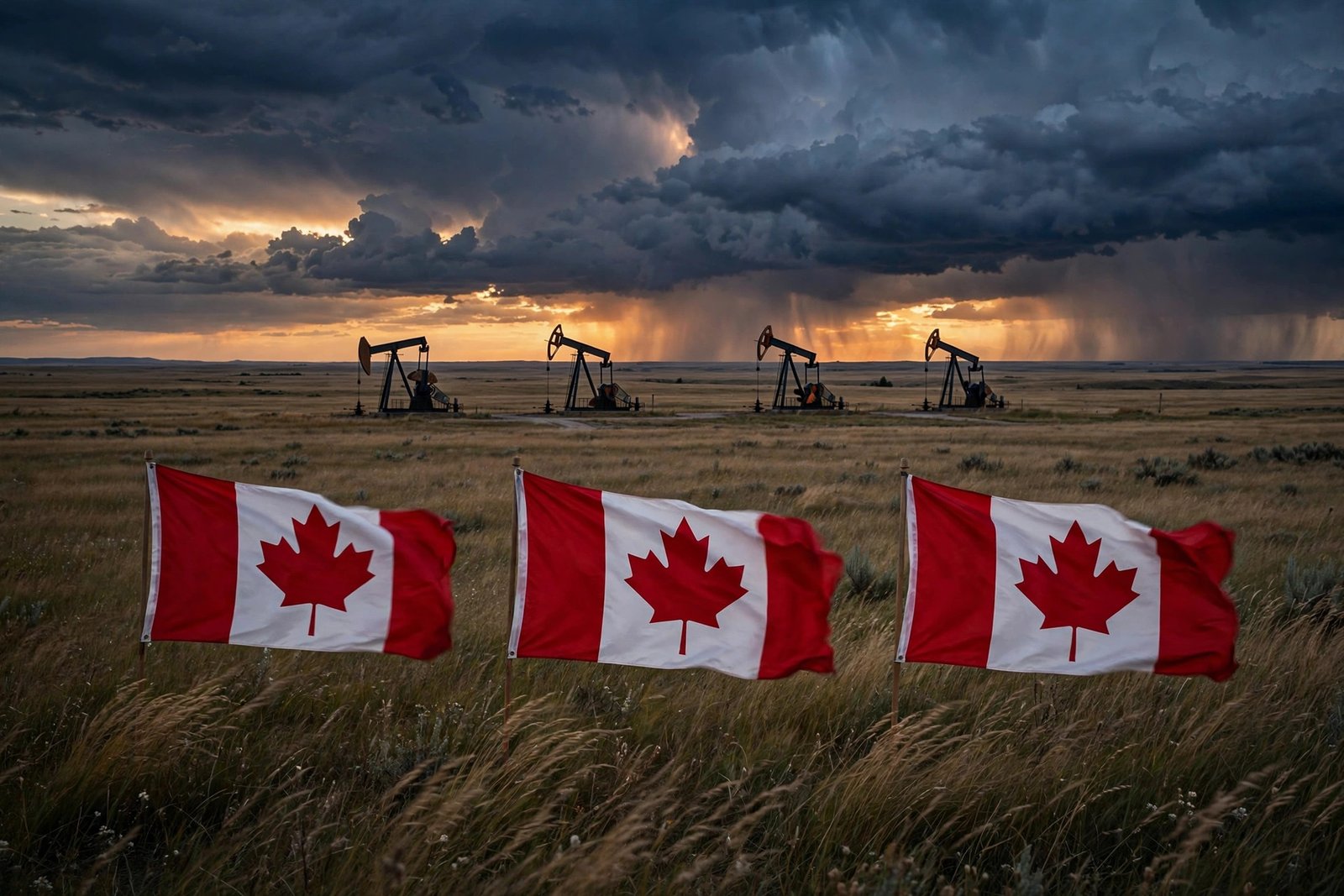
Canadian Prime Minister Mark Carney warned this week that foreign forces are trying to “break” Canada so they can “own us,” as Alberta heads toward a high-stakes Alberta referendum on Monday that could set the oil-rich province on a path toward separation. Speaking at pro-Canada rallies in Calgary and Edmonton, Carney framed the vote as a moment of national peril — not merely a protest ballot against Ottawa, but a decision that could fracture the country at what he called “the worst possible time.”
The Alberta referendum is not a direct vote on independence. Instead, Albertans will decide whether the province should remain in Canada or instruct its government to begin the legal process toward a future separation referendum. But Carney’s stark language — and the unmistakable shadow of President Donald Trump’s trade war and repeated threats to make Canada America’s 51st state — has turned Monday’s ballot into one of the most closely watched votes in North America this year.
“The world has become more dangerous and divided,” Carney told a large Forever Canadian rally in Calgary on Thursday, according to the Associated Press. “Some outside our borders are working to break us so they can own us.” Advance voting is already underway across Alberta and runs through Saturday, with the main vote set for Monday, October 19.
- What the Alberta Referendum Is Actually About
- Carney’s Warning: “Break Us So They Can Own Us”
- Trump’s Trade War and the 51st State Threats
- Why Alberta Is Different From Canada’s Past Separation Movements
- Alberta’s Oil and Why Geography Gives Washington Leverage
- Polls Show Separation Is Still a Minority View
- What’s Next
- Additional Details
What the Alberta Referendum Is Actually About
To understand the stakes of the Alberta referendum, it is important to understand what is — and is not — on the ballot. As Interbellum News reported, Monday’s vote will not determine Alberta’s independence. Voters face a threshold question: should Alberta remain a province of Canada, or should it instruct the provincial government to begin the legal process that could lead to a future, binding referendum on separation?
A “remain” vote would effectively settle the question — at least for now. A vote to begin the separation process, however, would send the province down a legal route that could take years, with no guarantee of any particular outcome. Carney urged Albertans not to treat the ballot as a pressure valve for grievances against the federal government.
“Don’t be fooled by the idea you can ‘send a message’ with your vote,” Carney told the Calgary crowd, per the AP. “This is not poker. A vote against Canada is a dangerous bluff that will lead to years of deep division and great uncertainty.”
Notably, the referendum was called by Alberta Premier Danielle Smith — but Smith herself backs staying in Canada. She cast her ballot on Wednesday for the remain option, saying that while support for separation is higher than she would like, “Canada can still work,” with reforms. That unusual dynamic — a leader calling a vote on a path she opposes — reflects how politically potent Alberta’s alienation from Ottawa has become.
Carney’s Warning: “Break Us So They Can Own Us”
Carney, who grew up in Alberta, brought his unity campaign to the province in the final days before the vote. On Thursday he addressed a Forever Canadian rally at Calgary’s BMO Centre, where his office estimated about 5,000 people attended, some waiting more than two hours to get through security. A second rally was planned for Friday in Edmonton.
The Calgary speech, covered by the Associated Press, struck an unusually dark tone for a sitting prime minister. “This referendum comes at the worst possible time,” Carney said. “The world has become more dangerous and divided. Some outside our borders are working to break us so they can own us.”
Carney did not directly name the United States or President Donald Trump in that passage, the AP noted — but he has named them in similar past speeches, and the context was unmistakable. Trump is waging an escalating trade war with Canada and has repeatedly threatened to make Canada America’s 51st state. Carney has responded by arguing that Canada needs to become more economically resilient and less dependent on the United States.
At Friday’s Edmonton rally, Carney went further, repeating the warning in even starker terms: “Open your eyes. There are some outside our borders who are working to break us, so they can own us. Never, never,” he said, again declining to identify the foreign actors by name. He also leaned into an economic message tailored to Alberta, highlighting the province’s central role in Canada’s energy sector and pointing to the Pacific Link pipeline as a key project to expand Canada’s energy exports and reduce its dependence on the United States. “Canada is building big again. Alberta is at the very heart of it,” he said.
Trump’s Trade War and the 51st State Threats
Carney’s warning cannot be separated from Washington’s posture toward Ottawa. Since returning to the White House, Trump has imposed and threatened tariffs against Canada, framed the northern neighbor as an economic problem, and floated — publicly and repeatedly — the idea that Canada should become the 51st U.S. state. The trade war has strained a relationship that is, by most measures, the deepest bilateral economic partnership on earth.
That backdrop is why the Alberta referendum is drawing outsized attention south of the border. If foreign pressure is genuinely shaping Alberta’s politics, the mechanism runs through energy and trade: the United States is Alberta’s overwhelming export market, and tariff policy set in Washington directly affects the province’s livelihood. Carney’s argument, in essence, is that a fractured Canada would be a weaker Canada — and a weaker Canada would be easier for the White House to bully.
Trump’s approach to allies has been a recurring theme of his second term. StateLineDaily has covered the administration’s hardline moves against longtime partners and institutions — from Trump’s executive order waiving most new Russia sanctions under the Graham Act to the escalating midterm election battle shaping up at home. The Canada file fits the same pattern: transactional pressure applied to a friendly neighbor, justified as protecting American interests.
Why Alberta Is Different From Canada’s Past Separation Movements
Canada has faced existential separation threats before — but they came from Quebec, and they nearly succeeded. In the 1995 Quebec independence referendum, voters rejected sovereignty by the narrowest of margins: 50.58 percent to 49.42 percent. The result was so close that Canada spent years afterward building legal guardrails, culminating in the 2000 Clarity Act, which set rules for what would count as a “clear question” and a “clear majority” in any future secession vote.
Those guardrails were built for Quebec’s French-speaking nationalism. Alberta’s grievances are different: they are economic and cultural, rooted in the province’s identity as the engine of Canadian energy production, its resentment of federal environmental and fiscal policy, and a long-running belief that Ottawa takes Alberta’s wealth while constraining its ability to develop it. Where Quebec’s movement was about language and nationhood, Alberta’s is about pipelines, taxes, and who decides what gets drilled.
That distinction matters for what comes after Monday. Quebec’s movement had decades of intellectual and political infrastructure behind it — a separatist provincial party, a federal bloc, and a coherent constitutional theory. Alberta’s separatist organizations have gained momentum, but polling still shows fewer than one-quarter of Albertans support independence. A vote to begin the legal process would be the start of a very long road, not its end — and the legal questions would be novel, because no Canadian province has ever tested the Clarity Act’s machinery against an energy-driven, rather than language-driven, separation movement.
Alberta’s Oil and Why Geography Gives Washington Leverage
Alberta sits on the world’s fourth-largest proven oil reserves — a fact that makes the province enormously wealthy and strategically indispensable, and also deeply vulnerable. Unlike Norway or Saudi Arabia, Alberta is landlocked. Nearly all of its oil flows south to American refineries through cross-border pipelines, giving Washington structural leverage over the province’s economic lifeline that no amount of patriotic rhetoric can erase.
This is the economic logic behind Carney’s Pacific Link pipeline push. If Canada can move more of Alberta’s energy to Pacific ports for export to Asia, the province’s dependence on the United States shrinks — and with it, the leverage the White House holds. “By building the Pacific Link pipeline, we are launching our full energy potential. We are reducing our dependence on the United States,” Carney said in Edmonton.
But pipelines take years to build, and the trade war is happening now. Tariff policy from Washington can bite Alberta’s producers long before any Pacific terminal comes online. That asymmetry — dependence today, independence promised tomorrow — is precisely what makes the timing of this Alberta referendum so dangerous in Carney’s telling. A province voting at the peak of its vulnerability, he argues, risks making decisions that look very different once the full costs are visible.
Polls Show Separation Is Still a Minority View
For all the drama, the available polling suggests the separation movement remains far from majority support. Fewer than one-quarter of Albertans support independence, according to polling cited in recent coverage, though separatist organizations have been gaining political momentum and the movement’s energy on social media and at rallies outpaces its ballot numbers.
That gap between enthusiasm and electoral support is familiar to watchers of insurgent political movements — and it is exactly why Carney is campaigning so hard for a decisive “remain” result. A narrow remain vote, he argued, would settle little and invite years of relitigation. A decisive one, in his framing, “could settle the separation question” for a generation.
Premier Smith’s own position complicates the picture. By calling the referendum while voting remain, she is trying to have it both ways: channeling Alberta’s discontent into a democratic outlet while positioning herself as the voice of Canadian unity. Whether voters read that as statesmanship or political theater may determine how Monday goes.
With midterm elections just weeks away in the United States, the White House will be watching Alberta too. A province choosing unity would undercut Trump’s implicit bet that America’s neighbors are falling apart; a vote for the separation path would hand him a propaganda victory he could wave as evidence that the whole continent is rethinking its arrangements.
What’s Next
When is the Alberta referendum vote?
Monday, October 19, 2026, with advance voting running through Saturday, October 17. Results are expected Monday evening.
What happens if the “remain” side wins?
A decisive remain victory would, in Carney’s words, settle the separation question — at least for now. It would also strengthen Carney’s hand politically as he pursues energy independence and trade diversification away from the United States.
What happens if the separation-process option wins?
Alberta’s government would begin the legal process toward a future referendum on separation — a years-long undertaking with uncertain constitutional terrain. Markets, investors, and pipeline planners would face years of uncertainty, which is exactly the outcome Carney is warning against.
Will the United States respond to the vote?
The White House has not commented directly on the Alberta referendum. But given Trump’s repeated 51st-state rhetoric and the ongoing trade war, any result will be read in Washington — and possibly tweeted about.
Is this the end of the story?
Not remotely. Even a remain victory leaves Alberta’s grievances intact, and the legal and political machinery the vote creates will outlast Monday’s count. Watch for Carney’s Pacific Link pipeline timeline and any tariff moves from Washington as the two tracks to follow.
Additional Details
Description: Alberta referendum 2026: Canadian PM Mark Carney warns the US is trying to “break” Canada so it can “own us” as Albertans vote Monday on whether to begin a separation process. Full details on the Calgary and Edmonton rallies, Trump’s trade war and 51st-state threats, polls, and what happens next.
The Monday vote caps an extraordinary week in Canadian politics: two national rallies by a prime minister fighting for his country’s unity, a provincial premier campaigning against her own referendum question, and a province sitting on some of the world’s largest oil reserves deciding whether to start the process of leaving the country that built its wealth. Whatever Albertans decide, the Alberta referendum will reverberate far beyond the province’s borders — in Ottawa, in Washington, and across energy markets worldwide.