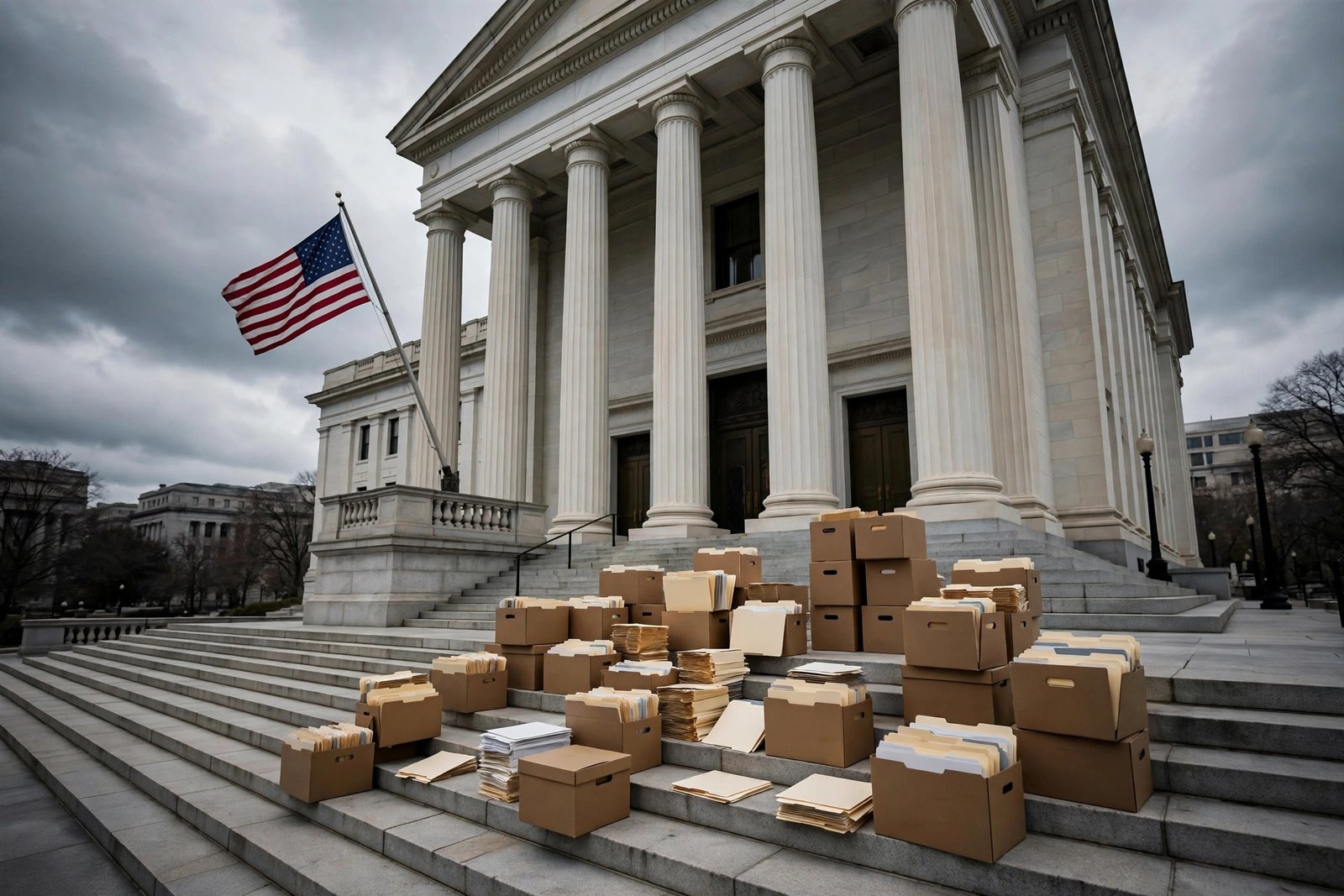
The Presidential Records Act faced its most serious legal challenge yet on Friday, October 16, 2026, as a federal appeals court in Washington heard arguments on the Trump administration’s claim that papers created in the White House belong to Donald Trump personally — not to the American people. Three judges of the U.S. Court of Appeals for the D.C. Circuit took up the case in what both sides call the boldest test yet of the post-Watergate limits on presidential power, with the conservative-leaning Supreme Court the likely final stop.
Roughly six months ago, the Justice Department moved to invalidate the Presidential Records Act of 1978, the statute that requires presidents to preserve White House records and hand them over to the National Archives when they leave office. White House spokeswoman Lauren Bis has called the act “unconstitutional and a clear violation of the separation of powers,” while conservative lawyer Michael Edney described it on a Federalist Society webinar as an overbroad post-Watergate incursion into executive branch prerogatives. Every president since 1978 has complied with the law — until this year.
The case began with an opinion from Trump’s own Office of Legal Counsel declaring the statute unconstitutional, drew a lawsuit from historians and transparency groups, and earned a rebuke from a federal judge who opened his ruling with a passage from George Orwell’s 1984. With Friday’s arguments now complete, a ruling could take weeks or months — and the losing side is widely expected to seek Supreme Court review.
- What Happened at Friday’s Hearing
- The Administration’s Claim: White House Papers Belong to Trump
- Six Months Ago: The DOJ Move to Invalidate a 48-Year-Old Law
- The Mar-a-Lago Connection: How a Dismissed Indictment Shaped This Fight
- The Judge Who Quoted Orwell: Inside the May Ruling
- Former Archivists Warn: National Security Is at Stake
- EXTRA: For 200 Years, Presidents Treated White House Papers as Their Own
- EXTRA: What the Law Actually Says — Personal vs. Presidential Records
- Why This Case Could End at the Supreme Court
- What’s Next
What Happened at Friday’s Hearing
Three judges from the U.S. Court of Appeals for the D.C. Circuit heard oral arguments on Friday in the case over the Presidential Records Act, the 1978 law that declares the nation’s presidential records the property of the United States government. Administration lawyers defended the position that papers created in the White House are the personal property of Donald Trump — a claim NPR described in its coverage as “an especially bold claim.”
The administration’s core argument, laid out in court papers, is that the Presidential Records Act is unconstitutional and that preserving every White House record imposes an unreasonable burden on the presidency — one that could chill advisers from having honest, candid conversations with the president. On the other side, watchdog groups including Citizens for Responsibility and Ethics in Washington (CREW) sued over the administration’s move. Nikhel Sus, CREW’s chief counsel, warned that if the courts accepted the administration’s position, the public would effectively lose any right of access to presidential papers — “a major loss for archivists, historians and to the American people writ large.”
The Presidential Records Act hearing lands at a politically charged moment. As StateLineDaily reported this week, President Trump’s approval rating has sunk to 36% in the latest Fox News polling, with Democrats leading the midterm generic ballot by nine points — 18 days before Election Day. And as our coverage of the BBC deposition fight detailed, the administration is simultaneously battling on multiple legal fronts over what the president must disclose and what he may keep.
The Administration’s Claim: White House Papers Belong to Trump
The central claim is sweeping: if the Presidential Records Act falls, everything created inside the White House — memos, emails, briefing books, diplomatic notes — would become the personal property of the man sitting behind the Resolute Desk, not the public property of the nation that elected him.
Conservative lawyer Michael Edney, who served on the National Security Council and at the Justice Department under President George W. Bush, has been one of the most prominent outside voices defending the move. In a Federalist Society webinar, Edney called the Presidential Records Act “a post-Watergate, overbroad statutory incursion into the prerogatives of the executive branch” — part of a pattern of 1970s-era laws that went too far in restraining the presidency. He has said Congress could “probably” pass a more thoughtful preservation statute, but that parts of the current law — including provisions giving Congress automatic access and presuming eventual public disclosure — are “constitutionally problematic.”
Edney has also questioned whether the watchdog groups suing even have legal standing, a threshold issue that could end the fight before the merits are decided. But the administration appears to have breezed past those concerns, because, as Edney put it, the White House has a higher goal: “They want this to go to the Supreme Court.” The administration wants the question resolved “at a time of their choosing, with arguments of their choosing, and a court of their choosing, and with the Solicitor General’s office that’s making their arguments, as opposed to a subsequent administration.”
Six Months Ago: The DOJ Move to Invalidate a 48-Year-Old Law
The fight did not begin in a courtroom. It began inside the Justice Department, roughly six months ago, when Trump’s Office of Legal Counsel — the DOJ office that gives legal advice to the executive branch — concluded that the Presidential Records Act was unconstitutional. Legal analysts called the OLC memo an audacious move, not least because it appeared to brush aside Supreme Court precedent supporting Congress’s power to regulate the preservation of presidential records.
The guidance was also narrower than the law it attacked: it addressed only the preservation of email and text messages, rather than the full range of electronic records the Presidential Records Act covers. The response was swift. The American Historical Association and the transparency group American Oversight filed suit, warning that presidential records their researchers intend to use “will be irretrievably lost” if the courts did not intervene.
A federal judge then ordered White House staff to preserve their official records while the case played out — but declined to impose restrictions directly on the president, the vice president, the National Archives, or the archivist. That half-step left the core constitutional question over the Presidential Records Act for the appeals court that heard arguments on Friday.
The Mar-a-Lago Connection: How a Dismissed Indictment Shaped This Fight
To understand why the administration is fighting so hard over who owns the president’s papers, look back at the case that nearly put Donald Trump in a federal courtroom: the classified documents indictment. After leaving the White House in 2021, Trump took boxes of presidential records — including highly classified documents — to his Mar-a-Lago resort, where investigators later found them in a bathroom, a ballroom, and an office. He was indicted on obstruction of justice charges for allegedly stockpiling and concealing the materials. A federal judge threw the case out on technical grounds related to the appointment of the prosecutor, and after Trump won reelection, the Justice Department dropped it entirely.
That prosecution grew, in part, out of the chain of events the Presidential Records Act set in motion: the National Archives knew documents were missing, asked for them back, and the paper trail led to the FBI search of Mar-a-Lago. Without the Presidential Records Act‘s preservation-and-transfer requirements, the Archives would have had no legal basis to demand anything. Critics argue the current push to invalidate the law is an attempt to make sure a case like that can never be built again; the administration insists the law was always an unconstitutional overreach and that Mar-a-Lago simply shows why a post-Watergate statute needed revisiting.
The Judge Who Quoted Orwell: Inside the May Ruling
In May, Senior U.S. District Judge John Bates, an appointee of former President George W. Bush, ruled against the Trump White House, concluding that the Presidential Records Act was likely constitutional. Bates opened his opinion with one of the most famous lines in political literature, from Orwell’s dystopian novel 1984: “Who controls the past controls the future; who controls the present controls the past.” It was an unmistakable signal that he saw the stakes as a question of who gets to write history — not an administrative paperwork dispute.
The ruling ordered White House staff to preserve their official records while the lawsuit proceeds, though Bates declined to restrict the president, the vice president, or the Archives directly. The Justice Department appealed to the D.C. Circuit — and Friday’s arguments were the result. That a judge appointed by a Republican president ruled the Presidential Records Act “likely constitutional” is a data point both sides will lean on going forward.
Former Archivists Warn: National Security Is at Stake
Some of the most forceful voices in this fight are the people who actually ran the National Archives. Six former archivists — covering every living person to have previously held the role, spanning Republican and Democratic administrations — filed an amicus brief urging the appeals court to reject the administration’s effort to invalidate the Presidential Records Act, warning that ignoring the Presidential Records Act jeopardizes national security and the continuity of government.
Their argument is practical. In their experience, the most frequent requesters of preserved presidential records are the incoming president’s own national security advisers. “Preserving presidential records ensures that new leaders can have immediate and ongoing access to the data, strategy, and rationale behind past policy decisions,” the group said. Their brief warned that “geopolitical tensions do not pause for an inauguration” — and that without the records, new officials cannot evaluate active threats or make informed decisions during global crises.
John Bellinger, who served as legal adviser to the National Security Council under George W. Bush, told NPR that access to former presidents’ national-security records is “really vital for the continuity of our government,” adding that “often the only record of what a president has said to a foreign leader… is in a written document.” Without those papers, he warned, future presidents would be at a “terrible disadvantage.”
The administration has rebuffed the alarm, insisting the “lion’s share” of records is being preserved through work on official devices. The archivists are not persuaded: they say the act “helps to bridge the gap between the outgoing and incoming administrations,” and that ignoring the Presidential Records Act puts that bridge at risk.
EXTRA: For 200 Years, Presidents Treated White House Papers as Their Own
Here is the context most Friday coverage glossed over: the Presidential Records Act did not invent government ownership of presidential papers out of thin air — it ended a practice stretching back to George Washington. For roughly two centuries, presidents treated the papers they created in office as personal property. They took them home, donated them to private libraries, burned them, or locked them away at their own discretion. It was simply how things were done.
The break came with Richard Nixon. After Watergate, Nixon claimed his papers and tapes were his private property and tried to take them with him when he resigned. Congress, alarmed at the prospect of the most scandal-ridden presidential archive in history being spirited to a private compound, passed the Presidential Recordings and Materials Preservation Act of 1974, declaring Nixon’s materials federal property. Nixon challenged that seizure — and in Nixon v. Administrator of General Services (1977), the Supreme Court upheld it, a precedent the current OLC memo has been accused of ignoring.
Four years later, Congress went further. On November 4, 1978, President Jimmy Carter signed the Presidential Records Act, declaring presidential records the property of the United States government. The law took effect at Ronald Reagan’s inauguration, making Reagan’s the first covered presidency; Ford and Carter were the last presidents permitted to keep their own records. Carter, notably, invited federal archivists to help organize his White House records for his presidential library in Georgia even though the law did not apply to him.
That history is why the administration’s claim lands so oddly: for 200 years, “these papers are mine” was simply the custom — and the 1978 act was Congress’s deliberate decision to end that custom forever. What the White House now calls “unconstitutional” — the Presidential Records Act — was a bipartisan response to a president who used personal ownership of the record as a shield against accountability. Every president from Reagan through Biden complied without challenging the law’s constitutionality — until this year.
EXTRA: What the Law Actually Says — Personal vs. Presidential Records
A second detail competitors have largely missed: the Presidential Records Act already draws the exact line the administration says the law erases. The statute does not claim every scrap of paper a president touches. It carefully distinguishes between “presidential records” and “personal records” — and treats them completely differently.
Under the Presidential Records Act, presidential records are documentary materials created or received by the president, his immediate staff, or units of the Executive Office of the President that advise and assist him, in the course of conducting official duties. Those records must be preserved and transfer to the National Archives when the administration ends. Personal records — explicitly excluded — are materials “of a purely private or non-public character” with no bearing on official duties: diaries and journals, materials relating exclusively to the president’s own election campaign with no connection to official duties, and materials about private political associations. Those are not subject to the act’s retention or access requirements at all.
That distinction matters for the “chilling” argument. The administration says the law chills honest advice; defenders answer that the Presidential Records Act was written with carve-outs for the genuinely personal and political — and that nearly five decades of presidents got candid advice while complying. It also matters for readers: the act does not give Americans access to a president’s diary. It gives them access, eventually, to the record of what their government actually did.
Why This Case Could End at the Supreme Court
Several factors make Supreme Court review likely. The question is pure constitutional law — whether the Presidential Records Act can survive a separation-of-powers challenge — and the extent of congressional authority over the executive branch. The dispute implicates precedent directly: Nixon v. Administrator of General Services (1977) upheld Congress’s power to regulate presidential record preservation. And the stakes are enormous either way: an administration win would dismantle the records regime that governed six presidencies; a challengers’ win would rebuke one of the boldest executive-power claims of the second Trump term.
The court’s conservative leaning is part of the administration’s calculus. But the lower-court ruling came from a judge appointed by a Republican president, and the amicus brief defending the Presidential Records Act came from archivists who served under both parties. The case does not split neatly along partisan lines — which is why the eventual reasoning will matter as much as the outcome. As StateLineDaily’s coverage of the election-office threats has shown, Washington is bracing for a consequential final 18 days before the midterms — and this case will still be alive long after the votes are counted.
What’s Next
When will the appeals court rule?
The D.C. Circuit typically issues written opinions weeks or months after oral arguments. There is no fixed deadline, and complex separation-of-powers cases often take longer.
Will the losing side appeal?
Almost certainly. The administration has signaled it wants the Presidential Records Act case at the Supreme Court, and the watchdog groups have too much invested to walk away. Expect a petition for certiorari if the D.C. Circuit rules against the White House — and possibly an en banc rehearing request first.
What happens to White House records in the meantime?
Judge Bates’s order requiring White House staff to preserve official records under the Presidential Records Act remains in effect. The administration says the “lion’s share” of records is being kept through official devices; the archivists and historians remain skeptical.
Could Congress moot the case?
In theory, Congress could pass a new, narrower preservation statute — Edney himself has said a “thoughtful” replacement for the Presidential Records Act might pass muster. In practice, with 18 days until the midterms, new legislation is a long shot.
Does this affect the midterms?
Indirectly. The case feeds the broader executive-power narrative voters are weighing — alongside the economy, the September inflation data, and the generic-ballot polling — but no ruling is expected before November 3.
Additional Details
Description: On October 16, 2026, the U.S. Court of Appeals for the D.C. Circuit heard oral arguments on the Trump administration’s bid to invalidate the Presidential Records Act of 1978, claiming White House papers belong to Donald Trump personally rather than the American people. This article covers the hearing, the administration’s separation-of-powers argument, the DOJ Office of Legal Counsel memo, the Mar-a-Lago classified documents connection, Judge John Bates’s May ruling quoting Orwell’s 1984, the amicus brief from six former National Archives leaders, the 200-year history of presidential papers from Washington to Nixon, and why the case is headed for the Supreme Court.