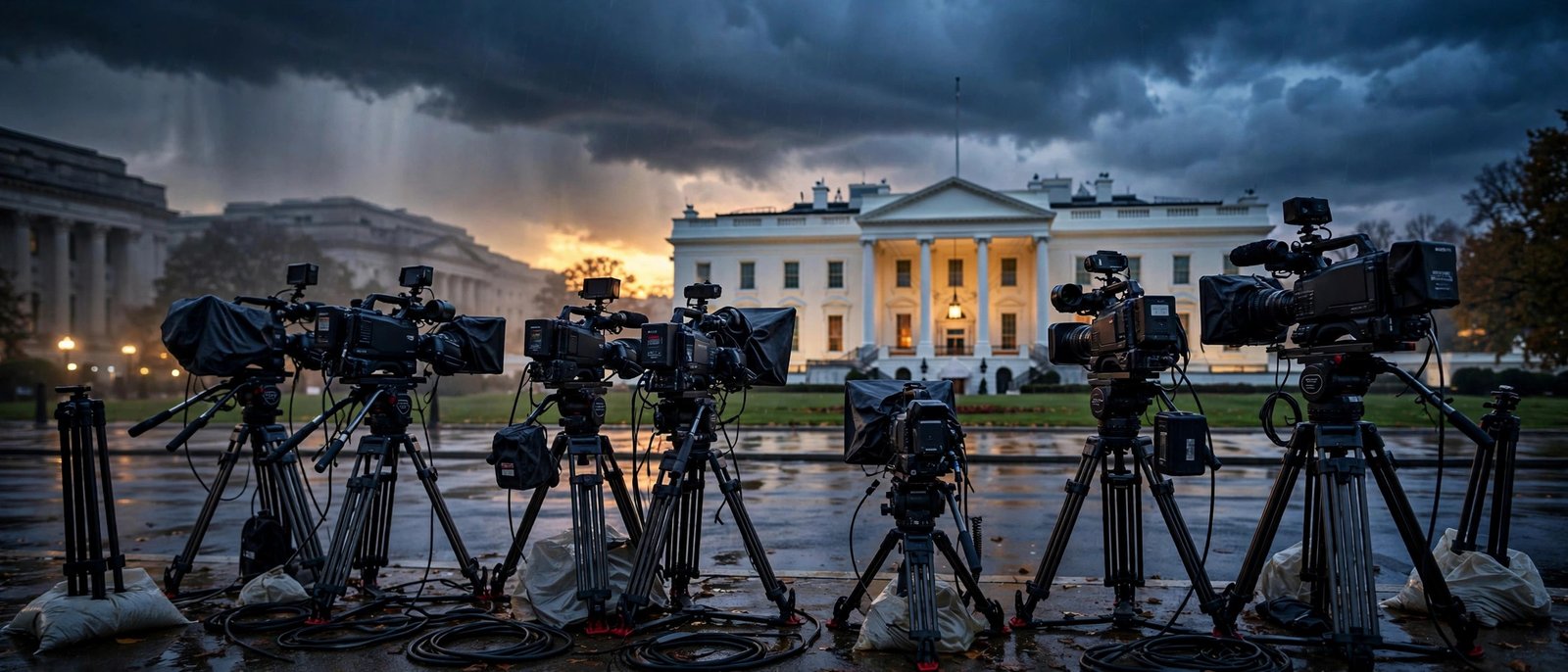
The Justice Department is turning its antitrust firepower on the news business itself. The DOJ investigates networks ABC, CBS, CNN, Fox News and NBC over their decision to temporarily suspend shared White House press pool duties last month, an extraordinary escalation of the Trump administration’s confrontation with the media that press-freedom advocates are calling intimidation dressed up as law enforcement.
Civil investigative demands — the Justice Department’s formal tool for prying open evidence in antitrust probes — were sent to the five networks on Friday, October 9, according to the department. The news became public on October 18, when OK Magazine first reported the investigation, citing the department. The probe accuses the networks of an antitrust “group boycott” after they stood together against the Trump administration’s removal of CNN from the White House press pool.
All five of the networks under investigation are commercial competitors. But the thing they did together was refuse to help a president punish a rival newsroom for its coverage. That is the line at the heart of this fight: the government says it is policing competition; the journalists say they were defending the First Amendment.
- DOJ Investigates Networks in Antitrust Probe Over Press Pool Halt
- Why the DOJ Investigates Networks: The ‘Group Boycott’ Allegation
- The Press Pool Dispute: How CNN’s Removal Sparked the Boycott
- The Networks’ Joint Statement and First Amendment Defense
- The CNN Lawsuit and the Judge’s Temporary Ruling
- What Competitors Missed: The AP ‘Gulf of America’ Fight That Set the Stage
- The Sherman Act Has Almost Never Been Turned on Newsrooms
- Press Advocates Say the Probe Is Intimidation
- What’s Next
- Additional Details
DOJ Investigates Networks in Antitrust Probe Over Press Pool Halt
Five of America’s largest television networks are facing a federal antitrust investigation after standing together against the Trump administration’s exclusion of CNN from the White House press pool. The Justice Department confirmed the investigation is underway and said the television pool members “boycotted covering White House events,” according to the department’s own account reported on October 18.
The television pool is the rotating system in which the five networks take turns recording a president’s public appearances and travel. The network on duty captures the video and audio and distributes it to all the other news organizations, allowing broad coverage in situations where space or security restrictions prevent every outlet from being present. The networks also rotate the costs of that coverage. It is, in practical terms, the plumbing of presidential coverage — invisible when it works, crippling when it stops.
The DOJ is now examining whether that system was weaponized against the White House. But the networks’ side of the story reframes the action entirely: they did not boycott the White House, they say — they declined to take over CNN’s duties after the administration removed CNN from its scheduled place in the rotation.
As NBC News reported, the individual networks continued covering White House events that were open to the wider press while they declined to participate in the shared pool arrangement. In other words, the boycott was targeted and narrow: no network would step into the slot the administration had stripped from a competitor. Coverage of open events never stopped. Pool coverage — the part the White House controls — has since resumed.
Why the DOJ Investigates Networks: The ‘Group Boycott’ Allegation
The department’s case rests on a loaded phrase from antitrust law: “group boycott.” Justice Department spokesperson Emily Covington put it bluntly: “Group boycotts among commercial competitors can violate the Sherman Act. The Antitrust Division is simply investigating to determine whether these news organizations have violated the antitrust laws.”
The Sherman Act of 1890 is the granddaddy of American competition law, aimed at monopolies, price-fixing and conspiracies in restraint of trade. A “group boycott” — where competitors act together to exclude someone from a market — is one of the classic violations. But applying that framework to a press-pool protest is almost unheard of, because the networks were not trying to fix prices or corner a market. They were making an editorial and solidarity decision about how to cover the presidency.
That novelty is what makes the probe so volatile. The DOJ is, in effect, arguing that the five networks are competitors who colluded to punish the White House. The networks’ defenders argue the exact opposite: that the White House punished a competitor — CNN — for its reporting, and the other networks refused to become instruments of that punishment. Under the First Amendment, editorial decisions about coverage are protected speech, not commercial conduct subject to antitrust enforcement.
Civil investigative demands are no small matter. They are the civil equivalent of subpoenas, and they can compel companies to turn over internal documents and answer written questions. For news organizations, that raises an immediate specter: internal editorial communications, potentially including reporter-source-adjacent material, sitting in a Justice Department file.
The Press Pool Dispute: How CNN’s Removal Sparked the Boycott
The dispute began with a ban. On September 18, 2026, President Donald Trump announced in a social media post that he was barring reporters from three major media outlets — CNN, MS NOW and Politico — from the White House, because he views their coverage as “FAKE NEWS,” as USA Today reported at the time.
Trump later said there wasn’t a specific incident or story that prompted the ban. “It’s really just cumulative stories over the last few years. You get sick of it,” he said, per USA Today. His Truth Social post was blunter: “Media outlets shouldn’t be able to constantly write or report FICTION and LIES when they’re covering the president of the United States.” He added that “I don’t have to let them into my, into the people’s house” — and that the bans could be lifted if the outlets “straighten out.”
The ban was not merely symbolic. Reporters’ badges were deactivated and journalists were turned away from the White House grounds, according to multiple reports. When CNN was subsequently removed from its scheduled place in the television rotation, the other four networks — plus CNN itself — briefly declined to assume its duties. The refusal was the trigger for everything that followed.
The pool system has operated under administrations from both parties for decades, and its material reaches far beyond the five networks themselves — including subscribers like C-SPAN and domestic and international outlets that depend on the shared feed. Breaking that system, even briefly, left a practical gap in shared footage of presidential events, including Trump’s United Nations General Assembly trip in September 2026.
The Networks’ Joint Statement and First Amendment Defense
The five networks did not act quietly. They issued a joint statement that drew the constitutional line explicitly: “The public has a vital interest in receiving accurate, independent information about its government. No administration should restrict a news organization because it objects to its reporting.”
That framing matters because it is the core of the legal defense taking shape. The networks are not arguing that they coordinated to extract better commercial terms from the White House. They are arguing that they made a collective editorial decision not to participate in a system the administration had turned into a punishment mechanism. Under First Amendment doctrine, courts have repeatedly held that once the White House provides access to journalists, it cannot deny that access arbitrarily or based on the content of their reporting.
White House Correspondents’ Association president Jacqui Heinrich — herself a Fox News senior White House correspondent — reinforced the point when the ban was announced, saying revoking reporters’ White House access violates the First Amendment: “A standard used to exclude one news outlet because of its coverage could be applied to any outlet in the future.”
The irony of the lineup is hard to miss. Fox News, often the administration’s most sympathetic network, stood in the same joint statement as CNN, and now faces the same DOJ demands. The investigation does not distinguish between friendly and unfriendly outlets — it treats all five as co-conspirators.
The CNN Lawsuit and the Judge’s Temporary Ruling
CNN, MS NOW and Politico did not take the ban lying down. The three outlets sued, alleging the ban violated the First Amendment. A judge temporarily restored their access for 14 days and later extended that protection, according to the October 18 report.
The legal landscape, as USA Today noted, is uncertain. During Trump’s first term, the White House pulled the press credentials of CNN correspondent Jim Acosta in 2018, complaining that he refused to yield the microphone at a press conference. A federal judge appointed by Trump himself later forced the White House to restore the pass, saying Acosta hadn’t been given a proper chance to defend himself.
The September 2026 ban is broader than the Acosta episode because the White House named entire organizations rather than excluding one reporter from one event. It is also broader than the Associated Press dispute that began in early 2025 — which centered on particular presidential spaces and pool access rather than a stated ban on an organization’s journalists from the entire White House grounds.
Even Trump acknowledged the legal vulnerability. Asked what made him think his ban would survive in court, he said: “Depends on the judge you get, to be honest with you. I don’t think a court should allow fake news to be written day after day after day.”
What Competitors Missed: The AP ‘Gulf of America’ Fight That Set the Stage
Most coverage of the DOJ probe treats the press-pool fight as a September story. It isn’t. It is the third act of a campaign that began almost immediately after Trump returned to the White House in January 2025 — and understanding that timeline changes what the antitrust probe really looks like.
Act one came in early 2025, when the White House blocked the Associated Press from the Oval Office, the East Room and the press pool that sometimes travels with the president. The offense: the AP declined to change its style for describing the gulf bordering the U.S. and Mexico from the “Gulf of Mexico” to the “Gulf of America,” the name Trump had ordered onto official maps. The AP sued, arguing the penalty targeted editorial speech. One federal trial judge appointed by Trump temporarily blocked the ban — but two appeals court judges, also appointed by Trump, reversed that decision in a 2-1 ruling on the three-judge panel. The case is still being litigated.
Act two was the 2025 pool overhaul itself. The White House moved to replace the WHCA-run rotation with government-selected outlets, welcoming nontraditional conservative-leaning commentators into the briefing room and Oval Office. Critics warned that when the government picks the rotation, it can favor friendlier questions and sideline adversarial coverage — exactly the concern the WHCA, then led by CBS News senior correspondent Weijia Jiang, raised when the CNN ban landed.
Act three is now: banning three outlets outright in September 2026, then using antitrust law against the five networks that refused to normalize it. What the DOJ frames as a boycott, the timeline reframes as resistance to a year-and-a-half-long restructuring of who gets to cover the presidency. Competitors covering the probe as a discrete “group boycott” story are missing the escalation pattern — and that pattern is what press-freedom groups are reacting to.
The Sherman Act Has Almost Never Been Turned on Newsrooms
Here is the second thing most coverage is glossing over: the legal theory the DOJ is testing is nearly unprecedented. The Sherman Act was built for railroad barons, oil trusts and price-fixing cartels. Its “group boycott” doctrine has been aimed at car dealers, sports leagues and professional associations — commercial actors withholding commerce to hurt a rival.
Newsrooms have almost always been protected from this line of attack for a simple reason: their product is speech. When newspapers in the same city agreed to standardize advertising rates or coordinate distribution, courts could treat that as commercial conduct. But when editors make joint decisions about coverage — who to cover, how to cover, whether to participate in a government-managed pool — that is editorial judgment, and the First Amendment has consistently insulated it.
The DOJ’s argument would require a court to treat the networks’ refusal as a conspiracy to restrain trade in presidential news coverage — a “market” in which the government is simultaneously the biggest newsmaker, the gatekeeper of access, and now the antitrust enforcer. That tangle of roles is precisely what First Amendment doctrine warns against: the state deciding which editorial choices are lawful and which are conspiracies.
Reporters Committee for Freedom of the Press president Bruce D. Brown put the constitutional point directly, saying the First Amendment protects editorial coverage decisions — and calling the investigation “another and even more brazen attempt to try to intimidate journalists.” If the DOJ’s theory ever reached a judge, it would force an extraordinary question: can the government that expelled CNN from the White House grounds then prosecute CNN’s rivals for refusing to fill the vacancy?
Press Advocates Say the Probe Is Intimidation
The press-freedom world has not waited for a court date to render its verdict. Jose Zamora, the Committee to Protect Journalists’ regional director for the Americas, wrote on X: “The government should not use antitrust investigations to intimidate news outlets defending press access. The public’s right to know depends on that access.”
That “intimidation” framing is the consensus across the advocacy community, and it connects to a wider pattern this election season. The same Justice Department that is investigating five networks for a pool boycott has also, as StateLineDaily reported, announced plans to deploy 1,000 federal poll monitors nationwide for the November 3 midterms — a move the NAACP is suing to block, warning of voter intimidation. The through line, critics say, is a DOJ being deployed as an instrument of pressure: against newsrooms in Washington and against voters in the states.
With the midterms just 16 days away on November 3 — and polls, as StateLineDaily’s forecast analysis detailed, pointing to a Democratic House wave — the stakes of who gets to cover the final stretch of the campaign could not be higher. Every rally, every gaffe, every concession-or-not speech runs through the pool. A legal war over the pool is, functionally, a war over the visual record of the election’s endgame.
What’s Next
Will the DOJ file an actual antitrust case against the networks?
A civil investigative demand is an investigation, not a lawsuit. The Antitrust Division will review whatever the networks turn over and decide whether to bring a case. But winning a group-boycott claim against news organizations acting on editorial solidarity — with the First Amendment on the other side — is a steep climb. The more likely outcome, critics argue, is the process itself: months of document demands that chill editorial independence regardless of the legal result.
Could the networks refuse the CIDs?
They could challenge them in court, arguing the demands target protected editorial activity. A First Amendment challenge to a DOJ civil investigative demand from major news organizations would itself be a landmark press-freedom fight — one that could define the limits of antitrust enforcement against the media for a generation.
What happens to CNN, MS NOW and Politico’s lawsuit?
Their access has been temporarily restored by the court and extended, but the underlying First Amendment case continues. If they win a final ruling that the ban was unconstitutional, it would undercut the entire premise of the DOJ probe — you cannot run a “group boycott” of a pool rotation the government had no lawful right to strip in the first place.
Is the press pool system itself at risk?
Yes — and that may be the point. The decades-old rotation only works if participants trust it is neutral. An administration that can remove outlets from the rotation at will, then summon the Justice Department when others object, has converted a shared utility into a loyalty test. Whatever the courts decide, the institutional damage is already done: every future pool decision will now be made in the shadow of a federal investigation.
Additional Details
Headline: DOJ Investigates ABC, CBS, CNN, Fox News and NBC Over White House Press Pool Halt: Antitrust ‘Group Boycott’ Probe
Focus keyword: DOJ investigates networks
Slug: doj-investigates-networks-white-house-press-pool-halt
SEO title: DOJ Investigates ABC, CBS, CNN, Fox News and NBC Over White House Press Pool Halt
Meta description: The DOJ investigates networks ABC, CBS, CNN, Fox News and NBC over their White House press pool halt. Inside the antitrust ‘group boycott’ probe, the CNN ban that sparked it, and the First Amendment fight now headed to court.
Category: Politics
Tags: DOJ, White House press pool, CNN, ABC, CBS, NBC, Fox News, First Amendment, Trump administration, press freedom, antitrust
Description: The Justice Department has opened an antitrust investigation of ABC, CBS, CNN, Fox News and NBC over their temporary suspension of shared White House press pool duties after President Trump’s September 18, 2026 ban of CNN, MS NOW and Politico from White House grounds. Civil investigative demands were sent October 9, and the DOJ calls the move a ‘group boycott’ under the Sherman Act — while press-freedom advocates call it intimidation, and the networks defend their joint statement as protected First Amendment editorial judgment.
Published: October 18, 2026