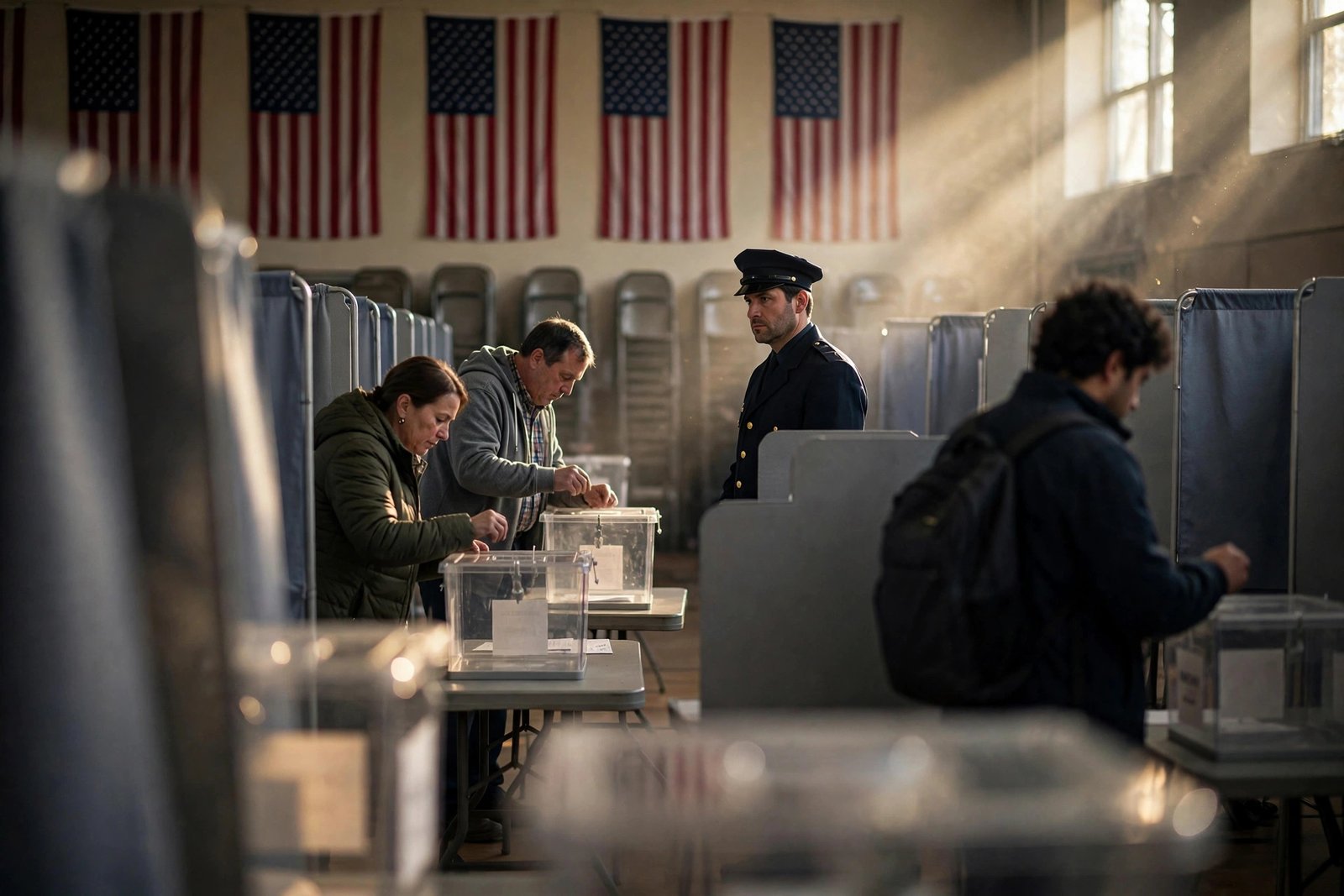
The NAACP poll monitors lawsuit has turned the 2026 midterms into a courtroom battle over who gets to watch Americans vote — and why. On Friday, October 16, 2026, the nation’s oldest civil rights organization sued the Department of Justice in federal court, asking a judge to block the Trump administration from deploying 1,000 federal poll monitors to voting sites across the country ahead of the November 3 midterms.
The complaint, filed in the U.S. District Court for the District of Columbia, does not challenge poll monitoring as a concept. It argues that this particular plan — 1,000 monitors dispatched with what the NAACP calls an explicit mission to root out voter fraud — is a pretext for intimidation. “There is no federal statute that gives Defendants the authority to turn polling places into interrogation rooms,” the NAACP wrote, as Democracy Docket reported.
The lawsuit asks the court to block the deployment under the Voting Rights Act’s anti-intimidation protections and demands that the Justice Department hand over a complete list of the jurisdictions it plans to target. With early voting already underway and just 16 days until Election Day, the case sets up a fast-moving legal fight over the physical atmosphere of American polling places — and over whether federal power will be used to protect voters or to pressure them.
- The NAACP Poll Monitors Lawsuit Lands in DC Federal Court
- “Interrogation Rooms”: The NAACP Poll Monitors Lawsuit’s Core Accusation
- The “Root Out Fraud” Mission: Key Evidence in the NAACP Poll Monitors Lawsuit
- Wyoming’s Warning: A Republican Governor Called the Monitors “Aggressive and Irregular”
- The 35-Year Consent Decree That Once Restrained Poll Monitoring
- Section 11(b): The Legal Engine of the NAACP Poll Monitors Lawsuit
- The Joyce Vance Warning: “Groundwork for Another Stolen Election Claim”
- 16 Days to November 3: Why This Fight Hits During Early Voting
- What’s Next
The NAACP Poll Monitors Lawsuit Lands in DC Federal Court
The NAACP poll monitors lawsuit was filed Friday in the U.S. District Court for the District of Columbia, seeking to stop the Trump administration’s plan to send 1,000 poll monitors to voting sites nationwide during the midterm elections, according to Democracy Docket.
The scale is what makes this case different. While the DOJ has historically operated smaller poll monitoring programs, the NAACP argues the Trump administration is using poll monitoring as a pretext to intimidate and potentially disenfranchise eligible voters — and to harass election workers — in pursuit of the president’s unsupported allegations of widespread voter fraud.
That distinction is the legal core of the case. The NAACP is not asking the court to outlaw federal election observation. Its complaint draws a sharp line between the Justice Department’s traditional role — sending “carefully trained” observers to polling locations to ensure election workers complied with federal voting laws — and what it says the administration is planning now: monitors dispatched not to protect voters, but to hunt for fraud. “A limited, hands-off election monitoring effort is not what the Justice Department is planning this year,” the NAACP said.
The lawsuit also demands the complete list of jurisdictions targeted for monitoring — a transparency demand that goes to the heart of the case. If the government will not say where its monitors are going, the NAACP argues, voters cannot assess whether the deployment is aimed at particular communities. Read StateLineDaily’s full timeline of 2026 midterm predictions here for the polling context that makes every one of these fights so consequential.
“Interrogation Rooms”: The NAACP Poll Monitors Lawsuit’s Core Accusation
The NAACP poll monitors lawsuit is built around a single, vivid accusation: that the administration is converting a civil rights protection into a law-enforcement dragnet. “There is no federal statute that gives Defendants the authority to turn polling places into interrogation rooms,” the complaint states — a line the NAACP clearly intends to define the public debate as much as the legal one.
The legal vehicle is Section 11(b) of the Voting Rights Act, the provision meant to prevent voter intimidation, which the NAACP is using to ask a federal judge to block the plan outright. Carmen Daugherty, executive director of the civil rights nonprofit Advancement Project, whose lawyers are involved in the case, put the historical stakes in stark terms: “The Voting Rights Act exists to protect voters from exactly this kind of intimidation, including by the DOJ,” Daugherty said. “Generations of Black and brown voters faced down sheriffs and poll taxes to cast a ballot, so we know intimidation when we see it.”
NAACP General Counsel Kristen Clarke was blunter still: “Voter intimidation has no place in our democracy. This Justice Department is abusing its power and authority by deploying ‘monitors’ to discourage people from voting and to disrupt the election process.” Before joining the NAACP, Clarke served for nearly four years as the nation’s top civil rights lawyer inside the very Justice Department she is now suing, as DCReport noted.
The “Root Out Fraud” Mission: Key Evidence in the NAACP Poll Monitors Lawsuit
Much of the NAACP poll monitors lawsuit’s evidence comes from the administration’s own mouth. The complaint extensively quotes public statements by Assistant Attorney General Harmeet Dhillon — who leads the Civil Rights Division — and Attorney General Todd Blanche, both of whom have said publicly that they want to send the 1,000 monitors to voting sites across the country with an explicit mission to root out voter fraud.
That framing is the government’s central vulnerability. Traditional DOJ election monitoring has always been pitched as neutral observation: watching whether local officials comply with federal voting-rights law. A deployment whose stated purpose is hunting for fraud, built on the president’s repeated and unsupported claims of widespread cheating, is something else entirely, the lawsuit argues — and the mission statement itself becomes the evidence of improper motive.
The administration has defended its actions as lawful and necessary, and has rejected reports that it plans to send Immigration and Customs Enforcement officers to monitor polls in November, according to DCReport. But the NAACP was not reassured: it was one of nine civil rights and labor groups that preemptively sued, arguing that the Voting Rights Act’s Section 11(b) “squarely prohibit[s]” this type of voter intimidation. “We can’t afford to sit back and wait until Election Day to see whether ICE will comply with the Constitution and federal law,” Clarke said.
Wyoming’s Warning: A Republican Governor Called the Monitors “Aggressive and Irregular”
The NAACP poll monitors lawsuit does not rely only on the administration’s words. It points to a real-world preview of what federal monitors have already done in 2026 — and the warning comes from a Republican. Wyoming Governor Mark Gordon blasted the behavior of federal poll monitors during his state’s primary election this year, describing their conduct as “aggressive” and “irregular,” according to the complaint.
That a Republican governor in one of the reddest states in the country publicly criticized the monitors is the detail the NAACP is using to argue this is not a partisan grievance — it is a documented problem. The Wyoming primary was, in effect, a test run of the administration’s approach to federal election presence in 2026, and the state’s own Republican chief executive said the conduct was outside the bounds of what federal monitors are supposed to do.
This is not the NAACP’s first legal clash with the Justice Department over the monitors. The group previously sued the Trump administration for records about the deployment plan, filing a Freedom of Information Act lawsuit on October 2 after the department ignored a September 1 FOIA request seeking records on the legal authority, locations, training, personnel qualifications and state consent related to the monitors, as ChitaChatter reported. That transparency fight is still moving: the DOJ filed its opposition to the NAACP’s motion for a temporary restraining order on October 13, and the group is pressing for expedited production before November 3, according to Democracy Docket’s case tracker. Friday’s new lawsuit is the escalation — from demanding to see the plan to demanding the plan be killed.
The 35-Year Consent Decree That Once Restrained Poll Monitoring
Here is the historical context most coverage of the NAACP poll monitors lawsuit is missing — and it explains why this fight has such deep roots. For 35 years, one of America’s two major political parties was under a federal court order that specifically restrained how it could conduct poll monitoring.
In 1982, the Democratic National Committee sued the Republican National Committee over the RNC’s “ballot security” operations during New Jersey’s 1981 gubernatorial election — operations that included armed, off-duty law enforcement officers stationed at polling places in predominantly Black and Latino precincts, and mass mailings designed to purge voter rolls. The resulting consent decree barred the RNC from engaging in ballot-security activities targeting minority voters without prior court approval. It was extended again and again over the decades until a federal judge finally allowed it to expire at the end of 2017.
That history is why the NAACP’s invocation of sheriffs and poll taxes is not rhetorical flourish — it is institutional memory. The consent decree era was built on the recognition, enforced by a federal court for a generation, that organized poll-watching operations aimed at particular communities have a documented history of crossing the line from observation into intimidation. The decree’s expiration in 2018 reopened a door held shut for 35 years — and the current fight is the first time since that the question has been tested at anything like this scale.
Section 11(b): The Legal Engine of the NAACP Poll Monitors Lawsuit
The second piece of context competitors are likely to skip is the actual legal weapon the NAACP is wielding — and how deliberately it was chosen. Section 11(b) of the Voting Rights Act, 52 U.S.C. § 10307(b), is a short provision that makes it unlawful to intimidate, threaten or coerce any person for voting or attempting to vote. It has been on the books since 1965, and courts have long recognized that an unnecessary or menacing government presence at polling places can itself constitute intimidation — even without a single voter being turned away.
That is the legal theory doing the heavy lifting here. The NAACP does not need to prove that a specific voter was blocked from casting a ballot. Under the intimidation theory, it needs to show that the deployment — its scale, its stated fraud-hunting mission, its targeting of particular jurisdictions — is reasonably calculated to chill participation. Courts have recognized, as Democracy Docket’s background reporting notes, that unnecessary law enforcement and government presence at polling sites can cause fear, create confusion, impose burdens on election officials, and have a chilling or coercive effect on voters.
The provision also explains the lawsuit’s demand for the list of targeted jurisdictions. If the monitors are being sent disproportionately to precincts with large Black, Latino or other minority populations — the communities the Voting Rights Act was written to protect — that pattern itself becomes evidence of discriminatory intimidation. The NAACP is effectively daring the Justice Department to show its map.
The Joyce Vance Warning: “Groundwork for Another Stolen Election Claim”
The NAACP poll monitors lawsuit did not arrive in a vacuum. On Saturday night, as the filing was still reverberating, legal analyst Joyce Vance published an analysis arguing that the administration’s escalating involvement in election administration is part of a broader contingency plan — one designed for the scenario in which Republicans lose badly on November 3. “Trump is already laying the groundwork to claim another election was stolen, rather than accept a result he doesn’t like,” Vance wrote on her Substack, in an analysis summarized by Raw Story. “That’s what we need to be on guard for here.”
Vance’s analysis followed a week in which the Justice Department demanded that California not send ballots to a list of individuals — a sharp escalation in the administration’s involvement in election administration just weeks before the vote. According to Vance, the timing of these moves — coming in the eleventh hour — is what makes them look like a “setup” for a larger false claim rather than a genuine effort to protect election integrity. The White House has not responded publicly to Vance’s characterization, and the Justice Department has defended its actions as lawful and necessary.
But the through-line is hard to miss: a Justice Department that demands states withhold ballots, sues over voter rolls, and now wants 1,000 of its own people inside polling places is not behaving like a neutral referee. The NAACP’s lawsuit is the attempt to get a federal judge to say so before the votes are counted. See StateLineDaily’s coverage of the FBI’s suspicious-packages investigation at election offices here, another front in this season’s election-security battles.
16 Days to November 3: Why This Fight Hits During Early Voting
The calendar is the NAACP poll monitors lawsuit’s greatest ally — and the Justice Department’s greatest pressure. Americans are already voting. Early midterm voting is underway in states across the country, with voters casting ballots that will decide control of Congress for the final two years of Donald Trump’s presidency, along with dozens of governorships and thousands of state offices.
That is why the NAACP filed now rather than waiting for a fuller factual record. Every day the monitor plan remains in place while early voting proceeds is a day the alleged intimidation is actively happening — which is the foundation of the lawsuit’s request for emergency relief. And with polls pointing toward significant Democratic gains, an administration facing the prospect of losing its congressional majorities has every incentive to shape the conditions under which the votes are cast — precisely the suspicion the NAACP is asking the court to take seriously. See StateLineDaily’s report on Trump’s approval rating here for the numbers behind that pressure.
The Justice Department’s historical defense — that federal monitors protect voters — only works if voters believe the monitors are there for them. The NAACP’s bet is that 1,000 fraud-hunting monitors, dispatched weeks before a midterm the administration expects to lose, will not inspire that belief. Whether a federal judge agrees, and how quickly, will shape not just this election’s atmosphere but the precedent for every federal election that follows.
What’s Next
Will a judge block the monitors before Election Day?
That is the central question, and the clock is brutal. With 16 days until November 3 and early voting already underway, the NAACP will almost certainly seek emergency relief — a temporary restraining order or preliminary injunction — within days. The Justice Department will argue the deployment is a lawful exercise of executive authority. How fast the DC federal court moves will determine whether the ruling matters in practice or arrives as a postscript.
Will the DOJ reveal where the monitors are going?
The lawsuit’s demand for the complete list of targeted jurisdictions is a fight inside the fight. The administration has every reason to keep its deployment map private, and the NAACP has every reason to force it into the open — because the map itself could prove the intimidation claim. Expect this disclosure battle to run in parallel with the injunction fight.
Could this reach the Supreme Court?
Any emergency order blocking a presidential administration’s election deployment 16 days before a midterm is a candidate for rapid appellate review — and potentially for the Supreme Court’s emergency docket. A case pitting the Voting Rights Act’s anti-intimidation protections against claimed executive authority over elections is exactly the kind of dispute that climbs fast.
Does this change how the midterms are remembered?
Joyce Vance’s warning — that the administration is laying “groundwork to claim another election was stolen” — frames the monitors as one piece of a larger pre-election record. The lawsuit ensures there will be a judicial record of what happened, whatever the political verdict on November 3.
Additional Details
Description: The NAACP poll monitors lawsuit, filed October 16, 2026 in DC federal court, seeks to block the Trump Justice Department’s plan to deploy 1,000 federal poll monitors in the November 3 midterms, arguing the fraud-hunting mission amounts to voter intimidation under the Voting Rights Act.
Key facts: Filed Friday, October 16, 2026, in the U.S. District Court for the District of Columbia · Seeks to block deployment of 1,000 federal poll monitors nationwide · Invokes Voting Rights Act Section 11(b) anti-intimidation protections · Demands disclosure of all targeted jurisdictions · Quotes AG Todd Blanche and AAG Harmeet Dhillon on the “root out fraud” mission · Cites Wyoming Governor Mark Gordon’s criticism of “aggressive and irregular” monitor behavior in the state’s primary · Follows the NAACP’s October 2 FOIA lawsuit over the same plan · 16 days until the November 3, 2026 midterm elections
1 thought on “NAACP Sues DOJ to Block 1,000 Poll Monitors in Midterms: ‘Interrogation Rooms’ Warning”