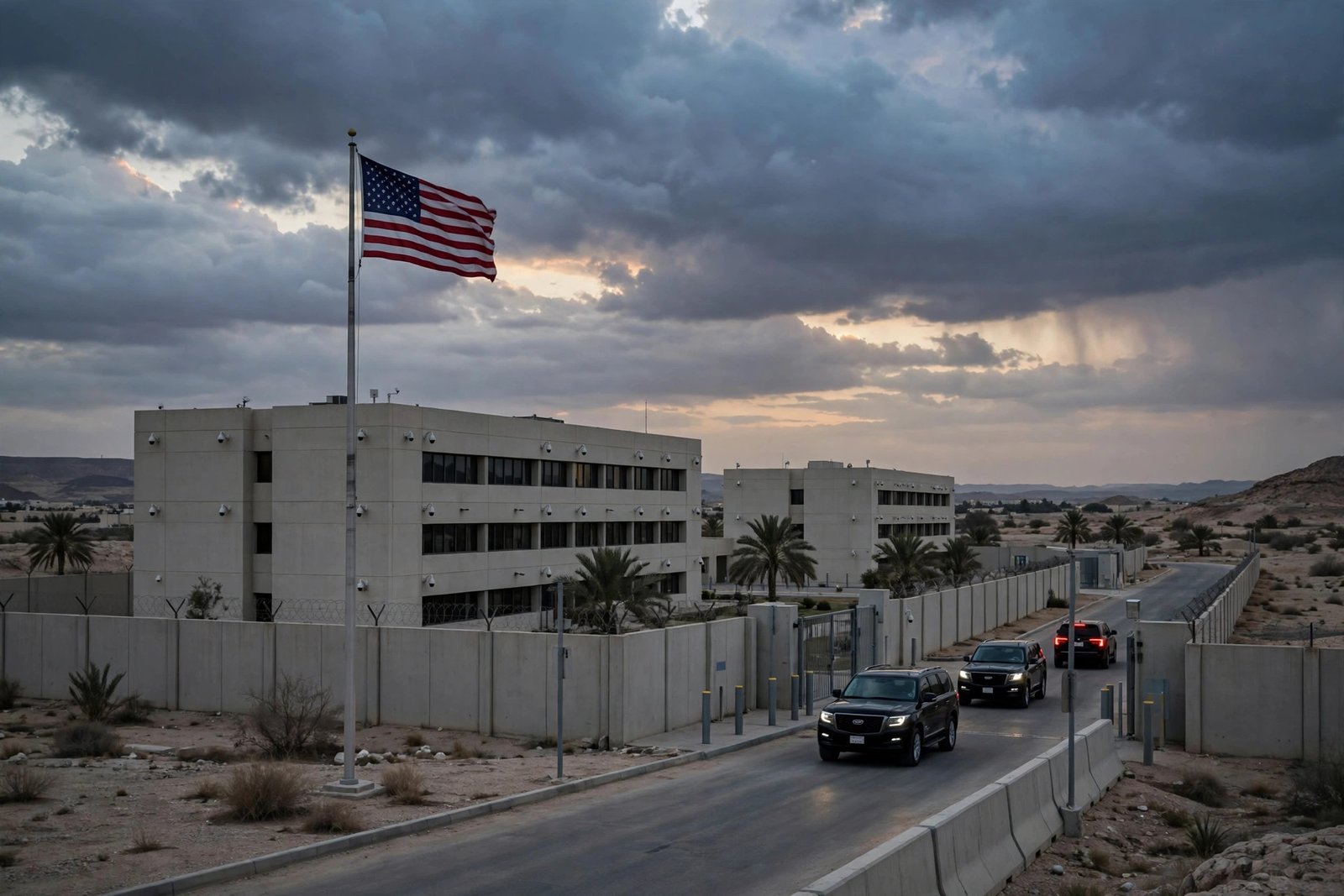
The US strike Iran weekend warning landed with unusual bluntness on Friday, October 23, 2026, when the United States ambassador to Turkey, Tom Barrack, said a new American attack on Iran could absolutely come as soon as this weekend. The remark, made during a podcast interview in the Gulf, instantly raised the stakes of a war that began in February 2026 and has never fully ended, even as President Donald Trump himself played down the idea hours later in Florida.
If that is the case, I do not know anything about it, Trump told reporters when asked about Barrack’s comments, according to TBS News. The split-screen message is now driving the weekend’s diplomacy, oil markets, and the hurried movement of American diplomats and their families out of the Middle East.
Behind the public confusion sits a harder, documented fact: an unclassified intelligence memo dated October 23 and sent to Secretary of State Marco Rubio says Iran has substantially increased efforts to target US personnel and that its plotting has reached advanced stages in both the Middle East and certain other countries. Axios was first to report on the memo, and CNN subsequently reported that the State Department has been quietly pulling staff and families from posts across the region. With the November 3 midterm elections just 10 days away, the US strike Iran weekend debate is no longer an abstract foreign-policy question.
- What Barrack Actually Said About a US Strike Iran Weekend Attack
- Trump’s Response: Denial, Distance, and a Midterm Clock
- The October 23 Intelligence Memo: Advanced Stages
- Diplomats Leaving: Saudi Arabia, Jordan, Qatar, and Beyond
- Iran’s Response: Mosaic Defence and Cable Threats
- Oil at $117: Why a US Strike Iran Weekend Warning Moves Markets
- Extra Knowledge: Ordered Departure vs. Restricted Operations
- Extra Knowledge: Eight Months of War, From Epic Fury to a Stalled Deal
- What’s Next
- Additional Details
What Barrack Actually Said About a US Strike Iran Weekend Attack
Barrack is not a peripheral figure. He serves as the US ambassador to Turkey and as Washington’s point man on Syria, and he was speaking in the Gulf, the region that would feel any new strike first. According to Gulf News, as reported by TBS News on October 24, Barrack said the United States could absolutely launch a strike against Iran within days. He added that negotiations had been going on for months, but warned that continued threats against US allies and the Gulf region would trigger consequences.
Two parts of his message matter as much as the headline. First, Barrack said any retaliatory action would not aim to overthrow Iran’s government. He pointed to concerns about the day-two scenario, what happens the morning after a regime falls, a caution that sets him apart from Israeli Prime Minister Benjamin Netanyahu, who has repeatedly called for the removal of Iran’s clerical regime after previous bombing campaigns and ahead of upcoming Israeli elections. Second, Barrack framed the strike option as leverage for a deal, not as a replacement for one, insisting that Trump remains open to a diplomatic agreement.
That framing is important because the US strike Iran weekend warning did not arrive in a vacuum. The Financial Times has reported that Barrack believes Washington is prepared for a long standoff with Iran, and sources have told CNN that Israel has lobbied, unsuccessfully for now, for more immediate action. Barrack’s own role, however, is a limit on his words: he does not have a direct role on the Iran file, which is one reason the White House could distance itself from his remarks so quickly.
Trump’s Response: Denial, Distance, and a Midterm Clock
Trump’s reply in Florida was short and deliberately vague. If that is the case, I do not know anything about it, he said, a line that neither confirmed nor denied any military planning. It is a familiar pattern for a president who has repeatedly used strategic ambiguity around Iran: keep Tehran guessing, keep allies guessing, and keep his own options open.
But Trump has also given a clearer signal on timing in the past. He has previously indicated that major action would not take place before the November 3 congressional elections, a position that sits uneasily alongside a US strike Iran weekend warning issued just 10 days before voters go to the polls. At his Sioux City, Iowa rally on Thursday night, Trump told supporters, We’re going to have Iran finished very soon. One way or the other, it is going to be done very soon, a line that now reads very differently in light of Barrack’s weekend timetable.
The midterm clock cuts both ways. On one hand, a fresh military escalation could rally voters around the president and dominate the final news cycle before Election Day. On the other, as Reuters’ five takeaways from Trump’s midterm rallies showed, voters are already connecting foreign policy to their own bills: national gasoline prices averaged $4.27 a gallon, about 40 percent higher than a year ago, and a Reuters/Ipsos poll earlier this month found 78 percent of Americans blame Trump’s policies for prices rising faster than their earnings. A US strike Iran weekend escalation that pushes oil higher would land directly on that sore spot.
The October 23 Intelligence Memo: Advanced Stages
The most concrete document behind this weekend’s alarm is the unclassified October 23 memo to Secretary Rubio. According to Axios, which first reported it, US intelligence found that Iran has substantially increased efforts to target American diplomats and officials, and that the plotting has reached advanced stages in the Middle East and in certain other countries. CNN’s subsequent reporting added the human detail: diplomats and families are being moved, some for the second time this year, and many describe the process as chaotic.
The memo does not, on its own, prove that an attack is imminent, and intelligence assessments of advanced stages can cover a wide range of activity, from surveillance and recruitment to the positioning of weapons. What it does explain is why the State Department acted before the weekend rather than waiting for more clarity. The memo also cited danger from Houthi militants in Yemen, whose attacks on Saudi Arabia have intensified in recent days and which the State Department has repeatedly warned have the potential to escalate rapidly beyond that immediate area.
Trump, asked about the new intelligence reporting, did not engage with its specifics. They are bad people, very bad leadership. They killed 75,000 protesters, he said, referring to Iran’s crackdown on protests. The remark, reported by multiple outlets, underscored how the administration is framing the confrontation in moral as well as strategic terms.
Diplomats Leaving: Saudi Arabia, Jordan, Qatar, and Beyond
The departures are happening on two tracks, and the distinction matters. In Saudi Arabia, the State Department issued a formal ordered departure of non-emergency personnel and all family members, citing Houthi escalations. That is a public, status-changing decision with clear entitlements attached. Elsewhere, the moves have been quieter: staffing caps adjusted, families asked to leave, but no formal change of status.
CNN reported that the department has been quietly adjusting staffing at multiple other embassies, including Jordan, Bahrain, Kuwait, Qatar, the United Arab Emirates, and Lebanon. A State Department official later confirmed to CNN that Lebanon, the United Arab Emirates, Qatar, and Jordan will see temporary changes to staffing levels under restricted operations, while saying there were no personnel changes in Kuwait or Bahrain because they were not over their staffing caps. Under Restricted Operations Status, staffing levels are constantly evaluated and adjusted, the official said.
For the families, the bureaucratic distinction has real financial consequences. To say it has been chaotic is an understatement, one US diplomat told CNN, explaining that the support offered so far does not cover the cost of moving an entire family. Many of those leaving had only recently returned to their posts after being ordered out during the height of the Iran war in February and March, re-enrolled their children in school, and settled back into homes they are now leaving again. There is a very Groundhog Day vibe, a source in Amman said of staff being asked to leave the Jordanian capital a second time.
The American Foreign Service Association, the union representing foreign service officers, said it is hearing accounts of bureaucratic ping-pong. Its spokesperson, Nikki Gamer, told CNN that families outside Saudi Arabia have been directed to leave without confirmed housing assistance or per diem, because their embassies are not changing status from restricted operations. A State Department official later said all direct-hire personnel and their families are getting per diem allowances and support for lodging and schools, with per diem allowances consistent with government rates, and added: We understand how hard being on Restricted Operations Status, Authorized Departure, or Ordered Departure is for our diplomatic staff and their families.
Iran’s Response: Mosaic Defence and Cable Threats
Iran has not waited to be attacked before answering. Revolutionary Guard spokesperson Hossein Mohebi announced the activation of what he called a decentralised mosaic defence doctrine, warning that Iran would no longer limit itself to proportionate responses and could take the initiative by launching attacks. In plain language, Tehran is signalling that the next round, if it comes, will not follow the tit-for-tat script of earlier exchanges.
Iranian officials have also told Reuters they have drawn up plans to target seven undersea communications cables in the Gulf, as well as US-linked data centres, AI facilities, and oil infrastructure, if attacked again. That threat is designed to widen the cost of a strike beyond the military domain: severed cables and damaged data infrastructure could disrupt banking, internet connectivity, and financial transactions across the region.
Diplomatically, Iran is not isolated. Foreign Minister Abbas Araghchi announced on Friday that President Masoud Pezeshkian will travel to Moscow next week for talks with Russian President Vladimir Putin. Turkey and France both urged restraint, with Turkish Foreign Minister Hakan Fidan warning that renewed attacks could widen the conflict and French Foreign Minister Jean-Noel Barrot cautioning that further escalation would push oil prices higher. Russia, for its part, denied that its diplomats and specialists at Iran’s Bushehr nuclear power plant were being evacuated.
Oil at $117: Why a US Strike Iran Weekend Warning Moves Markets
Brent crude surged to $117.30 a barrel amid fears of resumed hostilities involving the United States, Israel, and Iran, according to market reporting on October 24. Trump framed the rise as an acceptable cost, saying it was a small price to pay for removing a nuclear threat. Treasury Secretary Scott Bessent added that the US economic pressure campaign had significantly weakened Iran’s oil exports in under two months, while Persian Gulf oil exports from other producers rose above pre-war levels.
For American voters, the link between a US strike Iran weekend warning and the price at the pump is direct, even if it is not immediate. Higher Brent crude feeds into wholesale gasoline prices, which feed into the $4.27 national average that Trump himself acknowledged on the campaign trail has become a political liability. That is why the oil market is not a side story here: it is the mechanism by which a foreign-policy decision in the Gulf becomes a kitchen-table issue in Ohio, Texas, and Iowa in the final 10 days before the midterms.
The Strait of Hormuz remains the other pressure point. Tensions around the strait, through which a large share of the world’s seaborne oil passes, have been a recurring feature of this war, and any threat to Gulf internet infrastructure or shipping would compound the oil shock. Earlier in October, Trump claimed a deal to reopen the strait would be signed on a Sunday, a claim Tehran denied and whose envoys’ trip was then cancelled, as State Line Daily reported at the time. That failed deal is the backdrop to this weekend’s warning: diplomacy has been promised before, and it has collapsed before.
Extra Knowledge: Ordered Departure vs. Restricted Operations
Most readers hear evacuation and picture a single dramatic event. In State Department practice, there are gradations, and they determine what families are owed. An ordered departure is a formal, public decision: non-essential staff and families must leave, and the department’s obligation to pay for their relocation, lodging, and schooling is clearly triggered. Authorized departure lets families leave voluntarily with support. Restricted operations is murkier: an embassy keeps operating with a reduced footprint, staffing caps are quietly adjusted, and families may be told to leave without the embassy ever changing its formal status.
That murkiness is exactly what is angering diplomats this weekend. Because Lebanon, the UAE, Qatar, and Jordan remain on restricted operations, families there say they were initially told they would not get the same per diem and housing support as families leaving Saudi Arabia under an ordered departure, even though they are boarding the same planes, pulling children from the same schools, and paying the same emergency rents. The State Department’s later assurance that per diem is being provided consistent with government rates has not fully settled the dispute, because families say they were told different things by different posts, and some embassies held no planning meetings or town halls before the departures. A lot of people are hearing about it through the news instead of their leadership at post, one source told CNN. For a workforce that is supposed to project American steadiness abroad, that internal confusion is itself a vulnerability, and it is a detail competitors covering the US strike Iran weekend warning have largely missed.
Extra Knowledge: Eight Months of War, From Epic Fury to a Stalled Deal
The current crisis did not begin with Barrack’s podcast interview. The conflict began in February 2026 with Operation Epic Fury, the US-Israeli campaign against Iran that opened the war, and it is now approaching its eighth month. In the early weeks, diplomats fled posts across the Middle East, schools closed, and families scattered to temporary housing in the United States and Europe. When the fighting eased, many returned, only to find, eight months later, that the war had not ended so much as paused.
The pattern since then has been a cycle of escalation, claimed deals, and collapse. In October, Trump announced that an Iran deal signing was set for a Sunday to reopen the Strait of Hormuz, only for Tehran to deny it and for the envoys’ trip to be cancelled. Days later, at Sioux City, Trump said Iran would be finished very soon. Now, with an envoy warning of a US strike Iran weekend attack and an intelligence memo warning of advanced assassination plots, the cycle appears to be turning again, but with a new element: the threat is no longer only missiles and airstrikes, but targeted killings of American officials, undersea cable sabotage, and attacks on data infrastructure. That expansion of the threat picture, from battlefield to diplomats’ front doors and the internet’s physical backbone, is what makes this weekend different from earlier rounds, and it is why the State Department moved families before the weekend rather than after it.
The midterm connection is also older than this weekend. Trump has committed more than $400 million to Republican midterm campaigns, as State Line Daily reported, and his rallies have leaned heavily on the claim that his foreign policy protects Americans. Whether voters see a weekend strike warning as protection or as recklessness may be decided not in Tehran or Jerusalem, but at gas stations and grocery stores in the next 10 days.
What’s Next
Will there actually be a US strike Iran weekend attack? No strike has been confirmed, and Trump’s own denial leaves the timetable genuinely uncertain. Watch for US and Israeli military movements, further embassy departures, and whether Barrack’s remarks are walked back or repeated by officials with a direct Iran role.
What happens to the diplomats and families who left? The State Department says it is communicating directly with affected staff and will have more to say in the days ahead. The key test is whether families under restricted operations receive the same housing and per diem support as those under Saudi Arabia’s ordered departure.
Could oil prices rise further before the midterms? Yes, if hostilities resume or if Hormuz shipping or Gulf cables are threatened. Brent at $117 is already a political problem for Republicans; a further spike would sharpen the pocketbook argument Democrats are making in the final 10 days.
Is a deal still possible? Barrack said Trump remains open to an agreement, and Pezeshkian’s Moscow trip suggests Iran is still shopping for diplomatic cover. But with negotiations described as stalled and both sides warning of pre-emptive action, a deal would need a breakthrough that has eluded negotiators for months.
What should Americans watch for this weekend? Official statements from the State Department and Pentagon, any change in embassy status in the Gulf, oil price moves on Monday, and whether Trump repeats or retreats from the weekend timetable at his next public appearance.
Additional Details
Description: The US strike Iran weekend warning from Ambassador Tom Barrack, President Trump’s denial, an October 23 intelligence memo warning of advanced Iranian assassination plots, the quiet evacuation of US diplomats and families from Saudi Arabia, Jordan, Qatar, the UAE, and Lebanon, Iran’s mosaic defence response, and Brent crude at $117, explained 10 days before the November 3 midterms.
- Key figures: Tom Barrack, US ambassador to Turkey; President Donald Trump; Secretary of State Marco Rubio; Iranian President Masoud Pezeshkian; Israeli Prime Minister Benjamin Netanyahu; Treasury Secretary Scott Bessent.
- Key dates: February 2026, Operation Epic Fury begins the Iran war; October 23, 2026, intelligence memo to Rubio and Barrack’s podcast remarks; October 24, 2026, strike warning reported; November 3, 2026, US midterm elections.
- Oil benchmark: Brent crude $117.30 a barrel on October 24, 2026, amid fears of resumed US-Israeli-Iranian hostilities.
- Embassies affected: Saudi Arabia (ordered departure); Lebanon, UAE, Qatar, and Jordan (temporary staffing changes under restricted operations); no personnel changes reported in Kuwait or Bahrain.
- Sources: TBS News, Gulf News, Axios, CNN, Reuters, Financial Times, and the American Foreign Service Association, as cited inline above.
Update note on the US strike Iran weekend story: this US strike Iran weekend warning remains unconfirmed, and the US strike Iran weekend timeline will be clarified by official statements. Readers following the US strike Iran weekend developments should watch embassy updates, oil prices, and midterm polling. The US strike Iran weekend debate, the US strike Iran weekend warning from Barrack, and the US strike Iran weekend response from Tehran are all moving parts in the same US strike Iran weekend story.
- For market context on the US strike Iran weekend warning, see Reuters and Axios coverage of oil and diplomacy.
- For diplomatic reporting on the US strike Iran weekend evacuations, see CNN coverage of State Department staffing changes.
The US strike Iran weekend warning is the focus of this report, and the US strike Iran weekend question will remain open until officials confirm or withdraw the timetable.