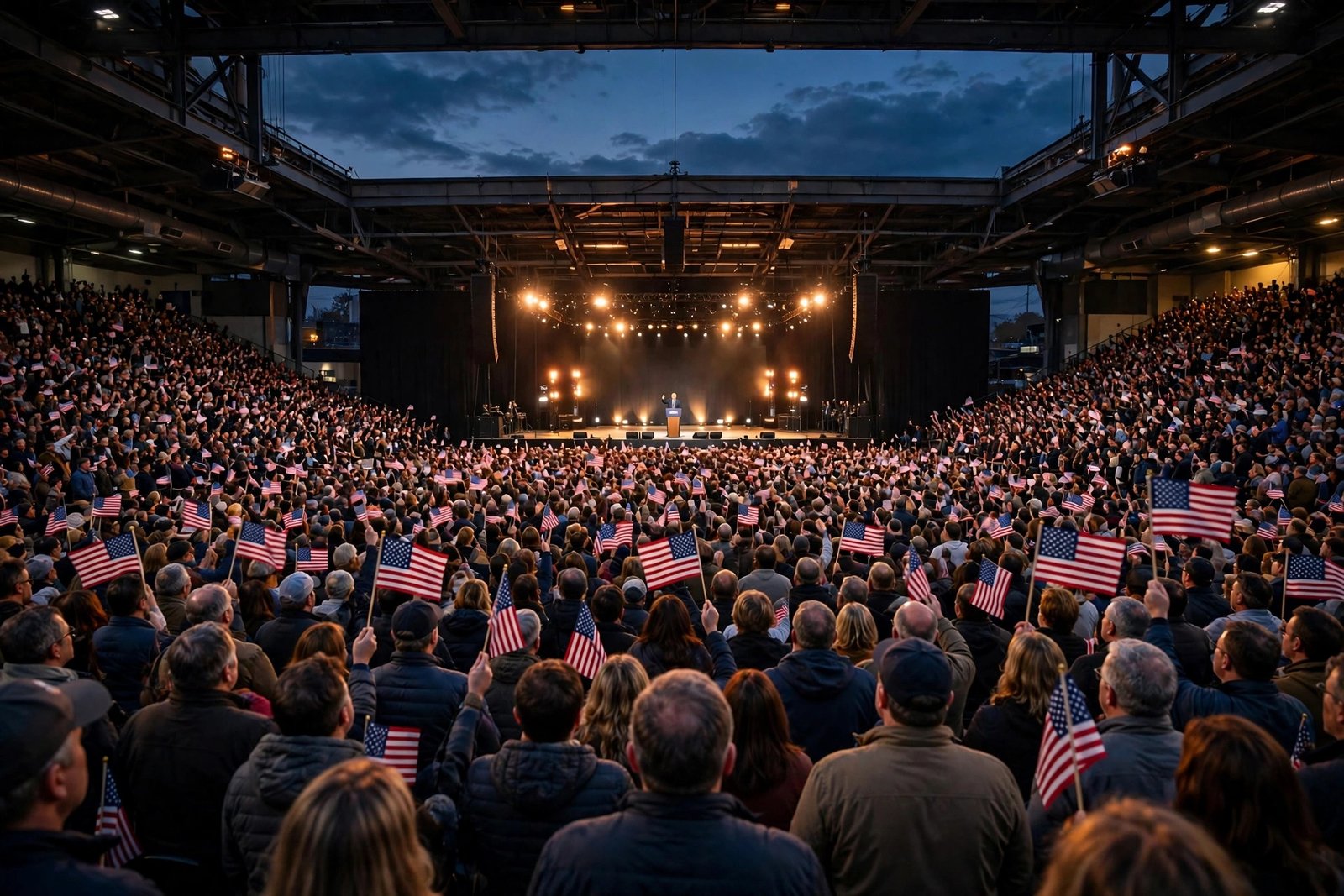
President Donald Trump is in the middle of a nationwide campaign blitz, holding near-daily rallies to boost turnout for Republicans fighting to keep control of Congress in the November 3 midterm elections.
With just 10 days to go, the Trump midterm rallies takeaways from Reuters coverage of the tour paint a picture that is more complicated than the 90-minute stump speeches suggest: an economic pitch colliding with what voters pay at the pump, a travel map that shows Republicans playing defense deep in conservative territory, crowd claims that do not always match the room, and a new foreign warning — France — that has crowded out the wars in Ukraine and Iran.
The Trump midterm rallies takeaways matter because Trump himself is not on the ballot on November 3. For Republican candidates, the open question is whether the enthusiasm he generates among his supporters can translate into votes for them. Reuters reporters Steve Holland, Bo Erickson, Nandita Bose and Jacob Bogage, who have followed the tour, distilled five themes from the appearances, staged mostly in Republican-friendly areas across the country.
Read together, the Trump midterm rallies takeaways show a president campaigning as if the election were about him — and a party that, in the final stretch, is spending its most valuable asset defending ground it used to win easily.
This is not a recap of a single rally. StateLineDaily has covered individual stops in this blitz, including the president’s Wichita rally for Roger Marshall and his Sioux City rally on Iran and the midterms. What follows is the wider pattern across the tour — and what it signals for the last 10 days.
- Trump Midterm Rallies Takeaways: The Economic Pitch Collides With Voter Reality
- Trump Midterm Rallies Takeaways: The Rally Map Shows Republicans Playing Defense
- Trump Midterm Rallies Takeaways: Crowd Boasts Meet an Uneven Reality
- Trump Midterm Rallies Takeaways: France Becomes the Midterm Warning
- Trump Midterm Rallies Takeaways: The Body Politic, From Husted to RFK Jr.
- Extra Knowledge: The Senate Map Math Behind the Tour
- Extra Knowledge: The Calendar Ahead — Mississippi, Texas, Michigan and Maine
- What’s Next
- Additional Details
Trump Midterm Rallies Takeaways: The Economic Pitch Collides With Voter Reality
The first of the Trump midterm rallies takeaways is the gap between the president’s economic story and the prices voters see every day. At the start of October, Trump said he had done a “bad job” explaining his economic record. He has tried to remedy that at his rallies, pointing to a record-low poverty rate, low unemployment, record highs in the stock market and cheaper prices for some food items, according to Reuters.
But his sales pitch is colliding with voters’ concerns about how much they are spending on gas, groceries and other everyday expenses. Consumer prices accelerated in September as the cost of gasoline surged. The nationwide average price of gas is $4.27 per gallon, nearly 40% higher than a year ago, according to AAA, Reuters reported. Trump has repeatedly promised that gas prices will fall once the Iran war ends — a promise that ties the cost of living, for many voters, to a war with no announced end date.
The disconnect was evident outside Trump’s rally in rural Kansas, where Chester Daniel, a 90-year-old military veteran and Trump supporter, said the economy has “a long way to go” to help working people. “Prices? Too high! We will never go back to what they were when this all started, but they need to come way down,” Daniel said. “I don’t know how these young people make a living for their family.”
When even a supporter in deep-red Kansas frames the economy that way, the Trump midterm rallies takeaways suggest the administration’s strongest argument is also its most vulnerable one.
The inflation backdrop is not new to StateLineDaily readers. US inflation jumped to 3.7% in September as gasoline prices surged ahead of the midterms, putting the cost-of-living squeeze at the center of the final campaign stretch. At rally after rally, Trump has answered that squeeze with a record of stock-market highs and low unemployment — measures that matter to investors and job-seekers, but do not change the number on the pump.
That tension is the through-line of the tour, and it is why the economic section of the Trump midterm rallies takeaways reads less like a victory lap and more like a warning.
Trump Midterm Rallies Takeaways: The Rally Map Shows Republicans Playing Defense
The second of the Trump midterm rallies takeaways is geographic, and it may be the most revealing. Trump’s travel map signals just how difficult it will be for Republicans to retain control of Congress, with the president forced to play defense deep in conservative territory, Reuters reported.
Trump has traveled twice to Texas for Republican Senate nominee Ken Paxton, campaigned for Republican Senate incumbent Roger Marshall in Kansas and made two stops in Ohio for Senator Jon Husted. Trump also rallied for Republicans in competitive races in Alaska, Iowa, Montana and South Carolina. He is set to visit Mississippi on Monday. Those are places Republicans are accustomed to winning easily, not battlegrounds where Trump would spend time during the crucial final weeks before an election.
The polls explain why. Paxton narrowly trails Democrat James Talarico in polls, while Marshall faces a serious challenge from Democrat Adam Hamilton in a state that has not elected a Democratic senator in nearly a century. Husted trails former Democratic Senator Sherrod Brown in polls in Ohio, and Republican Senate hopeful Ashley Hinson is in a close race against Democrat Josh Turek in Iowa, according to Reuters.
StateLineDaily’s own coverage of the Texas race found the same knife-edge picture: Talarico edges Paxton 51-49 in a CBS poll as early voting gets underway, a dead heat that helps explain why Trump keeps returning to Texas.
Notably absent from Trump’s travels so far with less than two weeks until Election Day: Michigan, Maine, Minnesota and New Hampshire — also home to tight Senate races. He is soon poised to hit some of those locations. He is scheduled to travel to Michigan on Sunday and has said he also plans to go to Maine, Reuters reported. The Trump midterm rallies takeaways therefore cut two ways: the map shows a party on defense, but it also shows a president who still has stops left to shore up the races he has not yet visited.
Trump Midterm Rallies Takeaways: Crowd Boasts Meet an Uneven Reality
The third of the Trump midterm rallies takeaways concerns one of the president’s favorite measures of political strength: crowd size. Trump has made crowd sizes a recurring theme of his midterm rallies, portraying packed arenas and thousands of people he says are stranded outside as evidence of his persisting popularity, Reuters reported.
But actual turnout on the campaign trail in recent weeks has been uneven. Some rallies have drawn capacity crowds but have shown little sign of the overflow Trump described. At others, large sections of seats remained empty even in modest-sized venues. “I’m doing these every night, and no matter where I go, it’s the same thing. It’s massive crowds,” Trump said at a rally in North Carolina on Tuesday. “We have big screens outside. Thousands and thousands of people. There’s something going on that’s very special.”
The venue was filled to capacity, Reuters reported, but there were no signs of crowds outside waiting to get in or watching on screens.
At an October 7 rally in San Antonio, Texas, Trump said lines stretched two miles outside the arena even as sizable sections inside remained empty, according to Reuters. Crowd sizes are not always an accurate measure of political support, but Trump has pointed to them as a sign of strength even as his approval rating has fallen to 31%, the lowest of either of his presidential terms, according to a Reuters/Ipsos poll released on Monday.
That 31% figure is a fresh data point in a polling picture StateLineDaily has tracked all month. Prediction markets give Democrats 90% House odds as polls and forecasters agree on the direction of the race, and earlier polls put Trump’s approval at 33% in a Washington Post survey and 36% in a Fox News survey. The Trump midterm rallies takeaways do not treat crowd size as a poll — but they note that a president citing packed rooms as proof of momentum is doing so while his own approval sits at a term low.
Trump Midterm Rallies Takeaways: France Becomes the Midterm Warning
The fourth of the Trump midterm rallies takeaways is the tour’s newest foreign foil: France. Trump has often used French President Emmanuel Macron as a foil in his campaign stump speeches, claiming he strong-armed Macron into raising prescription drug prices in France by threatening tariffs on a popular French export, champagne, and other goods, Reuters reported.
But in the last week or so Trump has seized on another narrative about France, casting its violent unrest of recent weeks as a warning of what he says could happen in the US if Democrats win in the midterms. Trump has blamed the unrest on migrants and Muslims, following a familiar playbook that has featured in his politics for more than a decade. “What the hell happened to France?” Trump told a crowd in a livestock competition arena in Clemson, South Carolina, on Wednesday.
Notably, the French protests have taken a larger role in Trump’s recent speeches than two other major foreign policy headaches he has been unable to resolve: Russia’s invasion of Ukraine and his war against Iran. “They’ll end one way or another,” Trump said of the two conflicts at his Clemson rally, according to Reuters. He did not elaborate on how they might end, but complained that he was not awarded the Nobel Peace Prize for his work to resolve conflicts around the world.
StateLineDaily readers have seen this France theme before, up close. Trump called Paris a future “Muslim city” as he blamed migrants for the unrest, and in Wichita he warned the US would “burn” like France if Democrats prevailed. The Trump midterm rallies takeaways confirm that France is no longer a one-rally riff: it has become the tour’s central cautionary tale, displacing the wars that once dominated the president’s foreign-policy pitch.
Trump Midterm Rallies Takeaways: The Body Politic, From Husted to RFK Jr.
The fifth of the Trump midterm rallies takeaways is the most Trumpian: the president has put the body in body politic. Trump has long had a fixation on the human physique that stretches beyond the body politic, Reuters reported. This campaign season, Trump has given particular attention to Husted, a 59-year-old former college football player for the University of Dayton.
At rallies in Ohio, Kentucky and North Carolina, Trump marveled at Husted’s physique, at one point saying his backside is “like a pile of muscle.” “Then I looked at his legs, and I said, ‘Man, his feet are big.’ Then I looked at his shoulders, and I tapped him on the shoulder, and it actually hurt my hand. It was like a piece of steel. I said, ‘This guy’s a monster,'” Trump said, according to Reuters.
Trump had similar praise on Friday for Robert F. Kennedy Jr., his secretary of health and human services, telling a campaign rally in Florida that the 72-year-old “has the body of a 30-year-old.” Such riffs are familiar terrain for Trump. At the close of his 2024 campaign, he used a Pennsylvania rally speech to tell a crude story about PGA legend Arnold Palmer’s prowess beyond his golf game. Trump’s focus over the years on people’s physical attributes has also included mocking the weight and looks of his opponents, Reuters noted.
Trump finds even some of his friends lacking in fashion sense, including the rumpled Paxton. “Some may not like the way he dresses,” Trump said about him at the Republicans’ midterm convention in Dallas in mid-September, adding: “I don’t.” That has not stopped Trump from campaigning for Paxton, however.
He returns to Texas on Tuesday for two more campaign rallies, Reuters reported — a reminder that, for all the stagecraft, the Trump midterm rallies takeaways keep returning to the same practical point: the tour exists to move votes in specific Senate races, not just to fill rooms.
Extra Knowledge: The Senate Map Math Behind the Tour
Why would a president spend the final two weeks of a midterm campaign in Texas, Kansas and Ohio — states he carried comfortably? The answer lies in the Senate map math that the Trump midterm rallies takeaways only sketch. Senate races are statewide, expensive and personal in a way House races are not, and a single lost seat in a red state can erase a majority built over a decade. When Reuters notes that Marshall faces a serious challenge in a state that has not elected a Democratic senator in nearly a century, it is describing a structural shock: if Kansas is competitive, almost nowhere is safe.
The same logic applies to Ohio, where Husted trails a former senator, Sherrod Brown, who held the seat for 18 years and retains statewide name recognition that a first-term appointee cannot buy.
And it applies to Texas, where Paxton’s narrow deficit to Talarico in polling coincides with the largest, most expensive media market map in the country. A president who can fill an arena in San Antonio for free is, in effect, donating the one thing money cannot buy in the final stretch: national attention for a race that might otherwise be drowned out by the sheer size of the state. That is the less glamorous reason behind the tour’s geography — and the reason the Trump midterm rallies takeaways treat the map itself as news.
Extra Knowledge: The Calendar Ahead — Mississippi, Texas, Michigan and Maine
The tour does not stop with the Reuters analysis. According to the White House weekend schedule, Trump travels Saturday to Perry, Georgia, for remarks at 7:00 p.m., then Sunday to Port Huron, Michigan — the Michigan stop Reuters said was imminent. He is set to visit Mississippi on Monday and returns to Texas on Tuesday for two more campaign rallies for Paxton. He has also said he plans to go to Maine, home of the Susan Collins race that StateLineDaily covered when Trump lifted some Canada tariffs in a boost for Collins as the Maine Senate race tightened.
That calendar matters because the final 10 days of a midterm are when early voting — already underway in many states — turns into Election Day turnout. A rally in Perry, Georgia, on Saturday night, a Michigan stop on Sunday and a Mississippi visit on Monday is a three-day sprint through the South and the industrial Midwest, followed by a Texas double-header.
If the Trump midterm rallies takeaways are right that the party is playing defense, the closing schedule is the defense itself: every remaining stop is a race Republicans cannot afford to lose, in a state they cannot afford to take for granted.
What’s Next
Will Trump visit Michigan, Maine, Minnesota and New Hampshire before Election Day? Michigan is scheduled for Sunday and Maine is promised, according to Reuters. Minnesota and New Hampshire remain unvisited with less than two weeks to go — watch the White House schedule for additions, because an added stop is itself a signal about internal polling.
Can the economic pitch close the gap on gas prices? The administration’s answer so far is that prices will fall once the Iran war ends. With gas at $4.27 a gallon and September inflation at 3.7%, voters will judge that promise against the pump, not the stump speech.
Does crowd size matter? Not as a poll — but as a turnout signal. The test is November 3: whether the people who filled the arenas, and the voters who did not, show up for Paxton, Marshall, Husted and Hinson rather than for Trump himself.
Will France stay the tour’s warning? The Clemson speech suggests yes. If unrest in France fades from the headlines, watch whether Ukraine and Iran return to the center of the stump speech — or whether the president finds a new foil for the final weekend.
Additional Details
Description: Reuters’ October 24 analysis of President Donald Trump’s midterm campaign rallies finds an economic pitch colliding with $4.27 gas, a Republican map playing defense in Texas, Kansas, Ohio and Iowa, uneven crowds behind the “massive crowds” claims, France as the new midterm warning, and a tour that returns to Texas on Tuesday — with 10 days until the November 3 midterms.
- Source reporting: Reuters, October 24, 2026, by Steve Holland, Bo Erickson, Nandita Bose and Jacob Bogage
- Election Day: November 3, 2026 — 10 days from the Reuters analysis
- Gas price: $4.27 per gallon nationwide, nearly 40% higher than a year ago (AAA via Reuters)
- Approval: 31% in the Reuters/Ipsos poll released Monday, the lowest of either Trump term
- Next stops: Perry, Georgia (Saturday); Port Huron, Michigan (Sunday); Mississippi (Monday); Texas (Tuesday, two rallies)