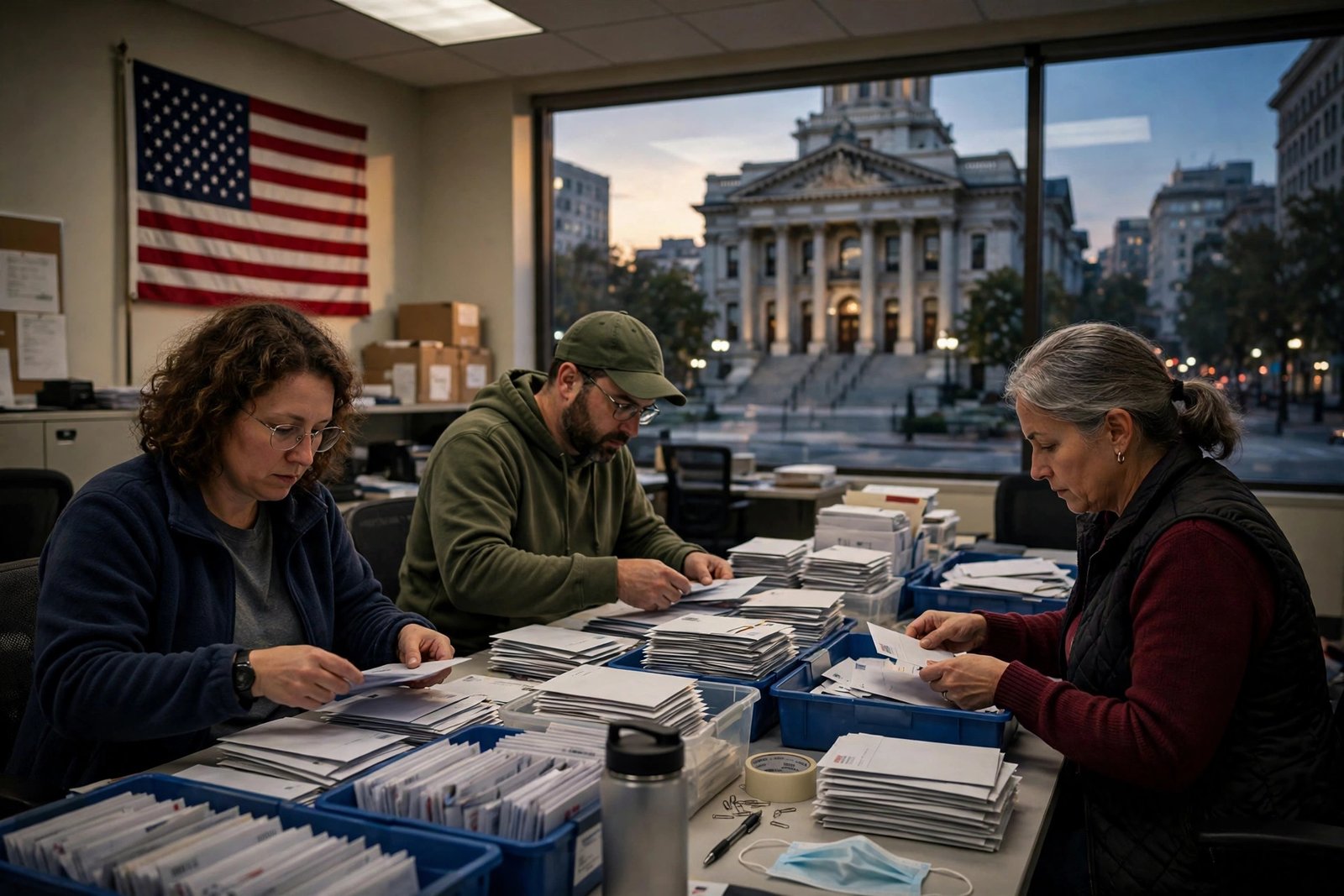
The Justice Department on Friday ordered California counties to set aside mail-in ballots cast by voters it suspects are noncitizens, warning election officials who knowingly count those ballots that they could face criminal liability, in the sharpest escalation yet of the Trump administration’s pre-election fight over voter rolls. The DOJ California noncitizen ballots order landed just 10 days before the November 3 midterm elections, with voting already underway in the nation’s largest state.
Letters in the DOJ California noncitizen ballots dispute sent to county election offices asked officials to work with the Justice Department and the Department of Homeland Security to “identify who on the accompanying list is a citizen and who is not,” and to set aside ballots from anyone whose citizenship cannot be confirmed. First Assistant U.S. Attorney Bill Essayli, the top federal prosecutor in Los Angeles, warned in a letter to San Bernardino County officials seen by CNN that “if persons knowingly tabulate ballots cast by individuals identified by federal agencies as noncitizens, they risk becoming aiders and abettors to a federal crime.”
California officials pushed back immediately, calling the federal lists unreliable and the threats an unlawful attempt to interfere in a state-run election. Senator Alex Padilla, the ranking Democrat on the Senate Rules Committee, which oversees federal elections, said the administration had produced no evidence of massive voter fraud and accused it of acting out of desperation. The fight now runs on two tracks at once: a federal lawsuit over more than 20,000 ballots, and a new 48-hour demand to nearly every county in California. Here is what the DOJ California noncitizen ballots order does, why California says the underlying data cannot be trusted, and what happens next.
- What Happened: The DOJ California Noncitizen Ballots Order
- The 48-Hour Letters to 57 Counties
- The Lawsuit and the Race to the 9th Circuit
- Who Is on the Federal List — and Who Is Not
- Why the Citizenship Data Keeps Failing Under Review
- How California Counts Mail Ballots — and Why Set-Asides Matter
- The Alaska Parallel: A Second Front Over Certification
- What California Counties and Officials Are Saying
- What’s Next
- Additional Details
What Happened: The DOJ California Noncitizen Ballots Order
The DOJ California noncitizen ballots order arrived on Friday, October 23, 2026, as a set of letters from federal prosecutors to California county election offices. The letters directed counties to identify suspected noncitizens on their voter rolls, hand over identifying information and registration records for the people flagged, and set aside — rather than count — any mail-in ballots tied to registrants whose citizenship officials cannot verify. The demand gave counties 48 hours to act, according to reports of the letters.
The order marks a clear escalation in the DOJ California noncitizen ballots dispute and in the Trump administration’s efforts to scrutinize voter rolls ahead of the midterms, as CNN reported. It follows months of claims by President Donald Trump that noncitizens are voting in large numbers — claims that election officials and courts have repeatedly found unsupported by evidence — and it turns those claims into a direct, county-by-county demand backed by a threat of criminal prosecution.
That threat is the part of the story that changes the stakes for local officials. County registrars are not political operatives; they are career administrators who run elections under state law. Telling them they personally risk becoming “aiders and abettors to a federal crime” if they count a ballot flagged in the DOJ California noncitizen ballots list puts them in an impossible position: follow state law, which requires verifiable evidence before removing a voter or discarding a ballot, or follow a federal letter, which demands action within two days on the basis of a list the state says is unproven. Read StateLineDaily’s earlier coverage of the federal voter-fraud crackdown in California Voter Fraud Bust: Feds Arrest 28 in ‘Operation Protect the Vote’, where the same prosecutor, Bill Essayli, warned that noncitizens are voting.
The 48-Hour Letters to 57 Counties
The scale of the DOJ California noncitizen ballots letters is what makes Friday’s move different from everything that came before it. A spokesman for the U.S. Attorney’s Office in Los Angeles said 57 of California’s 58 counties received letters, with Los Angeles County the exception only because it had already received an earlier notice, according to reports of the letters first carried by the San Francisco Chronicle. In other words, this was not a targeted inquiry into one county’s rolls. It was a statewide sweep.
The DOJ California noncitizen ballots letters sought personal identifying information, including Social Security numbers and registration records, for voters flagged as possible noncitizens, and they instructed counties to segregate ballots where citizenship could not be confirmed, EconoTimes reported. In San Bernardino County alone, the federal list named 1,133 suspected noncitizen voters whose ballots now face extra scrutiny, according to the Associated Press account of the letters.
The 48-hour clock matters because of where California is in its election calendar. Voting is already underway: more than 23 million Californians are registered to vote, and more than 330,000 mail-in ballots have already been counted. A demand in the DOJ California noncitizen ballots case to identify, verify, and segregate ballots on a two-day timetable, in the middle of active counting, is not an administrative request that can be handled at leisure. California’s lawyers have warned that withholding ballots on the basis of an unverified list could delay certification and, worse, prevent eligible citizens from having their votes counted at all.
The Lawsuit and the Race to the 9th Circuit
The DOJ California noncitizen ballots county letters did not arrive out of nowhere. They are the second wave of a campaign that began earlier this month. On October 13, Acting Deputy Attorney General Trent McCotter gave Los Angeles County and California Secretary of State Shirley Weber 48 hours to review a federal list of suspected noncitizens who had been sent mail-in ballots, threatening to seek “emergency relief” if officials did not comply. That letter included a password-protected thumb drive containing names of people the administration “believes are likely non-citizens” who had been sent ballots for the November election, and it asked officials to temporarily set aside ballots from people whose citizenship could not be confirmed, rather than cancel their registrations.
When Weber and Logan, the Los Angeles County registrar, balked, the Justice Department sued California and Los Angeles County last week in the DOJ California noncitizen ballots lawsuit, seeking to prevent officials from counting more than 20,000 mail-in ballots associated with people the government believes are likely noncitizens.
A federal judge scheduled a hearing on the case for next week, but on Friday the Justice Department asked the 9th U.S. Circuit Court of Appeals to intervene before then. “Every minute of processing that occurs without segregating the ballots of suspected ineligible voters causes untraceable disenfranchisement and dilution of the votes of United States citizens,” the department’s motion argued, according to CNN.
That argument — that counting a disputed ballot causes irreversible harm, while setting it aside is harmless — is the legal heart of the DOJ California noncitizen ballots fight, and California disputes it entirely.
State officials argue the reverse: that setting aside the ballot of an eligible citizen on the basis of bad data is itself disenfranchisement, and that once a ballot is segregated and an election certified, the citizen’s vote may never be recovered. The 9th Circuit’s decision on whether to step in before the district court hearing will signal how much weight the appeals court gives to each side’s claim of irreparable harm.
Who Is on the Federal List — and Who Is Not
One of the most important facts about the DOJ California noncitizen ballots list is what it does not prove. The department’s own complaint does not establish that anyone listed is ineligible to vote or has cast a ballot. The list identifies people the administration considers “likely” noncitizens, based on comparing voter-registration records with federal immigration data. “Likely” is doing a great deal of work in that sentence — and California’s challenge to the list rests on the gap between a data match and a legal finding.
Only U.S. citizens are allowed to vote in federal and state elections, a point no party in this fight disputes. Some California jurisdictions do allow noncitizens to vote in certain local or school board elections under local laws, which is a separate question from federal and statewide races and does not make those voters eligible for a midterm ballot in the DOJ California noncitizen ballots case. The federal lists, however, do not distinguish cleanly between those categories in the eyes of critics — and, more importantly, they have repeatedly flagged people who turn out to be citizens.
In the DOJ California noncitizen ballots dispute, the administration has alleged that hundreds of thousands of noncitizens are on voter rolls nationwide. In August, Homeland Security Secretary Markwayne Mullin said his department had identified 250,000 people it believed were noncitizens and registered to vote in four states, including California, Pennsylvania, New Jersey, and Nevada, by comparing registration records with federal immigration data. That headline number has not survived contact with state-level review, as the Nevada example below shows — and it is the reason California officials insist that no ballot should be set aside on the basis of a match alone.
Why the Citizenship Data Keeps Failing Under Review
Here is the part of the DOJ California noncitizen ballots story that most national coverage glosses over, and it is the reason this fight is about more than one state’s politics: federal citizenship matching has a known, structural failure mode, and it fails in exactly the direction that harms naturalized citizens.
The DOJ California noncitizen ballots matching method is straightforward on paper. Federal agencies compare state voter rolls against immigration databases — records of visas, green cards, asylum applications, and naturalization proceedings. If a name appears in an immigration database but not in a naturalization record, the system flags the person as a possible noncitizen.
The problem is that immigration databases are historical records, not live citizenship ledgers. A person who became a U.S. citizen years ago may still appear in older immigration files. A name may match the wrong person entirely, especially with common surnames. A data-entry error at any point in a decades-long paper trail becomes a “likely noncitizen” flag in the present.
Nevada is the cautionary tale, and it comes from the administration’s own numbers. Federal officials initially told Nevada that 15,900 people on its rolls were potentially noncitizen registrants. After further review, the department said the finding was preliminary and unvetted, and that it had confirmed only 185 through manual review. Nevada officials then reviewed those 185 themselves — and found that all 185 were U.S. citizens, a conclusion the federal agency disputes.
In other words, the pipeline went from 15,900 suspects to 185 “confirmed” cases to zero, once a state actually checked. California officials cite that collapse as proof that the DOJ California noncitizen ballots lists cannot be treated as evidence, and that setting ballots aside on their say-so risks disenfranchising exactly the naturalized Americans the system is supposed to protect.
There is a second, quieter data problem. Federal law already requires states to maintain accurate voter rolls, and California, like other states, removes voters who are confirmed ineligible through its own processes, including death records, felony convictions, and confirmed noncitizen status.
What the DOJ California noncitizen ballots letters demand is not that California follow its own process faster, but that it substitute a federal match for that process — and do it in 48 hours, under threat of prosecution. That is why Los Angeles County Clerk Dean C. Logan, responding to the October 13 letter, stressed that “federal and state laws are clear on how voter eligibility is established — and any action to remove a voter from eligibility must be based on verifiable information, not assertions of unconfirmed data matching.”
How California Counts Mail Ballots — and Why Set-Asides Matter
To understand why a set-aside order in the DOJ California noncitizen ballots case is so consequential, it helps to know how California actually counts votes — a system that is slower, and more protective of voters, than the Election Night picture most Americans carry in their heads. California mails a ballot to every registered voter. Ballots postmarked by Election Day can arrive and be counted for days afterward, and every signature on a mail ballot envelope is verified against the voter’s registration record. If a signature does not match, the voter is notified and given a chance to “cure” it — to confirm that the ballot is theirs — rather than having the vote silently discarded.
That cure process is precisely what is at stake in the DOJ California noncitizen ballots fight. A ballot that is set aside pending a citizenship check is not counted on Election Night, and it may not be counted in the initial results that shape the public narrative of who won.
If the check clears the voter, the ballot can still be counted before certification — California’s certification deadline falls weeks after Election Day, which is why the state can afford a deliberate count. But if the check is slow, or the voter cannot be reached, or the county is overwhelmed by thousands of new verification demands in the middle of counting, a lawful vote can slip through the cracks. And in close races — the kind that decide control of the House — a few thousand segregated ballots in a few counties can be the whole ballgame.
California’s scale magnifies the risk in the DOJ California noncitizen ballots dispute. With more than 23 million registered voters, even a small error rate in a federal matching program translates into thousands of wrongly flagged citizens. The state’s lawyers have warned that the department’s demands could delay certification statewide, not just in the counties that received letters. For the broader midterm picture, see StateLineDaily’s 2026 Midterm Predictions: Prediction Markets Give Democrats 90% House Odds as Polls and Forecasters Agree, and our recent analysis in Trump Midterm Rallies Takeaways: Gas Prices, Crowd Claims and a Defense-Mode Map With 10 Days to Go.
The Alaska Parallel: A Second Front Over Certification
California is not the only front in the DOJ California noncitizen ballots fight. A similar legal battle is unfolding in Alaska, where the Trump administration is seeking to block certification of the state’s Senate race under certain circumstances if Republican Senator Dan Sullivan loses. The race is being closely watched as Democrats seek to regain control of the Senate, and the administration’s move there — like its move in California — would put a federal thumb on the scale of a state certification decision.
The Alaska parallel matters because it reveals the pattern in the DOJ California noncitizen ballots case. In both states, the administration is not waiting for a state to finish counting and then challenging the result in court. It is asking federal courts to intervene before certification, to segregate ballots or block certification itself, on the basis of claims that state officials say are unproven. Supporters of the administration argue that this is the only way to prevent ineligible votes from being counted in the first place, since a counted vote cannot be uncounted. Critics argue that it reverses the normal burden of proof: instead of the government proving a voter ineligible before discarding a ballot, the voter must prove eligibility to rescue one.
That reversal is also the thread connecting the DOJ California noncitizen ballots letters to the administration’s broader election agenda. Attorney General Todd Blanche has declined to rule out Justice Department intervention in state election certification, and the department has weighed lawsuits against all-mail-ballot states. The California letters, the Alaska certification fight, and the earlier voter-roll lawsuits are not isolated disputes. They are a single strategy, applied state by state, in the final days before voters decide control of Congress.
What California Counties and Officials Are Saying
California’s response to the DOJ California noncitizen ballots letters has been swift and unusually blunt. Senator Padilla, responding to Friday’s letters, said: “Trump’s DOJ has not provided any evidence for their claims of massive voter fraud. They’ve admitted that the data they point to is inaccurate and unreliable. No matter how many lawsuits they file or how many election officials they threaten, they do not have the authority to interfere.”
He added: “The Trump administration is afraid and desperate. Their attempts to take over our elections will fail. Election officials: We have your back. California: Your vote is your voice. Use it and let’s hold this administration accountable.”
County officials have been more measured in public in the DOJ California noncitizen ballots dispute, but their legal position is consistent: they will follow state law, which requires verifiable evidence before a voter is removed or a ballot discarded. Los Angeles County’s Logan made that point after the October 13 letter, and the state’s court filings in the 20,000-ballot lawsuit make the same argument at greater length — that the federal list’s reliability has not been established, that withholding ballots could delay certification, and that eligible citizens could lose their votes.
The Justice Department, for its part in the DOJ California noncitizen ballots dispute, has not backed down. Essayli’s statement to reporters was short: “The letters speak for themselves. Any election official who knowingly processes the ballot of a noncitizen is opening themselves to legal jeopardy.” That sentence, repeated across 57 counties, is the administration’s theory of the case in miniature: the risk of counting an ineligible ballot outweighs the risk of setting aside an eligible one, and local officials who disagree do so at their own peril.
What’s Next
Will the 9th Circuit intervene before the district court hearing? The Justice Department asked the appeals court to step in before next week’s hearing on the 20,000-ballot lawsuit in the DOJ California noncitizen ballots case. If the 9th Circuit acts, it could order segregation of disputed ballots statewide while the case is litigated. If it declines, the district court hearing next week becomes the first real test of the department’s evidence.
Will counties comply with the 48-hour letters? The 48-hour window in the DOJ California noncitizen ballots dispute expires over the weekend, before most counties will have had time to verify thousands of flagged names. Watch for whether counties seek court protection, ask for more time, or comply in part — for example, by segregating ballots without conceding that the voters are ineligible. Any county that refuses outright should expect to be named in a new federal filing.
Could this delay California’s certification? Possibly, and that is the scenario California’s lawyers fear most in the DOJ California noncitizen ballots dispute. If large numbers of ballots are segregated and verification drags on, certification of close races could slip — and with it, the seating of members of Congress. A delayed certification in the nation’s largest state, in a year when House control may hinge on a handful of seats, would become a national story in its own right.
Does this spread to other states? The Alaska fight suggests it already is. Pennsylvania, New Jersey, and Nevada were all named in the administration’s August claim of 250,000 suspected noncitizen registrants. If the DOJ California noncitizen ballots letters survive legal challenge, similar letters to other states would be the logical next step — and the next midterm flashpoint.
Additional Details
Description: The Justice Department ordered California counties to set aside mail-in ballots from voters it suspects are noncitizens, giving 57 counties 48 hours to verify flagged names and warning officials who count disputed ballots that they risk criminal liability as aiders and abettors. The move follows an October 13 demand to Los Angeles County and Secretary of State Shirley Weber, a federal lawsuit over more than 20,000 ballots, and a new request to the 9th Circuit to intervene before a district court hearing next week. California officials say the federal lists are unreliable, citing Nevada’s review in which 185 “confirmed” noncitizen registrants all turned out to be U.S. citizens, and warn that setting ballots aside could delay certification and disenfranchise eligible voters. The DOJ California noncitizen ballots fight lands 10 days before the November 3 midterms, with voting already underway and more than 330,000 California mail ballots already counted.
- What happened: DOJ California noncitizen ballots letters to 57 of California’s 58 counties ordering verification and set-aside of suspected noncitizen ballots within 48 hours.
- Key official: First Assistant U.S. Attorney Bill Essayli, author of the San Bernardino County letter warning of criminal liability.
- Earlier steps: October 13 McCotter 48-hour demand to Los Angeles County and Secretary Shirley Weber, including a password-protected thumb drive of “likely non-citizens.”
- Lawsuit: DOJ sued California and Los Angeles County over 20,000-plus ballots; district hearing next week; DOJ asked the 9th Circuit to intervene first.
- San Bernardino: Federal list named 1,133 suspected noncitizen voters in that county alone.
- Statewide scale: More than 23 million registered California voters; more than 330,000 mail ballots already counted.
- Data dispute: Nevada’s initial 15,900 flagged registrants narrowed to 185 “confirmed” cases, all found by the state to be U.S. citizens.
- Parallel fight: Trump administration seeking to block certification of Alaska’s Senate race under certain circumstances if Senator Dan Sullivan loses.
- California response: Senator Alex Padilla called the administration “afraid and desperate” and said it has provided no evidence of massive voter fraud.
- Next dates: 48-hour county deadline over the weekend; district court hearing next week; November 3 midterm elections.