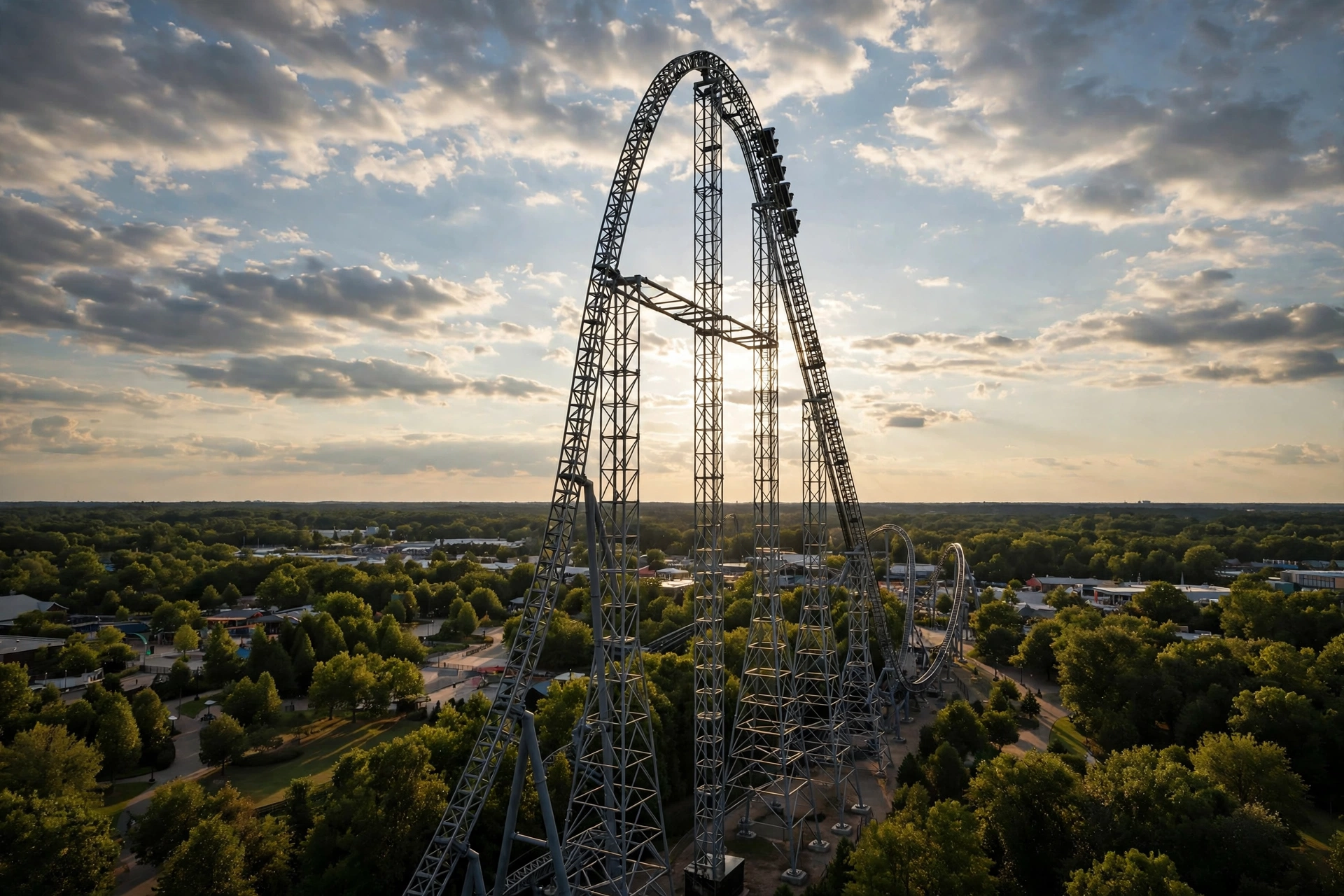
The Six Flags Goliath accident has shocked the amusement park world. A man died and four other guests were injured on Monday, October 12, 2026, after a rider was thrown from the Goliath roller coaster at Six Flags Over Georgia, the 200-foot-tall hypercoaster just outside Atlanta.
Witnesses described a horrifying scene as the man came free of his seat while the ride was in motion and struck parts of the coaster as he fell, while horrified riders watched from their seats. The park immediately shut the ride down, evacuated stranded passengers from the top of the lift hill with harnesses, and turned the investigation over to the Cobb County Police Department’s Major Crimes Unit.
Here is what we know so far about one of the deadliest theme park incidents in Georgia in recent memory.
- The Six Flags Goliath Accident: What Happened
- Witness Accounts and the Evacuation
- The Goliath: What We Know About the Ride
- Police Investigation: What Happens Next
- The Six Flags Goliath Accident and the Park’s Safety Record
- How Rare Are Fatal Roller Coaster Accidents?
- What Happens Next After the Six Flags Goliath Accident
The Six Flags Goliath Accident: What Happened
The Six Flags Goliath accident happened shortly before 4 p.m. Eastern Time on Monday at Six Flags Over Georgia in Austell, Cobb County, about 15 miles northwest of downtown Atlanta. The Cobb County Police Department said the incident was reported at approximately 3:58 p.m., and officers confirmed that one guest died and several others were hurt. Local television stations reported that four additional visitors sustained injuries, though police had not released details about their conditions by Monday evening.
The victim fell from the Goliath roller coaster during a ride cycle, according to witnesses and local news reports. He was pronounced dead at the scene. His identity had not been released by Monday evening, and police said details were being withheld out of respect for the family. A department spokeswoman told USA Today that detectives from the Major Crimes Unit were leading the investigation into how a rider ended up outside his seat on one of the park’s most popular attractions.
Six Flags issued a statement Monday afternoon confirming the death. “We are deeply saddened by the guest incident at our park today,” a park spokesperson said, adding that park staff and local authorities responded immediately and that the company is cooperating fully with investigators. The park declined to share additional details about the victim or the circumstances, citing the family’s privacy. Park officials also said they were providing support to guests and team members who were affected by the tragedy.
The incident forced large parts of the park to close for the remainder of the day. Emergency crews from multiple agencies responded, and the area around the Goliath was shut down as investigators began documenting the scene. By early evening, the Six Flags Goliath accident had become a national story, with coverage from USA Today, CNN, NBC News, and local outlets across the country.
Witness Accounts and the Evacuation
Riders who were on the Goliath when the tragedy occurred described a scene of chaos and terror. Multiple witnesses told Atlanta television stations that the man appeared to come free of his seat as the coaster moved through its course. One rider, Logan Conner, who was on the train with his fiancee, told reporters the man seemed to float up out of his seat. “The man started levitating in the air sideways,” he said, adding that he made direct eye contact with the victim during the fall.
Other witnesses said the man struck the coaster train multiple times as he fell. One told a local station the victim appeared in the train’s souvenir photo, and several riders described hearing and seeing him hit the structure on the way down. One local report said the victim’s body came to rest on the roof of a nearby haunted house attraction, though police have not confirmed that detail.
Several accounts circulating online and shared with reporters suggested that the restraint on the victim’s seat may have been unlatched, but authorities have not verified those claims and have urged the public not to speculate.
After the fall, the Goliath came to a stop with the train stranded on the track, including near the top of the 200-foot lift hill. Between 15 and 20 riders were stuck high above the park. Park staff and emergency crews evacuated the stranded guests four at a time, using harnesses and the emergency stairs that run alongside the track. News helicopters captured the slow, painstaking evacuation from the air. One witness told reporters that the victim had been seated with a child, and said blood from the incident ended up on their ride vehicle — an account police have not confirmed.
The Goliath: What We Know About the Ride
The Goliath is one of the signature attractions at Six Flags Over Georgia. The steel hypercoaster stands 200 feet tall and reaches speeds of up to 70 miles per hour, making it one of the tallest and fastest rides in the southeastern United States. It was built by the Swiss manufacturer Bolliger & Mabillard, one of the most respected roller coaster designers in the world, and has been in operation at the park since 2006.
Like most modern hypercoasters, Goliath uses individual lap bars rather than over-the-shoulder harnesses. Lap bar restraints are the industry standard for this type of ride and are designed to keep riders securely in their seats during steep drops, high speeds, and moments of negative G-force, when riders briefly feel weightless.
Investigators will almost certainly focus on whether the restraint on the victim’s seat functioned properly, whether it was locked correctly before the train left the station, and whether ride operators followed dispatch procedures.
The ride’s long operating history without a widely reported fatal incident makes Monday’s tragedy particularly shocking to coaster enthusiasts. The park’s website describes Goliath as a flagship ride, and it draws long lines on busy days. The coaster had no publicly known history of restraint failures before the Six Flags Goliath accident, according to local news coverage.
Police Investigation: What Happens Next
The Cobb County Police Department’s Major Crimes Unit is leading the investigation into the Six Flags Goliath accident. Investigators will examine the restraint system on the victim’s seat, the ride’s mechanical components, maintenance and inspection records, and operator procedures to determine what caused the ejection. Officials have not said how long the investigation will take or when the Goliath might reopen.
Because the victim’s identity has not been released, the medical examiner’s findings will play a key role in establishing the official cause of death. The procedure here is routine in fatal theme park cases: coroners document the injuries, investigators reconstruct the sequence of events, and state inspectors review whether the ride met all applicable safety standards before it is allowed to carry passengers again.
Mableton Mayor Michael Owens, whose city includes the park, released a statement Monday expressing condolences. He said the city’s public safety director was coordinating with Cobb County police and park security. Six Flags said it is cooperating fully with law enforcement and would not release further details while the investigation is active. As of Monday evening, the park had not announced when Goliath — or the surrounding area of the park — would reopen to guests.
The Six Flags Goliath Accident and the Park’s Safety Record
The Six Flags Goliath accident comes at a difficult moment for the amusement park industry and for Six Flags in particular. Just last month, Six Flags Magic Mountain in Southern California announced it was retiring its famous X2 roller coaster amid lawsuits alleging serious brain injuries caused by the ride.
The company recently settled a wrongful-death lawsuit brought by the family of a 22-year-old man who died after riding a coaster in 2022, and three additional lawsuits alleging traumatic brain injuries were filed against the company last week.
The wider industry has also faced scrutiny. Last year, a 32-year-old man died after riding a high-speed roller coaster at the Universal Epic Universe theme park in Florida. He died from blunt impact injuries, and his death was ultimately ruled accidental. Each of these cases has renewed public debate about who is responsible when a thrill ride turns deadly — the park, the ride manufacturer, or the regulatory system that oversees them.
Local outlets have reported that Six Flags Over Georgia, which opened in 1967, has seen multiple fatalities over its nearly six decades of operation, involving both guests and employees in incidents both on and off the rides. For the latest on how the investigation unfolds, readers can follow continuing coverage on StateLineDaily’s homepage.
How Rare Are Fatal Roller Coaster Accidents?
Fatal roller coaster accidents are extremely rare in the United States relative to the enormous number of rides given each year. Hundreds of millions of guests ride coasters and other fixed attractions annually, and industry safety data consistently shows that the chance of a serious injury on any given ride is vanishingly small. Safety experts point out that modern coasters are engineered with multiple redundant systems — mechanical restraints, computer-monitored dispatch interlocks, and daily inspection protocols — precisely to prevent the kind of ejection witnesses described on Monday.
That rarity is part of why the Six Flags Goliath accident has drawn such intense attention. When a ride with a nearly two-decade operating history is involved in a fatal ejection, investigators look first at whether a restraint failed, whether it was secured incorrectly, or whether a guest’s size or behavior played a role.
Amusement ride regulation in the United States is handled at the state level rather than by a single federal agency, and the thoroughness of oversight varies from state to state. Georgia requires fixed amusement rides to be inspected, and the ride’s inspection history will now be under the microscope.
Consumer safety advocates have long argued that parks should be more transparent about ride incidents, including near-misses that never become public. Whether this tragedy leads to new inspection requirements or restraint standards will likely depend on what investigators find in the coming weeks.
What Happens Next After the Six Flags Goliath Accident
As of Monday evening, the investigation was in its earliest stages. Cobb County police had not released the victim’s name, the conditions of the four injured guests, or a preliminary theory of what caused the fall. The Goliath remains closed indefinitely, and it will likely stay that way until investigators, state inspectors, and the park itself are satisfied the ride is safe to operate.
The family of the victim will be the first to receive official answers, and Six Flags has said it will not discuss the case publicly out of respect for them. In the meantime, the Six Flags Goliath accident is already reshaping the conversation about theme park safety in 2026 — arriving weeks after the X2 lawsuits and months after the Epic Universe death.
Lawsuits from the victims’ families are a near-certainty in cases like this, and the findings of the Major Crimes Unit investigation could determine whether the case ends as a mechanical failure, an operational error, or something else entirely.
StateLineDaily will continue to follow this story as new details emerge from police and park officials. For more breaking national coverage, visit StateLineDaily and follow our updates on Threads, Instagram, and Facebook.
Anyone with information about the Six Flags Goliath accident is urged to contact the Cobb County Police Department’s Major Crimes Unit.