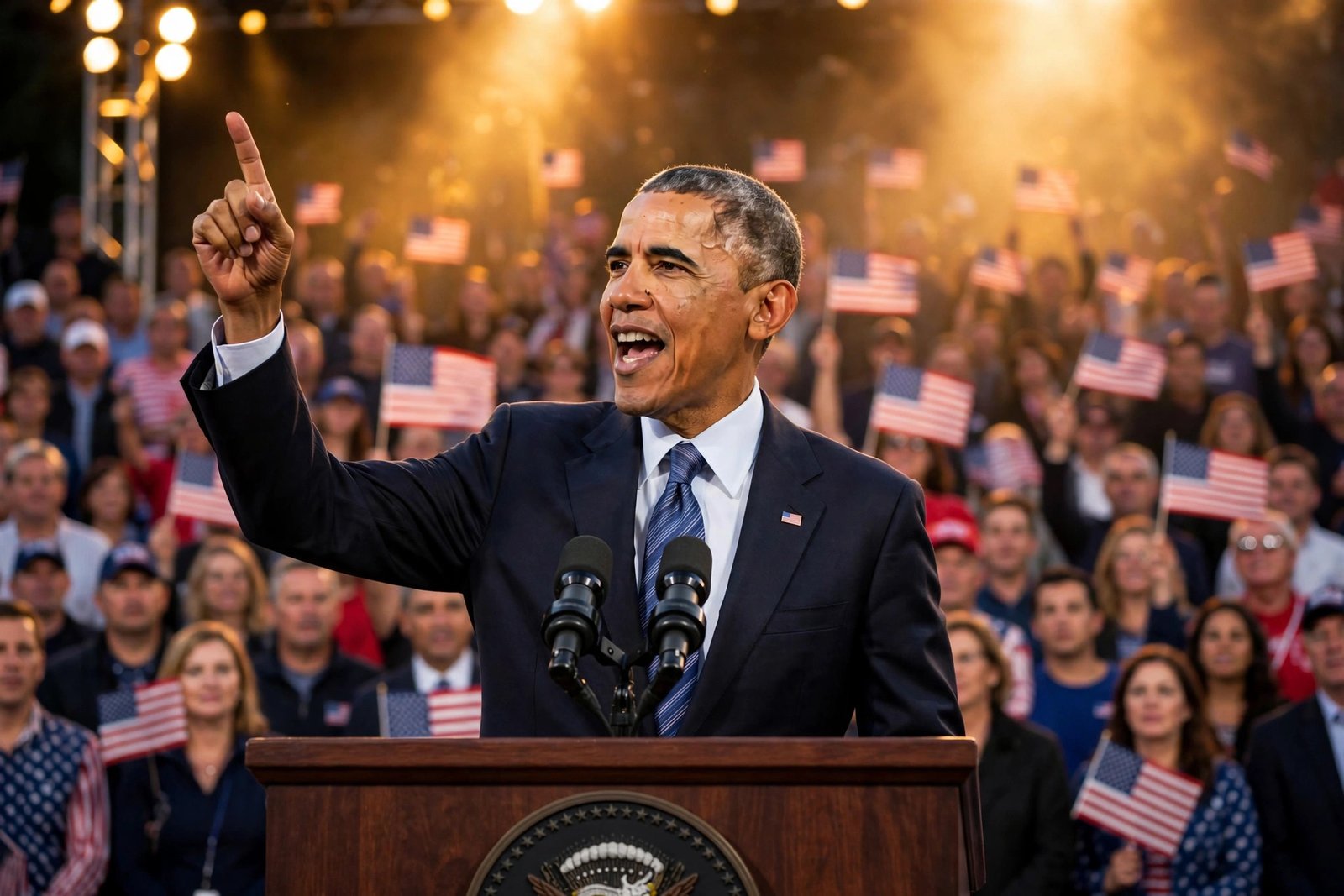
Former President Barack Obama took the campaign trail by storm on Saturday, stumping for Democrats at rallies in Cleveland and Detroit just nine days before the November 3 midterm elections. The Obama midterm rallies marked his most aggressive intervention of the 2026 campaign so far, as he accused President Donald Trump of corruption, mocked his Iran strategy and ridiculed the gilded makeover of the White House.
Speaking to energized crowds in two of the Rust Belt states that will help decide control of Congress, Obama framed the November 3 vote as a “circuit breaker” — a chance, in his words, to “at least rein in some of the foolishness” of Trump’s presidency. “We got to flip that circuit breaker, bring some accountability to this government,” Obama told supporters, according to Reuters, which covered both stops.
The twin rallies underscored how both parties are now deploying their biggest names in the closing stretch. Trump himself voted early on Saturday in West Palm Beach, Florida, before heading to a campaign rally in Georgia, telling voters to treat the midterms as if he were on the ballot. Obama answered that challenge directly, giving Democrats the high-profile surrogate they have been waiting for in the tightest Senate races in the country.
- Obama Midterm Rallies Deliver the “Circuit Breaker” Message
- Obama Midterm Rallies in Cleveland: Brown and Acton Take the Stage
- Obama Midterm Rallies in Detroit: El-Sayed, Benson and Day One of Early Voting
- Obama Midterm Rallies and the Corruption Charge: “Grifting, on Your Dime”
- Obama Midterm Rallies Take Aim at the Iran Strategy
- Obama Midterm Rallies Mock the White House Makeover
- Obama Midterm Rallies vs. Trump: Two Presidents, One Saturday
- Extra Knowledge: Inside Obama’s Expanded 2026 Campaign Machine
- Extra Knowledge: Why Ohio and Michigan Decide the Senate
- What’s Next
- Additional Details
Obama Midterm Rallies Deliver the “Circuit Breaker” Message
The central theme of the Obama midterm rallies was accountability. Nine days out from elections that will determine control of the closely divided Congress, Obama told crowds that the vote was not just about individual candidates but about placing a check on a presidency he described as unchecked. His “circuit breaker” line, delivered in Michigan while campaigning for Senate candidate Abdul El-Sayed, quickly became the defining soundbite of the day.
“We got to flip that circuit breaker, bring some accountability to this government,” Obama said, framing the November 3 vote as a moment to interrupt what he characterized as a run of excesses. The metaphor was deliberate: a circuit breaker does not rebuild the house, it stops the surge. For Democrats, that framing offers a middle path between promising a sweeping reversal and settling for incremental gains.
Obama, who served as president from 2009 until Trump began his first term in 2017, remains one of the most popular figures among Democrats. Party strategists hope that bringing him into the race can fire up supporters in Senate contests where polling averages show races within a few points. His Saturday swing through Ohio and Michigan — two states where Democrats must win to have any realistic path to the Senate majority — was the clearest sign yet that the party is going all-in on that bet.
Obama Midterm Rallies in Cleveland: Brown and Acton Take the Stage
In Cleveland, Obama campaigned alongside former Senator Sherrod Brown, who is trying to unseat Republican Senator Jon Husted from the seat once held by Vice President JD Vance, and Dr. Amy Acton, the Democratic nominee for governor. The Associated Press reported ahead of the trip that the Cleveland stop was designed to shore up support in both of Ohio’s marquee statewide races, which have drawn a flood of campaign cash.
Brown’s candidacy is unusual. The three-term former senator lost his seat just two years ago to Republican Bernie Moreno, yet remains one of Ohio’s most successful vote-getters — which is why Democrats recruited him back rather than running a newcomer. In a video endorsement recorded before the rally, Obama said Brown “worked with me to protect Ohio jobs,” adding: “This race is going to be close. It could determine which party controls the Senate and whether Ohioans can count on the people in Washington to be fighting for you.”
Acton, a former Ohio health director, faces tech entrepreneur and former presidential candidate Vivek Ramaswamy in the race to succeed term-limited Republican Governor Mike DeWine. Her campaign has focused on parts of the state that have been voting Republican in recent elections, betting that economic frustration — over gas and grocery prices — can crack open territory Democrats had written off. Polling averages compiled on October 24 put Brown narrowly ahead of Husted, keeping Ohio firmly in toss-up territory.
The Cleveland visit also marked Obama’s first trip to Ohio since 2018, a gap that speaks to how far the state has drifted from its old swing-state status — and to how seriously Democrats now take the fight to win it back. Trump stumped for Husted in Ohio earlier in the campaign, focusing heavily on immigration, and Vance has campaigned in his home state as well.
Obama Midterm Rallies in Detroit: El-Sayed, Benson and Day One of Early Voting
From Cleveland, Obama traveled to Detroit, where he campaigned with Abdul El-Sayed, the Democratic Senate nominee, and Jocelyn Benson, the party’s nominee for governor. The Detroit rally carried added weight: it fell on the first day of Michigan’s early in-person voting period, turning a campaign speech into a turnout event. El-Sayed said ahead of the rally: “I cannot wait to welcome former President Barack Obama back to Michigan.”
El-Sayed faces former Republican Representative Mike Rogers in a race that polling averages compiled on October 24 show as a narrow Democratic lead. The two met for their first debate on October 8 in Grand Rapids, a combative encounter in which they traded personal attacks. Benson, Michigan’s secretary of state, is running against Republican Representative John James for governor; the two held their first debate on October 6.
Obama’s Detroit appearance was also a pointed show of support for El-Sayed, a progressive nominee whose bruising primary win exposed divisions within the party. El-Sayed defeated moderate Representative Haley Stevens by less than a percentage point in the August primary, a race that became a national test of the Democratic Party’s ideological direction. Vermont independent Senator Bernie Sanders and Representative Alexandria Ocasio-Cortez backed El-Sayed, while Senate Democratic Leader Chuck Schumer supported Stevens.
Obama spoke with El-Sayed by phone after his primary victory, and former Vice President Kamala Harris campaigned with him in September. His presence in Detroit on Saturday sealed that consolidation effort, lending institutional credibility to a candidate the party establishment did not universally embrace.
Obama Midterm Rallies and the Corruption Charge: “Grifting, on Your Dime”
The sharpest lines of the Obama midterm rallies were about corruption. Playing to Democrats’ most frequently repeated criticisms of Trump — and of Republicans’ willingness to go along with him — Obama told the Michigan crowd: “We have never seen a president excel in straight-up grifting, on your dime, like this. Never seen a president so intent on selling favors like this. Now the party seems to stand for corrupt government, or inept government, or no government.”
The White House did not immediately respond to a request for comment on Obama’s remarks, Reuters reported. But the attack lands on ground where polling suggests vulnerability: a Reuters/Ipsos poll in August found that 63% of Americans think the president and his family have inappropriately profited from cryptocurrency since he returned to the White House last year, and that 69% believe his policy decisions are influenced by his private business dealings.
That corruption argument is also the through-line of the Democrats’ closing message nationally. As Trump’s own midterm rallies have leaned into crowd boasts and attacks on France, Democrats have tried to keep the focus on household costs and ethics — the same pocketbook frustrations that a Reuters analysis this week found are turning foreign policy into a liability for Republicans. Obama’s “grifting” line gave that argument its most quotable form yet.
Obama Midterm Rallies Take Aim at the Iran Strategy
Obama also ridiculed the administration’s claims of victory against Iran, arguing that the war has actually handed Tehran more economic leverage. His reasoning: Iran’s threats to attack shipping in the Strait of Hormuz have unsettled oil exporters and pushed up energy costs for Americans.
“Iran now has veto power over the Strait of Hormuz, where oil goes through to get to the world,” Obama said. The line cut against the administration’s presentation of the Iran campaign as a success, and it connected the distant war to the gas prices voters see every day — a connection Democrats have been hammering as the national average hovers near record levels.
The critique arrives at a delicate moment. The administration has signaled that no major new action against Iran will come before the midterms, while reports have suggested the United States and Israel are preparing a major escalation afterward. Obama’s argument reframes that timeline: whatever comes next, he suggested, the war has already strengthened Iran’s hand over the global oil artery that runs through the Strait.
Obama Midterm Rallies Mock the White House Makeover
Obama saved some of his most memorable lines for the administration’s style. He accused the Trump team of emphasizing unimportant matters, sarcastically calling Defense Secretary Pete Hegseth someone “laser-focused on important matters like the jawline and testosterone levels of our troops” — a jab at the Pentagon’s recent focus on military fitness standards and image.
Then came the line most likely to travel furthest on social media: ridiculing the White House renovations, Obama said Trump “has got the White House looking like Saddam Hussein opened a Cheesecake Factory.” The gilded aesthetic of the renovated White House — gold trim, ornate decor, ballroom plans — has become a recurring Democratic target, and Obama’s one-liner distilled weeks of criticism into a single image.
The humor served a purpose beyond entertainment. By mocking the renovations and the fitness rhetoric, Obama painted an administration distracted by appearances while Americans struggle with prices — the same contrast Democrats are drawing in Senate races across the map, from Maine, where tariff relief has become a campaign issue, to Texas and Kansas.
Obama Midterm Rallies vs. Trump: Two Presidents, One Saturday
Saturday produced a striking split-screen: a sitting president and a former president campaigning on the same day, nine days before voters decide Congress. Trump voted early in West Palm Beach alongside his wife Melania, told reporters he had cast all his ballots for Republican candidates, and then headed to Georgia for a Republican campaign rally. He also repeated his claim that he won the 2020 election, saying the results had been manipulated — a claim for which no credible evidence exists.
Trump has been telling voters to view the midterms as if he were on the ballot, and Obama on Saturday effectively accepted that framing — from the other side. Where Trump asks voters to pretend he is running, Obama asked them to treat the vote as a circuit breaker on his presidency. The two messages will now compete for the final nine days, with both men expected to keep campaigning through Election Day.
The dueling appearances also highlight the stakes both parties see. Prediction markets and forecasters broadly favor Democrats in the House race, with the Senate still in play — and with early voting already underway in many states, the window for persuasion is closing fast. More than 24 million early ballots had already been cast nationally by the weekend, according to election trackers.
Extra Knowledge: Inside Obama’s Expanded 2026 Campaign Machine
What made Saturday’s Obama midterm rallies notable was not just the rhetoric but the scale of the operation behind them. According to plans shared first with the Associated Press, Obama is significantly expanding his midterm involvement in the closing weeks, with additional campaign stops and advertisements expected before Election Day.
The numbers behind that machine are striking: Obama has raised more than $13.6 million for Democrats since last year and taped two dozen advertisements for candidates, CBS News reported. That fundraising and ad blitz puts him among the party’s most valuable assets — not just as a speaker, but as a financier of the final push. Democrats have also deployed former President Bill Clinton, who made his first campaign stop of 2026 for Florida gubernatorial nominee David Jolly on October 20, giving the party two former presidents on the trail in the final stretch.
There is also a historical echo worth noting. Obama’s 2010 midterms, his first as president, produced a Republican wave that he himself called a “shellacking,” and 2014 cost Democrats the Senate. Saturday’s “circuit breaker” framing reflects that history: rather than promising voters a transformed Washington, Obama pitched a defensive, accountability-first vote — the message of a party that has learned how midterm waves actually work.
Extra Knowledge: Why Ohio and Michigan Decide the Senate
The choice of Cleveland and Detroit was no accident of geography. Ohio and Michigan sit at the center of the Senate math because both feature Democratic challengers trying to flip or hold seats in states Trump carried, in races polling averages show as genuine toss-ups. In Ohio, Brown is chasing the seat Husted was appointed to after Vance became vice president; in Michigan, El-Sayed is defending an open Democratic seat against Rogers.
The deeper story is in the primary results. In Michigan, the Democratic primary split almost evenly along ideological and geographic lines: Stevens took about 51% of the Democratic primary vote in Wayne County, which includes Detroit, to El-Sayed’s 45% — even as El-Sayed won statewide by less than a point. That split, in a county where more than three-quarters of residents are Black, was a warning sign for Democratic unity that Obama’s Saturday appearance was designed to erase.
In Ohio, the dynamic runs the other way: Brown’s return gives Democrats a proven statewide winner in a state that has trended Republican, while Acton’s governor campaign tests whether a health-focused, suburban-and-small-town message can compete with Ramaswamy’s entrepreneur brand. If Democrats win both Senate races, their path to the majority stays alive; if they lose either, it narrows dramatically. That is why a former president spent his Saturday in Cleveland and Detroit — and why both parties will keep fighting over these two states until the polls close.
What’s Next
Will Obama campaign again before Election Day? Yes, almost certainly. His team has signaled additional stops and advertisements in the closing weeks, and with nine days left, Democrats are expected to deploy him in more toss-up states where his popularity can drive turnout.
How will the White House respond? The White House did not immediately respond to Obama’s remarks on Saturday. Trump, who was campaigning in Georgia the same day, is likely to answer on the trail or on social media, where he has repeatedly attacked his Democratic predecessor.
Does a former president actually move votes? Historically, the effect is mostly about turnout rather than persuasion: Obama’s rallies energize Democratic base voters and can boost early voting, as Saturday’s Detroit event — held on day one of Michigan early in-person voting — was designed to do. Whether that is enough in races decided by one or two points will be answered on November 3.
What should voters watch next? Early voting numbers in Ohio and Michigan, the next round of Senate polls in both states, and whether Obama adds stops in other battlegrounds such as Texas, Kansas or Maine in the final week.
Additional Details
Description: Barack Obama campaigned for Democrats at rallies in Cleveland and Detroit on Saturday, October 24, 2026, nine days before the November 3 midterm elections, calling the vote a “circuit breaker” on Donald Trump’s presidency, accusing Trump of corruption, criticizing his Iran strategy and mocking White House renovations, while stumping for Sherrod Brown and Amy Acton in Ohio and Abdul El-Sayed and Jocelyn Benson in Michigan.