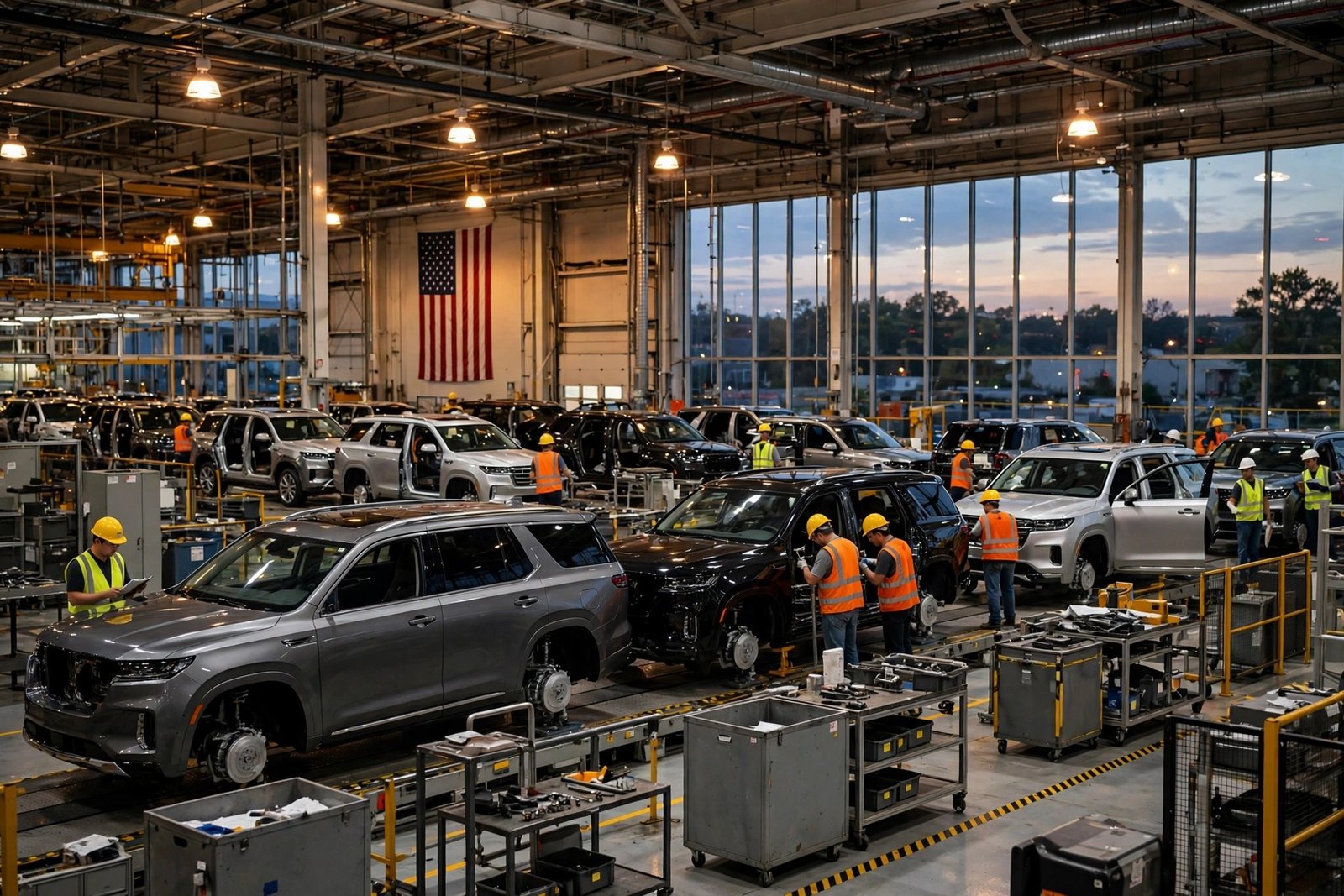
President Donald Trump announced on Saturday that Audi will build its first American assembly plant near Macon, Georgia, unveiling the Audi Georgia plant at a campaign rally in Perry as Republicans fight to hold Congress in the November 3 midterm elections. The Audi Georgia plant, a roughly $4 billion investment by Volkswagen’s premium brand, is planned to produce 200,000 SUVs a year and create about 4,500 jobs, with construction starting in 2027 and production beginning in the early 2030s.
Trump presented the Audi Georgia plant as proof that his tariff policies are pulling manufacturing back into the United States, telling the crowd in Perry that the German automaker would not be coming without them. Audi chief executive Gernot Döllner joined Trump on stage and called the project a long-term bet on the American market, saying the company plans to build its biggest and most premium SUVs in Macon.
The timing was no accident. The Audi Georgia plant announcement landed 9 days before Election Day in a battleground state where Republicans are defending a Senate seat and the governor’s mansion, and where Trump himself has now campaigned twice in eight days. As Reuters reported, Trump has pressed automakers to move production to the United States and raised tariffs on autos, steel, aluminum and parts — and he is eager to show voters that strategy is delivering jobs before they cast their ballots.
- Audi Georgia Plant Announcement: What Trump Unveiled in Perry
- Audi Georgia Plant Jobs and Timeline: 4,500 Jobs and 200,000 SUVs a Year
- Audi Georgia Plant and Tariffs: “If It Weren’t for the Tariff, They Wouldn’t Have Come”
- Audi Georgia Plant and the Georgia Midterm Races
- Audi Georgia Plant’s South Carolina Sibling: 25,000 Vehicles at Scout
- Extra Knowledge: Audi Georgia Plant Follows a $1.4 Billion Tariff Bill and Falling Sales
- Extra Knowledge: Audi Georgia Plant Fits a Wider Automaker Pattern
- Audi Georgia Plant Critics: Prices, Lost EV Incentives and a Long Wait
- What’s Next for the Audi Georgia Plant?
- Additional Details
Audi Georgia Plant Announcement: What Trump Unveiled in Perry
Trump made the Audi Georgia plant announcement at a rally at Guardian Centers in Perry, about 30 miles from the planned site near Macon in central Georgia. The rally had originally been billed for Macon before it was moved to Perry, and supporters had been gathering outside the venue since the morning, according to local coverage of the event.
“I am very pleased to announce that a fantastic corporation is making a major auto manufacturing investment in the great state of Georgia,” Trump told the crowd, as reported from the rally. “Think about it. 200,000 units a year. It’s truly amazing. This will be the single largest investment in the history of the American auto industry, in modern times.”
Döllner, the chairman of Audi’s board of management, stood alongside Trump as the announcement was made. “We are planning to bring our biggest and most premium SUVs, and produce them here in Macon, Georgia,” Döllner said. “This is a long-term investment, because we believe in the American market.”
The Audi Georgia plant will be Audi’s first assembly plant in the United States. Until now, Audi has imported every vehicle it sells in America from Europe or Mexico, leaving it fully exposed to the tariffs Trump imposed on imported cars and parts. A gold Audi with manufacturer license plates was parked outside the rally, a visual reminder of the brand Trump was courting on stage.
According to the Associated Press, Trump put the commitment at $4.2 billion for the plant near Macon, while Reuters reported the figure as about $4 billion. Either way, the project ranks among the largest single auto investments announced in Georgia, and Audi said in a news release that the plant would be its first in the state.
Audi Georgia Plant Jobs and Timeline: 4,500 Jobs and 200,000 SUVs a Year
The headline numbers for the Audi Georgia plant are striking: approximately 4,500 jobs, annual production of 200,000 vehicles, and a plant designed around Audi’s largest and most expensive SUVs. A U.S. official told Reuters the plant is expected to assemble the Audi Q7, Q8 and Q9 — the flagship models at the top of the brand’s lineup.
The timeline, however, is long. Construction is scheduled to begin in 2027, and production is not expected to start until the early 2030s, according to Audi. That means the Audi Georgia plant will not employ a single assembly worker or roll a single SUV off the line before voters decide the midterms, the 2028 presidential election, or even the 2030 midterms.
That long runway is normal for a greenfield auto plant, which requires land preparation, supplier networks, workforce training and tooling before production begins. But it also means the immediate economic effect in central Georgia will come from construction and site preparation, not from the 4,500 permanent jobs, which will phase in as production ramps up in the next decade.
For Macon and the surrounding region, the Audi Georgia plant still represents a major anchor investment. Auto plants typically draw suppliers, logistics firms and service businesses around them, and Georgia officials have spent years marketing the state — including the Middle Georgia Mega Site described in company materials as an investment-ready location — to large manufacturers.
The Q7, Q8 and Q9 focus also matters for the plant’s economics. Large premium SUVs carry higher margins than small cars, which helps justify a multibillion-dollar factory even as the broader auto market faces high borrowing costs and cautious consumers. Audi said the Georgia plant would be designed for premium SUVs tailored to North American customers and manufactured locally.
Audi Georgia Plant and Tariffs: “If It Weren’t for the Tariff, They Wouldn’t Have Come”
Trump left no doubt about how he wants voters to interpret the Audi Georgia plant. “If it weren’t for the tariff, they wouldn’t have come,” he said at the rally, crediting what he called his aggressive tariff policies for the company’s decision. The line echoed the central pitch of his midterm campaign: that tariffs, however unpopular with some economists, are forcing global companies to build in America.
The argument has a concrete foundation in Audi’s case. Last year, Trump’s tariffs dealt Audi a 1.2 billion euro ($1.4 billion) blow, according to Reuters, because the company imports all of its U.S.-market vehicles from Europe or Mexico. Building the Audi Georgia plant inside the tariff wall would eventually let Audi avoid those import duties on its biggest SUVs altogether.
That logic is exactly what tariff supporters predicted: make importing expensive enough, and manufacturers will localize production. It is also the logic behind Trump’s broader pressure campaign on automakers, which has combined tariffs on autos, steel, aluminum and parts with regulatory changes and public praise for companies that announce U.S. plants.
Republican Senator Bernie Moreno of Ohio amplified the message late on Saturday, saying that “with this investment, Audi will build all of their SUVs exclusively in the US.” Moreno added that the Audi Georgia plant “would never have happened without tariffs, without common sense regulations and without eliminating California’s ability to regulate fuel economy standards.”
Whether tariffs deserve the full credit is harder to prove. Automakers weigh many factors when siting a plant — labor costs, logistics, energy prices, supplier networks, state incentives and proximity to customers — and Audi had been studying a U.S. plant for years before the current tariff regime. The company’s own statement emphasized a long-term belief in the American market rather than tariffs specifically, a distinction worth keeping in mind as the claim is repeated on the campaign trail.
Audi Georgia Plant and the Georgia Midterm Races
The Audi Georgia plant announcement was staged as a campaign event, not a corporate press conference, and its political purpose was plain. Trump used the Perry rally to boost Republican candidates in a state where the Senate and governor’s races could help decide control of Congress and state government.
In the Senate race, Republican Representative Mike Collins is trying to unseat Democratic Senator Jon Ossoff, who is seeking another term. In the governor’s race, Republican Rick Jackson is running against Democrat Keisha Lance Bottoms, the former Atlanta mayor. Trump won Georgia in 2024 after losing it in 2020, and the state remains one of the country’s most competitive battlegrounds.
Jackson thanked Trump from the stage for the announcement. “Thank you on behalf of Georgia for putting the biggest economic deal in Georgia history right here today,” he said, according to the Associated Press. The line captured the Republican hope: that a jobs announcement in central Georgia will translate into turnout and swing-voter support in the final 10 days.
The Perry rally was Trump’s second Georgia visit in eight days, following his October 16 rally in Dalton, where he urged Georgians to treat the midterms as though his own name were on the ballot. As Reuters’ analysis of Trump’s midterm rallies found, the president’s economic pitch has collided with voter frustration over prices, with national gas prices averaging $4.27 a gallon — a tension the Audi Georgia plant announcement is designed to ease.
Democrats, meanwhile, are countering with their own star power. Former President Barack Obama is scheduled to campaign in Atlanta on October 28 for Ossoff and Bottoms, four days after Trump’s Perry rally, setting up a closing-week duel of presidential surrogates in Georgia.
Audi Georgia Plant’s South Carolina Sibling: 25,000 Vehicles at Scout
The Audi Georgia plant was not the only piece of Volkswagen news tucked into the announcement. A U.S. official told Reuters that Audi also plans to build 25,000 vehicles a year in neighboring South Carolina, at a $2 billion plant belonging to VW’s off-road brand Scout Motors that is under construction in Blythewood, near Columbia.
Some of those vehicles are currently built in Europe and would be exported under the new arrangement, the official said. The South Carolina detail shows that the Audi Georgia plant is part of a wider Volkswagen effort to build a North American production pillar alongside its existing networks in Europe and China, rather than a one-off Georgia project.
Scout Motors itself is a revival story: Volkswagen resurrected the Scout nameplate, once an American off-road icon, as a dedicated electric off-road brand, and its Blythewood plant is one of the largest industrial projects in South Carolina’s history. Adding Audi production there spreads Volkswagen’s U.S. bet across two Southeastern states and two brands.
For Georgia, the South Carolina connection cuts both ways. It confirms that Volkswagen sees the Southeast as its American manufacturing home, which should help Georgia suppliers. But it also means some Audi-related production — and the jobs that come with it — will land across the state line, a reminder that state-level jobs announcements are often part of multi-state corporate strategies.
Extra Knowledge: Audi Georgia Plant Follows a $1.4 Billion Tariff Bill and Falling Sales
To understand why the Audi Georgia plant matters to Audi itself, look past the rally stage to the company’s balance sheet. Audi’s sales have fallen for two consecutive years and slid 7% in the first half of 2026, according to Reuters, as fierce competition in China and U.S. tariffs hit demand. Its U.S. sales are down 16% this year — a steep decline for a premium brand that depends on American buyers for a large share of its profits.
The tariff bill explains much of the pressure. Because Audi imports every U.S.-market vehicle from Europe or Mexico, last year’s tariffs cost it 1.2 billion euros, or about $1.4 billion — money that would otherwise have funded new models, technology or marketing. Building the Audi Georgia plant is, in that light, less a favor to any politician than a straightforward business decision to stop paying a recurring tax on its own products.
Audi’s German footprint adds another layer that most rally coverage skipped. The company’s Neckarsulm plant in southwest Germany is one of four German Volkswagen plants facing possible closure after 2030, according to Reuters. A U.S. plant does not automatically mean a German plant closes, but the timing — new American capacity rising just as older German capacity faces an uncertain future — shows how tariff pressure is reshaping where global automakers put their factories.
That context also tempers the claim that the Audi Georgia plant proves tariffs create jobs without costs. Audi absorbed a $1.4 billion hit before announcing the plant, American buyers faced higher prices on imported Audis in the meantime, and the plant itself will not produce a vehicle until the early 2030s. The jobs are real, but they arrive after years of costs that consumers and the company have already paid.
Extra Knowledge: Audi Georgia Plant Fits a Wider Automaker Pattern
The Audi Georgia plant is the latest in a series of tariff-era auto announcements that reveal how differently each automaker is responding to the same pressures. In July, Japan’s Toyota said it would spend $3.6 billion to build a 2.5-million-square-foot truck assembly line on its San Antonio, Texas, manufacturing campus and shift some truck production to the U.S. from Mexico, creating 2,000 jobs by 2030, according to Reuters.
Honda, by contrast, is still deciding. The Japanese automaker is considering building a U.S. assembly plant but has warned it may not unless the U.S.-Mexico-Canada Agreement on trade is extended, Reuters reported. South Korea’s Hyundai went further, saying last year that if it had certainty about USMCA, it “would immediately unlock over $20 billion in new American investments.”
The pattern is instructive. Toyota moved first with a concrete, funded expansion of an existing campus. Audi followed with a greenfield plant a decade from production. Honda and Hyundai are holding their biggest commitments hostage to trade-deal certainty. All four companies are responding to tariffs, but none of them is responding in quite the same way — and the differences show that tariff policy alone does not dictate corporate strategy.
Trade uncertainty itself has been a drag, critics note. Reuters reported that critics say tariffs have boosted vehicle prices and that trade uncertainty has delayed some automaker investments, a counterweight to the White House’s claim that tariffs are unambiguously pulling factories to America. The Audi Georgia plant announcement, with its early-2030s production date, fits both narratives at once: a major commitment, and a very long wait.
Audi Georgia Plant Critics: Prices, Lost EV Incentives and a Long Wait
Critics of the tariff strategy argue that the Audi Georgia plant should not obscure what tariffs have already cost American car buyers. Tariffs on imported vehicles and parts tend to raise prices, and with the average new vehicle already expensive, even modest increases push monthly payments higher for working families. That pocketbook effect is central to the midterm debate: as Reuters’ pocketbook analysis found, most voters blame Trump policies for prices rising faster than earnings.
The administration’s own record on electric vehicles complicates the manufacturing story further. Trump has cut government incentives for electric vehicles, causing a significant reduction in U.S. EV and battery production, according to Reuters. U.S. vehicle and parts employment has actually fallen since Trump took office last year, despite the drumbeat of plant announcements.
That jobs paradox — announcements up, employment down — is the strongest rebuttal to the rally-stage narrative. Plant announcements make headlines; hiring, layoffs and supplier shifts determine actual employment. Until the Audi Georgia plant and its peers begin hiring at scale, the net effect of the tariff era on auto jobs remains negative by Reuters’ account.
Supporters counter that the employment decline reflects automation, model changeovers and the broader economy, not tariffs alone, and that the announced plants will reverse the trend in the 2030s. That is a plausible long-term case, but it asks voters to judge a policy by factories that do not yet exist — a difficult sell 10 days before an election fought largely on today’s prices.
There is also the question of incentives. Large auto plants rarely arrive without state and local tax breaks, infrastructure spending and workforce training subsidies, and Georgia’s package for the Audi Georgia plant has not yet been publicly detailed. Voters and taxpayers in central Georgia will reasonably want to know what the state offered, what it gets in return, and what happens if Audi’s timeline slips — questions that a rally announcement, by design, does not answer.
What’s Next for the Audi Georgia Plant?
When will construction actually start? Audi says construction is scheduled to begin in 2027. Watch for site preparation at the Macon-area location, environmental permits and any state incentive package debated in the Georgia legislature — those filings will show whether the 2027 date is firm.
Will the 4,500 jobs figure hold? Auto plants often revise headcount as automation and model plans change. The 4,500 figure is Audi’s current estimate for full production in the early 2030s; supplier jobs around the plant could add thousands more, or the total could shrink if the Q7, Q8 and Q9 lineup changes.
Does the Audi Georgia plant help Republicans on November 3? That is the political bet behind the Perry rally. Georgia’s Senate and governor races are close, and a jobs announcement in central Georgia gives Collins and Jackson a tangible talking point. Whether voters credit tariffs or simply welcome any jobs news will only be clear after the votes are counted.
What happens in South Carolina? The Scout Motors plant in Blythewood is already under construction, so Audi’s 25,000-vehicle South Carolina production could begin well before the Georgia plant opens. Watch for details on which models move there and when.
Will tariffs change before the plant opens? The Audi Georgia plant will not produce a vehicle until the early 2030s, spanning at least two presidential terms. Any future change to auto tariffs — up, down or replaced by a new trade deal — could alter the economics of building SUVs in Georgia versus importing them.
Additional Details
Description: Trump announced Audi’s roughly $4 billion Georgia plant at a Perry rally on October 24, 2026: Audi’s first U.S. assembly plant, near Macon, producing 200,000 Q7, Q8 and Q9 SUVs a year and creating about 4,500 jobs, with construction starting in 2027 and production in the early 2030s. Trump credited tariffs for the investment; Audi CEO Gernot Döllner called it a long-term bet on the American market. Audi also plans 25,000 vehicles a year at VW’s Scout Motors plant in Blythewood, South Carolina.
The announcement doubles as a midterm pitch in Georgia’s Collins-Ossoff Senate and Jackson-Bottoms governor races, 9 days before November 3 — while critics note tariffs already cost Audi $1.4 billion, U.S. auto employment has fallen, and no Georgia-built Audi will arrive until the next decade.
- Announcement: Perry, Georgia rally, October 24, 2026 (Guardian Centers)
- Investment: about $4 billion (Reuters); $4.2 billion (Associated Press)
- Location: near Macon, Georgia — Audi’s first U.S. assembly plant
- Production: 200,000 SUVs a year (Q7, Q8, Q9); construction 2027, production early 2030s
- Jobs: approximately 4,500 at full production
- South Carolina: 25,000 Audi vehicles a year at Scout Motors, Blythewood
- Tariff context: €1.2 billion ($1.4 billion) tariff cost to Audi last year; U.S. sales down 16% in 2026
- Election Day: November 3, 2026 — 9 days after the announcement
- Source reporting: Reuters, October 24, 2026, by Bo Erickson and David Shepardson; Associated Press, October 24, 2026