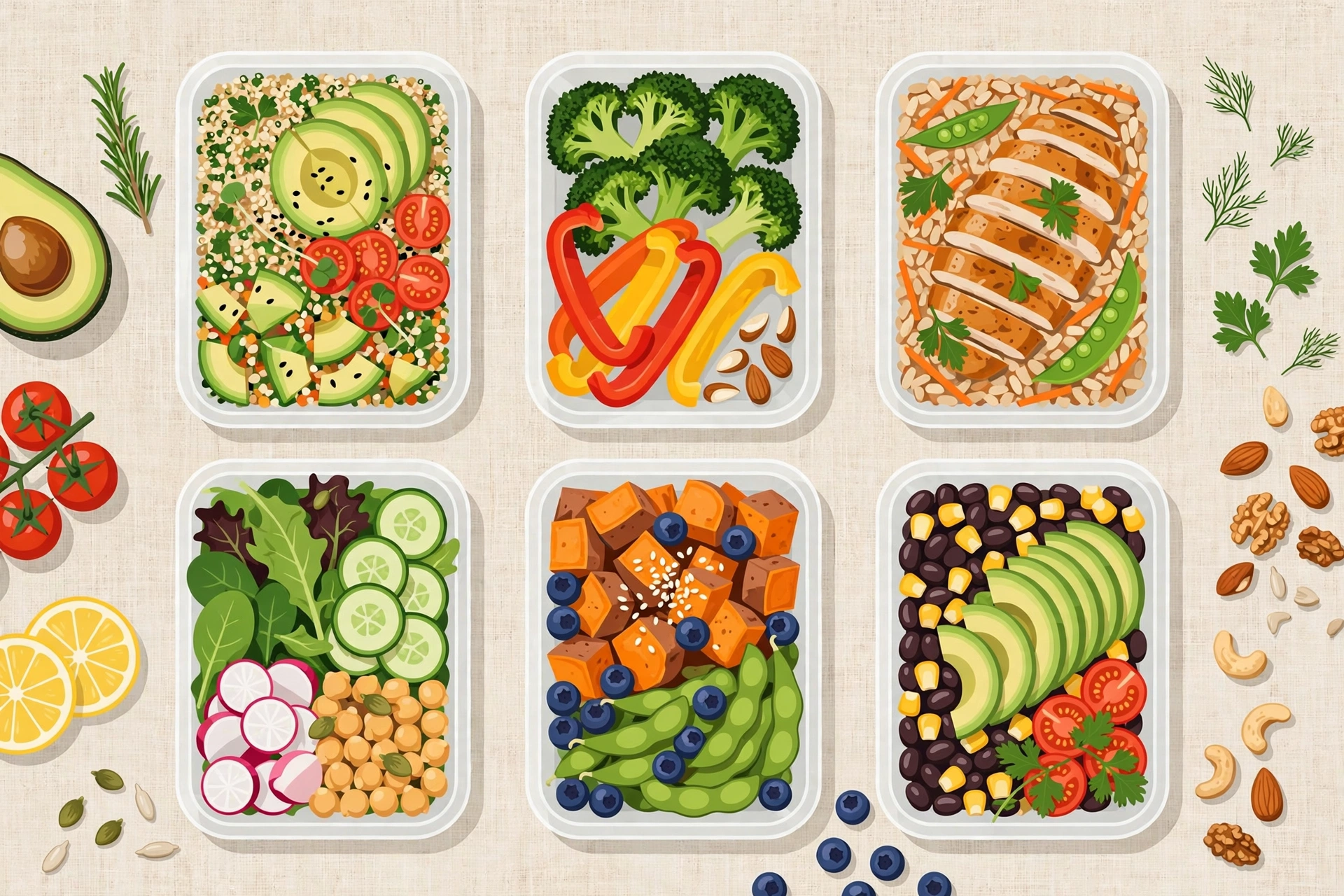
Meal prep — cooking in batches to eat well all week — is the closest thing to a life hack that nutrition science endorses. It saves money, slashes weeknight stress, improves diet quality, and reclaims hours. Yet meal prep for beginners often quit after one exhausting Sunday. This meal prep for beginners guide shows you how to start simply, avoid burnout, and build a sustainable practice.
Why Meal Prep Works So Well
Decision fatigue is real. After a full day of decisions, the "what's for dinner" question at 6 PM defeats willpower. Pre-decided meals eliminate the vulnerable moment when takeout apps beckon.
The economics are staggering. A home-cooked meal costs $2-4 per serving; takeout runs $12-20. Prepping just 5 weekly dinners saves a household $200-400 monthly — $2,400-4,800 yearly.
Nutrition improves automatically. You control ingredients, portions, and cooking methods. Studies link meal planning with better diet quality, more vegetable intake, and lower obesity rates.
Time math favors batches. Cooking 5 portions of one dish takes marginally longer than cooking one. The per-meal time cost plummets.
The Two Approaches: Full Prep vs. Component Prep
Full meal prep: Cooking complete meals, portioned into containers, ready to reheat. Maximum weeknight convenience; can feel monotonous by Thursday.
Component prep (recommended for beginners): Preparing building blocks — a grain, 2 proteins, roasted vegetables, a sauce, washed greens — then mixing and matching through the week. More variety, less boredom, slightly more assembly required.
Start with component prep. It is more forgiving, more flexible, and teaches the skills that make full prep easy later.
meal prep for beginners: Your First Prep Session
Do not attempt five new recipes in one day. Your first session:
- One grain: A big pot of rice, quinoa, or pasta
- One protein: Sheet-pan chicken thighs or baked tofu
- One roasted vegetable: Whatever is in season, tossed in oil and salt
- One fresh element: Washed lettuce or cut raw vegetables
- One sauce: A simple vinaigrette or sauce that makes everything taste intentional
- Containers: Glass with locking lids — microwave-safe, oven-safe, non-staining, lasting years. Start with 8-10 uniform containers.
- Sheet pans: Two large rimmed pans handle most roasting.
- A big pot and a sharp knife: The fundamentals.
- Mason jars: Perfect for overnight oats, salads (dressing on bottom), and snacks.
- Cool quickly: Divide large batches into shallow containers; refrigerate within 2 hours of cooking
- Know your windows: Cooked meals last 3-4 days refrigerated. Plan accordingly — prep Sunday for Sunday-Wednesday, with a mini-prep Wednesday for the rest, or freeze portions.
- Freeze smartly: Soups, stews, cooked grains, and proteins freeze beautifully for 2-3 months. Label with contents and date.
- Reheat thoroughly: Steaming hot throughout (165°F). When in doubt, throw it out.
- Raw and cooked separation: Standard food safety applies doubly in batch cooking.
- Start with 3 days, not 7. Prep lunches only, or dinners only. Expand when it feels easy.
- Repeat favorites shamelessly. Variety is nice; sustainability is essential.
- Keep one wild card. Leave room for spontaneity — a dinner out, a craving. Rigidity kills habits.
- Prep with entertainment. Podcasts, music, or a partner make sessions enjoyable rather than chores.
- Forgive bad weeks. Skipped a week? Just start again. Perfection is the enemy of the good habit.
That is it. Ninety minutes, five components, a week's worth of mix-and-match lunches and dinners.
Essential Equipment (You Need Less Than You Think)
Skip the specialized gadgets until you know your routine. Most meal-prep failures come from complexity, not equipment gaps.
food safety: The Non-Negotiable Rules
Building Your Recipe Rotation
Collect 10-12 reliable recipes you genuinely enjoy — this is your rotation. Criteria: reheats well (soups, stews, curries, grain bowls, roasted proteins), uses overlapping ingredients (efficiency), and includes flavors you will not tire of by day three.
Reheat champions: Chili, curry, pulled meats, lasagna, fried rice, hearty soups, grain bowls.
Reheat disappointments: Crispy things (go soggy), delicate fish, cream-based sauces (can split), fresh salads (prep components separately).
The Weekly Rhythm
Plan (15 min, e.g., Friday): Choose 2-3 dinners and lunches from your rotation; make a grocery list.
Shop (with list): Stick to the plan.
Prep (90-120 min, e.g., Sunday): Cook components while multitasking — grains simmer while vegetables roast while proteins bake.
Midweek check (5 min, Wednesday): Assess supplies; do a 20-minute mini-prep if needed.
Total weekly time: about 2.5 hours for 10+ meals. Compare to 30+ minutes per meal cooked from scratch nightly.
Avoiding Burnout: The Sustainability Rules
Meal Prep by Goal
Weight management: Pre-portioning is the mechanism — decided portions beat in-the-moment judgment. Include protein and fiber at every meal for satiety.
Muscle building: Batch-cook proteins; keep carbs ready; hit protein targets without daily cooking.
Family feeding: Component prep shines — picky eaters assemble their own combinations from shared components. Everyone eats; nobody cooks twice.
Tight budgets: Base preps on sale items and staples (rice, beans, eggs, seasonal produce, chicken thighs). Some of the cheapest foods are the most prep-friendly.
Beyond Dinner: Breakfast and Snacks
Overnight oats in mason jars (5 minutes for 5 breakfasts). Hard-boiled eggs by the dozen. Cut vegetables with hummus. Energy balls from oats, peanut butter, and honey. Prepped snacks prevent the vending-machine trap as effectively as prepped dinners prevent takeout.
The Bottom Line
Meal prep is not about becoming a different person — it is about making your current life easier. Start embarrassingly small, focus on components, respect food safety, forgive imperfection, and let the habit compound. Within a month, you will wonder how you ever survived weeknights without it. Your wallet, your health, and your 6 PM self will all thank you.
Meal Prep for Special Diets
The component approach adapts beautifully to dietary needs. High-protein: double the protein components, keep carbs measured. Vegetarian/vegan: batch-cook legumes, tofu, tempeh; nutritional yeast and tahini-based sauces add depth. Gluten-free: naturally compliant with rice, quinoa, potatoes as bases. Low-carb: cauliflower rice, zoodles, and extra roasted vegetables replace grains. The framework stays constant; only the components change — which is why learning the system matters more than collecting recipes.
Storage Guide: What Lasts How Long
Not all prepped foods are equal. Grains (rice, quinoa): 4-5 days refrigerated, months frozen. Cooked proteins (chicken, beef, tofu): 3-4 days refrigerated, 2-3 months frozen. Roasted vegetables: 4-5 days refrigerated. Soups and stews: 4 days refrigerated, 3 months frozen — they often taste better on day two. Hard-boiled eggs: one week refrigerated in shell. Cut raw vegetables: 5-7 days in water-filled containers. Sauces and dressings: 1-2 weeks. When freezing, cool completely first, leave headspace for expansion, and label everything — mystery containers get thrown away, labeled ones get eaten.