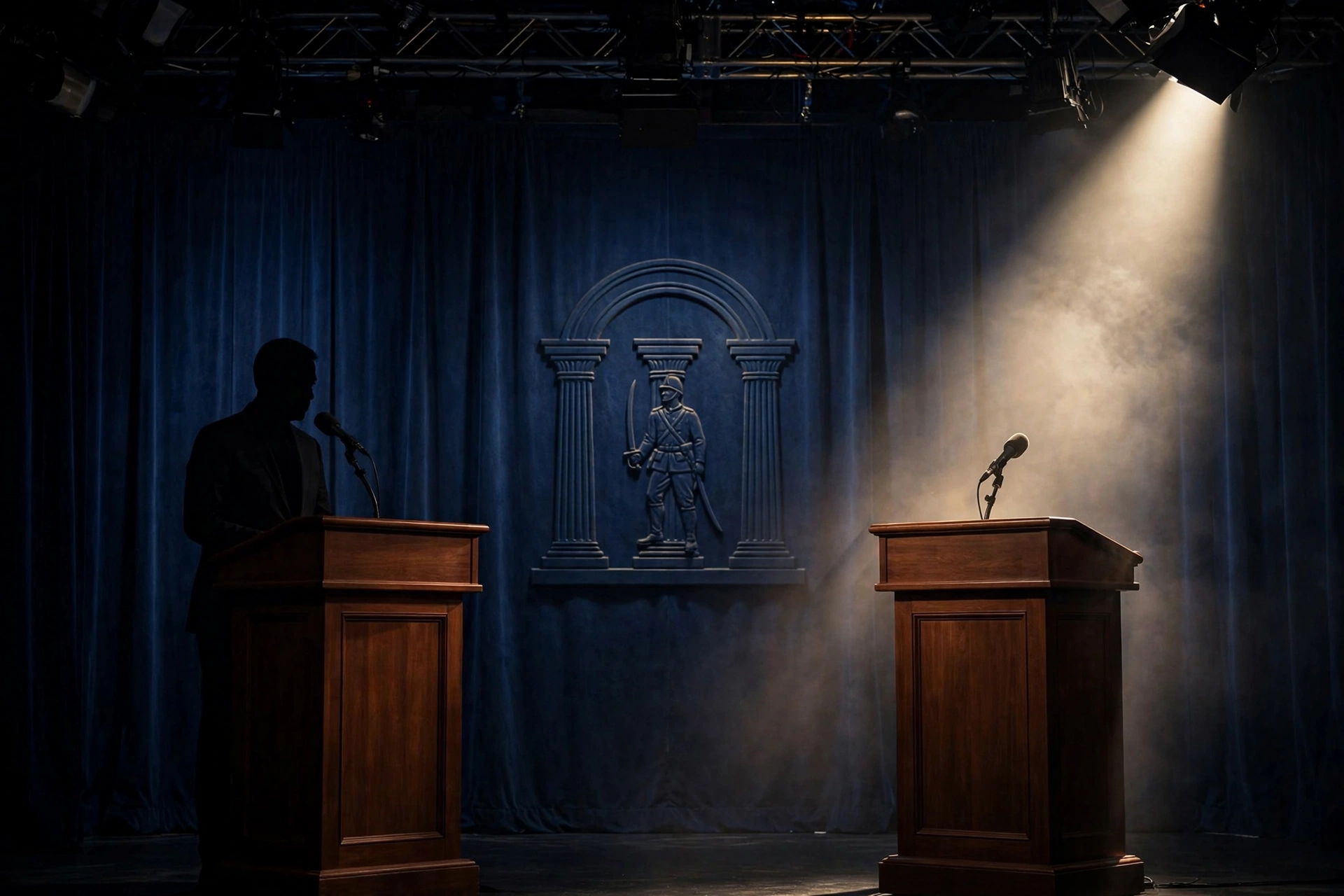
The Keisha Lance Bottoms debate Monday night looked like no Georgia governor’s debate in a generation: one candidate, one empty lectern, and a television audience watching history get made for the wrong reasons. Democrat Keisha Lance Bottoms took the stage alone at the Atlanta Press Club’s Loudermilk-Young Debates, held at the Georgia Public Broadcasting studio, after Republican nominee Rick Jackson declined to participate — becoming the first major-party Georgia gubernatorial candidate to skip one of the club’s general-election debates since 1994, a span of 32 years.
What Happened at the Keisha Lance Bottoms Debate
Monday’s governor’s debate was scheduled for 8 to 9 p.m. Eastern and broadcast live on Georgia Public Broadcasting. When the cameras went on, only Bottoms was there. Organizers placed an empty lectern beside her as a visible marker of her opponent’s absence — and Bottoms used it as a prop all night.
Jackson, a billionaire health care executive, announced his debate plans months ago and reaffirmed them at the beginning of September: he would not attend the Atlanta Press Club debate. Instead, he opted for a town hall-style event with Atlanta News First last week, taking questions from undecided voters rather than a panel of journalists — a format his campaign described as the true debate of the election.
The Keisha Lance Bottoms debate solo appearance thus turned into something between a town hall and an indictment: Bottoms took questions from journalists while repeatedly directing attention to the vacant podium, accusing Jackson of avoiding scrutiny.
Why Rick Jackson Skipped the Debate
Jackson’s campaign has been consistent about its reasoning. Campaign spokesperson Garrison Douglas said in a statement that “Rick is running to fight for everyday Georgians — not the media, not the political class, and not the special interests,” adding that the town hall format “allows voters to ask their own questions, hear direct answers, and decide for themselves who they trust to move Georgia forward.”
That framing became a centerpiece of Keisha Lance Bottoms debate coverage, as journalists pressed her on whether a governor can legitimately avoid a debate and still claim to represent the state.
The campaign confirmed to USA Today on September 1 that Jackson would not attend the Atlanta Press Club debate, framing the Atlanta News First town hall as “the debate for (this) election.” On Monday, Jackson said earlier in the day that voters — not the media — were his priority, and he spent the day traveling the state by private jet rather than appearing in Atlanta.
Bottoms seized on that image. During the Keisha Lance Bottoms debate appearance, she pointed to the empty lectern and to Jackson’s private jet travel, arguing that a candidate who won’t answer questions from journalists is hiding from the voters he claims to serve.
A 32-Year First for the Atlanta Press Club
The Atlanta Press Club’s debate series has been a fixture of Georgia general elections for decades. Until Monday, no major-party gubernatorial nominee had declined to participate in the club’s general-election debates since 1994 — a record that held through some of the most bitter campaigns in state history.
That unbroken streak is what makes the Keisha Lance Bottoms debate night genuinely historic. Georgia Democrats called it unprecedented. The Democratic Party of Georgia issued a statement noting that Jackson “became the first gubernatorial candidate – Democrat or Republican – to refuse to participate since 1994.”
Viewers who tuned into the Keisha Lance Bottoms debate saw a candidate fielding unfiltered questions for a full hour — something her opponent has refused to do.
Jackson’s decision also reflects a broader national trend. Across the country, candidates increasingly prefer controlled formats — town halls with friendly moderators, rallies, social media — over traditional debates with independent journalists. For more on how national politics is reshaping this year’s campaigns, see our coverage of the Trump Tennessee rally, where the president’s midterm remarks went viral this weekend.
What Bottoms Said: Medicaid, Schools, and Abortion Rights
With no opponent on stage, the Keisha Lance Bottoms debate became a solo showcase for the Democratic nominee’s agenda. Bottoms, the former mayor of Atlanta, used the hour-long event to lay out a platform centered on what she described as Georgia families’ kitchen-table concerns.
Medicaid expansion: Bottoms pledged to expand Medicaid and to reduce Georgia’s reliance on Governor Brian Kemp’s Pathways health program, directing more public health spending toward residents’ needs.
Lowering costs: She promised to focus on lowering everyday costs for Georgia families, tying Jackson’s record to policies she says are raising prices.
Women’s health: Bottoms pledged to restore abortion rights in Georgia and to oppose what she called policies advanced by President Donald Trump that harm the state.
Education: She committed to investing in schools and directed criticism at Jackson’s record, arguing that his opposition to expanding public services would shortchange Georgia students.
Public safety: Bottoms called for restricting Georgia State Patrol pursuits to only the most serious circumstances — such as cases involving suspected violent crimes — arguing that motorists should not be endangered over minor violations like a broken taillight.
Democrats Call It Accountability; Republicans Call It Strategy
Georgia Democratic Party Chair Charlie Bailey issued a scathing statement after the Keisha Lance Bottoms debate: “Tonight’s Atlanta Press Club debate makes it clear why Keisha Lance Bottoms is by far the best choice to lead our state. We need a governor who actually shows up for Georgia, but Slick Rick Jackson couldn’t even be bothered to show up to tonight’s debate, becoming the first candidate for governor in over 30 years – Democrat or Republican – to skip this crucial event.”
Democrats argue Jackson is “terrified to answer” for a record they describe as rigging the system against Georgians, supporting a total abortion ban, and standing with Trump “no matter how much his policies hurt Georgians.”
Republicans, for their part, see no downside. Jackson’s team believes debates with press-panel formats favor Democrats and that direct voter contact — the campaign points to more than 150 events across the state — matters more. The Jackson camp’s calculation is simple: he has led in most polling, and a controlled campaign in the final weeks avoids unforced errors.
A Toss-Up Race With Early Voting Starting Tuesday
The stakes behind the Keisha Lance Bottoms debate standoff are enormous. The Cook Political Report with Amy Walter rates the Georgia governor’s race a toss-up, and polling shows it neck and neck. A Wick poll put Jackson at 43.2 percent and Bottoms at 42.7 percent, with 14.1 percent of voters still undecided — a true coin flip with weeks to go.
Because the Keisha Lance Bottoms debate aired the night before early voting began, the contrast it drew may reach voters at exactly the moment they make up their minds.
Early voting in Georgia begins Tuesday, meaning the solo debate aired on the eve of ballots being cast. For undecided voters, the image of an empty lectern — and Bottoms standing alone answering questions — may prove more memorable than anything either campaign has spent on advertising.
The debate schedule itself continues Tuesday, with races for school superintendent, agriculture commissioner, insurance commissioner, and labor commissioner taking the stage, plus a closely watched U.S. Senate debate between Republican Mike Collins and Democrat Jon Ossoff scheduled for Tuesday evening at 8 p.m. — their second meeting in a week after a fiery exchange last Thursday.
What This Means for the Midterms
The Keisha Lance Bottoms debate episode is already becoming a case study in how 2026 campaigns handle traditional media. If Jackson wins without debating, expect more candidates — in both parties — to conclude that skipping debates carries no penalty. If he loses, the empty lectern will be Exhibit A in arguments that ducking debates costs votes.
For now, the Keisha Lance Bottoms debate will be remembered less for what was said than for who refused to say anything at all.
For Bottoms, the solo appearance was arguably the best-case scenario for a challenger: undivided attention, a sympathetic storyline, and a contrast she couldn’t have scripted better. The question is whether it moves the 14 percent of undecided Georgians who will begin voting Tuesday morning.
Georgia is one of 36 states electing a governor in this midterm cycle, and the race is among the most competitive in the country. For another look at a candidate navigating a viral controversy this week, see our report on the Roger Marshall cookie-bill controversy.
StateLineDaily will continue following the Georgia governor’s race as early voting begins. This is a developing story; check back for updates.