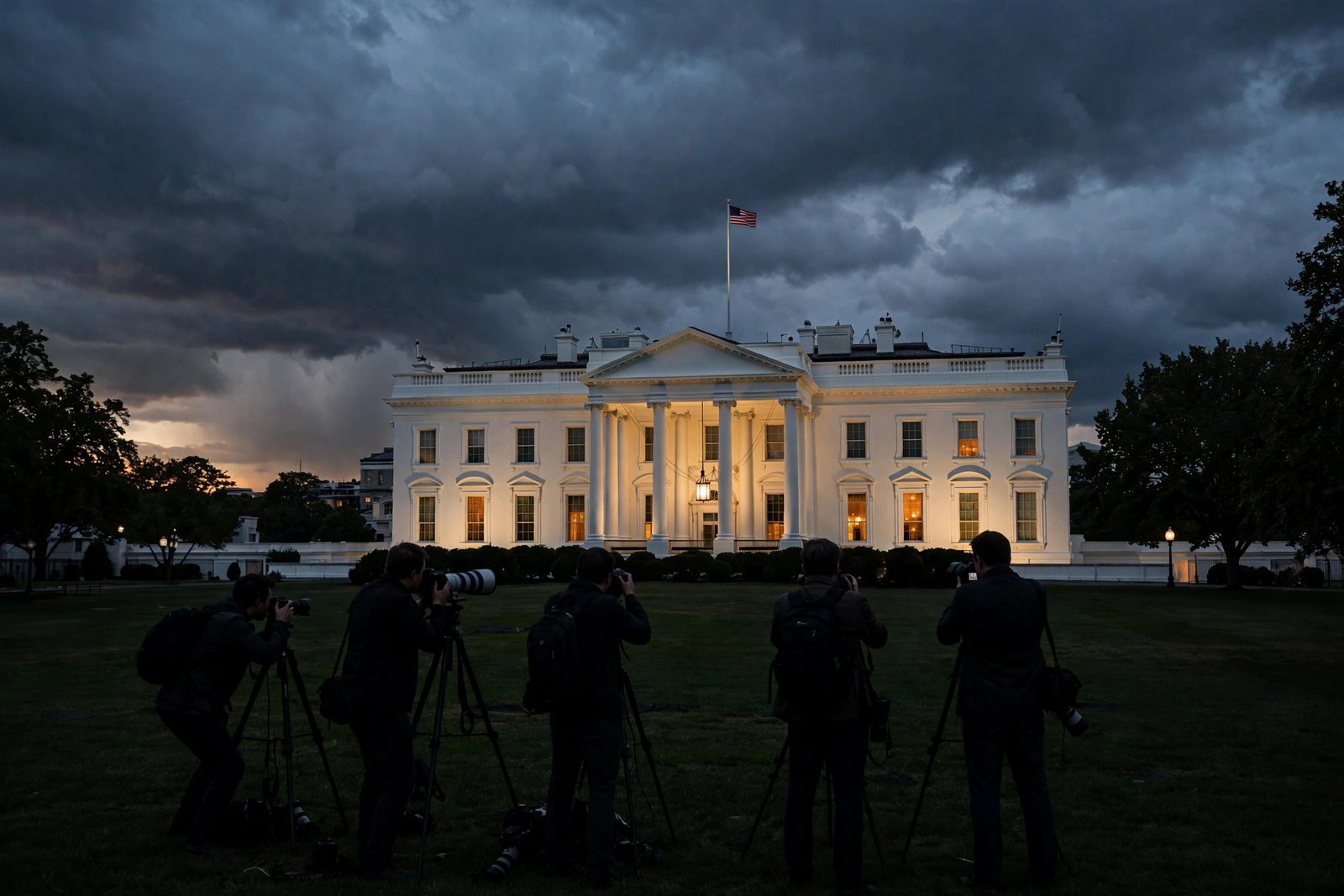
White House attorneys are evaluating whether to issue mass pardons to junior staffers ahead of the November 3 midterm elections, according to a report published Saturday by The Washington Sun, which cited two sources familiar with the conversations. The debate over White House mass pardons junior staffers has now moved from quiet speculation to an active legal question inside the West Wing, just 10 days before voters decide control of Congress.
The discussions would apply to a far greater number of White House staff than previously reported, and they come as allies of President Donald Trump press the administration to shield lower-ranked officials from prosecution, congressional investigations and civil lawsuits.
According to the Sun, a pardon covering every junior administration employee is viewed as unlikely. But blanket pardons for employees involved in particular policy areas — such as deportations, war or trade — are on the table, one source said.
That distinction matters: rather than one sweeping act of clemency, the White House is said to be weighing targeted, policy-by-policy pardons that would cover the staff who carried out the administration’s most contested programs. No staffers have been charged with any crime, and the White House did not immediately respond to a request for comment.
The report landed on a day when the president himself was on the campaign trail in Florida, where he declined to rule out pardoning junior staffers while voting early in West Palm Beach alongside first lady Melania Trump.
The timing — a Saturday report, a president on the stump, and a midterm electorate already voting — is why the White House mass pardons junior staffers story has spread so quickly across the political press.
- White House Mass Pardons for Junior Staffers: What the Report Says
- White House Mass Pardons for Junior Staffers: Blanket Pardons by Policy Area
- Who Is Pushing for the Pardons
- The Slotkin Remark That Lit the Fuse
- What Trump Himself Has Said
- White House Mass Pardons for Junior Staffers: Why Critics Are Alarmed
- A Short History of Preemptive Pardons
- What a Pardon Can — and Cannot — Do
- What It Means 10 Days Before the Midterms
- What’s Next
- Additional Details
White House Mass Pardons for Junior Staffers: What the Report Says
The Washington Sun reported Saturday morning that White House attorneys are evaluating whether to issue mass pardons to junior staffers, as Trump allies press the administration to protect lower-ranked officials from prosecution and other legal challenges.
The report was based on two sources familiar with the conversations, plus an additional source familiar with the conservative groups’ lobbying. MEAWW’s coverage of the report noted that legal teams are studying how broadly the president could extend clemency to protect personnel from future investigations, prosecutions or mounting legal expenses.
The central tension in the reporting is scale. While President Trump has publicly discussed issuing pardons for top aides, and has issued pardons for billionaires and major donors since returning to office, questions have mounted about the potential legal jeopardy facing thousands of employees who have implemented the White House’s agenda.
The White House mass pardons junior staffers discussions now under way, the Sun reported, would apply to a far greater number of White House staff than has been previously reported.
That framing is important because it reframes the pardon question. This is not, according to the sources, a debate about a handful of famous names. It is a debate about the career and political staff who signed the memos, ran the programs and enforced the policies — the people whose names rarely appear in headlines but whose decisions could become exhibits in a future investigation.
White House Mass Pardons for Junior Staffers: Blanket Pardons by Policy Area
A pardon for all junior administration personnel is viewed as unlikely, one source told the Sun. But the president could issue blanket pardons for all employees involved in particular policy areas, such as deportations, war or trade. Rifnote’s summary of the report put it the same way: the discussions would apply to far more White House staff than previously reported, but the likely vehicle is policy-area coverage, not a single universal pardon.
The three policy areas named are not random. They map directly onto the administration’s most legally contested work.
Deportations have generated a running stream of court fights over detention, removals and enforcement tactics. The war with Iran, launched with Israel about eight months ago, has raised questions about authorization and conduct that a future Congress could probe.
And the sweeping tariff program — including the 50 percent tariffs on Canadian imports that were partially lifted this week — has already drawn legal and political challenges.
A pardon sorted by policy area would, in effect, sort the workforce by which programs might have broken the law, which is why the White House mass pardons junior staffers plan is so revealing: administrations do not normally catalog their own staff by legal exposure.
Who Is Pushing for the Pardons
Several conservative organizations influential with the administration — including the Heritage Foundation and American Moment — have pressed White House counsel to either prepare pardons or put in place funding for the legal fees necessary to defend junior staffers from criminal and congressional probes or potential lawsuits, according to the sources.
The lobbying has two tracks: clemency itself, or money to pay the lawyers if clemency never comes. Both tracks serve the same goal: making sure the White House mass pardons junior staffers question is answered before any future Congress can act.
Mike Davis, a prominent Trump supporter and president of the Article III Project, an advocacy group that fights legal cases for the right, also said he plans to press the White House for action.
“After listening to Elissa Slotkin threatening to go after young people who joined the Trump administration, President Trump should issue very broad preemptive pardons for anyone who worked for him or in his orbit,” Davis said Friday, according to the Sun’s reporting. The Rothman Report’s account quoted Davis making the same case. Nick Solheim, CEO of American Moment, framed the effort as defensive: “The left will do everything in its power to hunt down conservatives who are implementing the president’s agenda.”
The Slotkin Remark That Lit the Fuse
These efforts have only intensified, the sources told the Sun, after Senator Elissa Slotkin, Democrat of Michigan, said earlier this month that congressional investigations into Trump officials should make young Republicans think twice before joining the administration in its final two years — a remark now cited by pardon advocates as the spark for the White House mass pardons junior staffers push.
Slotkin’s argument, as her supporters describe it, was about accountability: people who help steal taxpayer money or break the law should expect to answer for it.
The remark landed very differently on the right, where it was heard as a threat to a generation of young conservatives.
Davis’s response — a call for “very broad preemptive pardons” — shows how quickly a warning about future oversight can convert into a demand for present-day clemency.
The dynamic is now self-reinforcing: every Democratic promise of oversight strengthens the case for pardons among Trump allies, and every pardon discussion strengthens the Democratic case that the administration expects its conduct to need pardoning.
That loop is likely to keep running through Election Day, and it is a major reason the White House mass pardons junior staffers debate will not fade quietly.
What Trump Himself Has Said
Trump has made the same case before. In an interview earlier this month, quoted by the Sun, he said: “Because these people are lunatics on the, on the left — I don’t want to see people that work for me go through years of nonsense, hire lawyers and everything else, all for nothing.” He made a similar point in an October 15 interview on Newsmax, saying he does not want staffers going through years of what he called nonsense.
Trump has also said he would consider such pardons. “Yeah, sure I’d do that,” he told Time earlier this month, pointing to former President Joe Biden’s preemptive pardons. “Well, Sleepy Joe Biden, he gave pardons to everyone,” Trump said.
Biden issued pardons before leaving office, including to Dr. Anthony Fauci and retired General Mark Milley. And the idea has been floated in a joking register before: The Wall Street Journal reported in April that Trump joked about pardoning “everyone who has come within 200 feet of the Oval.”
Those two answers — the Newsmax defense of his staff and the Time nod to Biden’s precedent — frame the White House mass pardons junior staffers debate in Trump’s own terms.
What was once a joke is now, according to the Sun’s sources, a subject of formal legal evaluation — and on Saturday, while voting early in West Palm Beach, Trump declined to rule out White House mass pardons junior staffers, a non-denial that keeps the option visibly alive.
White House Mass Pardons for Junior Staffers: Why Critics Are Alarmed
The experts are not laughing. “There have never before been blanket preemptive pardons of everyone in the administration,” said Liz Oyer, Biden’s pardon attorney, who has also said Biden’s preemptive pardons set a “really bad precedent.” Doing it, she said, “would effectively place the executive branch outside the reach of the law, which would upset the constitutional order of our country in a very fundamental way.”
Clemency expert Mark Osler called it “a despoilment of what is supposed to be a tool for mercy and national reconciliation being used as a battlefield tool in political wars.” Robert Weissman, co-president of Public Citizen, said officials should be worried about accountability because a Justice Department doing its job would be required to investigate blatant illegalities.
The criticism has a common core: a pardon is traditionally an individual act of mercy, granted after a conviction or at least after specific conduct is identified.
A blanket, preemptive pardon for an entire class of officials — people who have not been charged with anything — inverts that logic. It would pardon conduct before it is investigated, and it would do so for the very people who carried out the president’s agenda. That is why critics say the White House mass pardons junior staffers idea is not mercy, but immunity purchased in advance.
A Short History of Preemptive Pardons
Preemptive pardons — clemency granted before any charge is filed — are rare, but they are not unprecedented. The most famous example is President Gerald Ford’s 1974 pardon of Richard Nixon, issued a month after Nixon resigned and before any criminal charge was brought over Watergate. Ford’s pardon covered “all offenses against the United States” Nixon had committed or may have committed during his presidency. It was a blanket, preemptive pardon of a single man, and it arguably cost Ford the 1976 election.
The Supreme Court has long read the pardon power broadly. In Ex parte Garland in 1866, the Court held that the pardon power extends to every offense known to the law and may be exercised before legal proceedings are even instituted.
That 19th-century precedent is the legal foundation on which any modern blanket pardon would rest: the Constitution, the Court said, does not require a charge first.
More recently, President Biden’s preemptive pardons in January 2025 — for Fauci, Milley, members of the House January 6 committee and members of his own family — were the closest modern parallel to what is now being discussed. Biden said at the time that the pardons were meant to shield public servants from politically motivated prosecutions.
The difference in scale is what alarms critics now: Biden pardoned a named list of individuals, while the reported Trump plan could cover entire categories of staff, numbering in the thousands — which is why the White House mass pardons junior staffers proposal would dwarf both the Nixon and Biden precedents.
What a Pardon Can — and Cannot — Do
Even a sweeping pardon has hard limits, and those limits shape what the White House can actually achieve. First, the presidential pardon power reaches only federal offenses. It cannot touch state charges, and several of the administration’s most contested policies have state-level dimensions that a federal pardon would leave untouched.
Second, a pardon does not block Congress. A pardoned official can still be subpoenaed, can still be compelled to testify, and can still face public hearings. In fact, a pardon can make testimony easier to compel: a witness who can no longer claim a Fifth Amendment privilege against self-incrimination over pardoned conduct has one less shield against a congressional summons. Clemency removes the criminal risk; it does not remove the spotlight.
Third, accepting a pardon has historically carried a sting of its own. In Burdick v. United States in 1915, the Supreme Court observed that acceptance of a pardon can carry “an imputation of guilt.”
For junior staffers hoping to build careers after this administration, a preemptive pardon could become a permanent line on a résumé.
Finally, a pardon cannot pardon the future: it covers conduct up to the date it is issued, so staff who remain in the administration’s final two years would still face exposure for anything they do after a pardon is signed — one reason the timing question, before or after the election, matters so much for any White House mass pardons junior staffers plan.
What It Means 10 Days Before the Midterms
The pardon debate is landing in a midterm environment that already favors Democrats. The president’s approval rating has fallen to 31 percent in recent Reuters/Ipsos polling, Democrats are widely projected to gain the House, and early voting is under way across the country — including Florida, where Trump himself voted Saturday before flying to a rally in Perry, Georgia.
The takeaways from Trump’s midterm rallies show a campaign playing defense deep in conservative territory, and the pocketbook pressures of the Iran war and tariffs are now central to the Democratic argument.
For Democrats, the White House mass pardons junior staffers report is a ready-made closing argument: an administration that expects to need pardons is an administration that expects to be investigated, and the White House mass pardons junior staffers story gives that argument a fresh headline every day it stays in the news.
For Republicans, it is a warning to their own base about what a Democratic Congress would do with subpoena power. Both readings can be true at once, and both will be deployed in the final 10 days.
The concrete legal jeopardy facing administration figures is not theoretical: the Justice Department has already opened a criminal investigation into Corey Lewandowski, the president’s former campaign manager and a former Department of Homeland Security official, over allegations he personally profited from his government role — a probe detailed in State Line Daily’s earlier reporting.
That investigation, opened under this administration’s own Justice Department, shows that staff-level legal exposure is a live issue, not a hypothetical one — and it gives the White House mass pardons junior staffers debate a concrete backdrop.
What’s Next
Will Trump actually issue the pardons? That remains the open question. The Sun’s sources describe legal evaluation, not a decision. Trump has said he would consider it, and on Saturday he declined to rule it out — but he has also stopped short of promising it, and a pardon for all junior staff is viewed as unlikely.
When would a decision come? The politics point in two directions. Issuing pardons before the election would signal to the base that the administration is protecting its own, but it would also hand Democrats a closing argument. Waiting until after the election — or until the end of the term — would avoid that cost but leave staff exposed in the interim.
Could the pardons be challenged in court? The pardon power is among the broadest presidential powers, and Ex parte Garland gives it a wide reading. But a class-wide, preemptive pardon of thousands of unnamed officials would test legal questions no court has squarely answered, including whether a pardon must identify the offenses or the offenders it covers.
What happens to staff who are not pardoned? The outside groups’ second track — legal-fee funding — suggests an answer: even without clemency, well-funded defense funds could carry junior staffers through investigations and lawsuits. The Heritage Foundation and American Moment lobbying covers both options.
Does this change the midterms? Probably at the margins, where this election will be decided. The pardon story reinforces the existing Democratic message about accountability and the existing Republican message about Democratic overreach. In a race this close, reinforcement can be enough.
The White House mass pardons junior staffers question will remain central in the final days before the midterms, with allies urging protection and critics warning against blanket clemency.
Additional Details
- Description: White House attorneys are evaluating mass pardons for junior staffers ahead of the November 3, 2026 midterms, The Washington Sun reported October 24, 2026, citing two sources familiar with the conversations. A pardon for all junior staff is viewed as unlikely, but blanket pardons by policy area — deportations, war or trade — are on the table. The Heritage Foundation, American Moment and Article III Project president Mike Davis are pressing the White House to act, a push that intensified after Senator Elissa Slotkin said congressional probes should make young Republicans think twice about joining the administration. President Trump has said he would consider such pardons and declined to rule them out while voting early in West Palm Beach on October 24. Critics, including former Biden pardon attorney Liz Oyer and clemency expert Mark Osler, warn that blanket preemptive pardons would be unprecedented in scale and would place the executive branch outside the reach of the law. No staffers have been charged with any crime.
- Focus keyword: White House mass pardons junior staffers
- Category: Politics
- Sources: The Washington Sun, Mediaite, MEAWW, The Rothman Report, Rifnote, The Wall Street Journal (April 2026 reporting as cited), Time, Newsmax, Associated Press early-voting coverage.