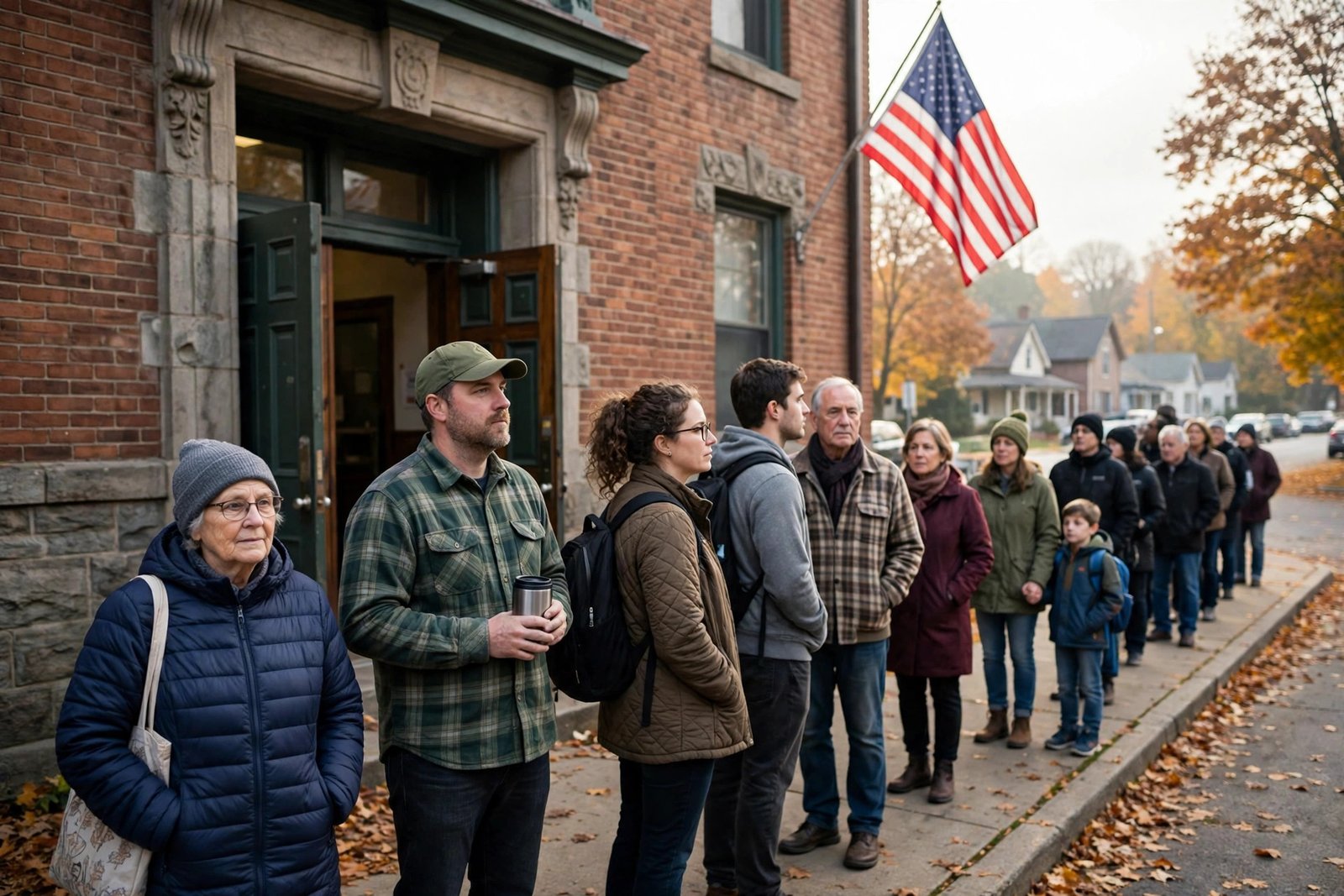
With Election Day on Tuesday, November 3, 2026 now just 10 days away, one question is beating every other voter query on Google: where is my polling place? In the final week of October, that question tops the list of what Americans are searching, followed closely by “what ID do I need to vote?” — ahead of even the horse-race coverage dominating cable news.
This guide answers all of it in one place: where is my polling place, how to check whether your voter registration is active, what identification your state actually requires, how to track your mail ballot, and when results will really be final. Every rule below varies by state, so this guide points you to the official source for your state rather than guessing — because the wrong assumption at the check-in table is how votes get lost.
The stakes are unusually high this cycle. All 435 House seats and 35 Senate seats are on the ballot, deciding control of the 120th Congress, and the 2026 midterms are already among the three most-searched midterm cycles in Google Trends history. Senate races alone are drawing four times the search volume of House races. If you vote, this is the checklist to run through first.
- Where Is My Polling Place?
- Is My Voter Registration Active?
- What ID Do I Need to Vote?
- How to Track My Mail Ballot
- Election Results Timeline 2026: When Will We Know?
- What America Is Actually Searching Before November 3
- What’s on the Ballot in the 2026 Midterms
- If You’re Told You’re Not Registered
Where Is My Polling Place?
If you are asking where is my polling place, start with this: Your polling place is assigned by your county based on your registered home address — it is not necessarily the nearest school or government building, and it can change between elections when precinct lines are redrawn. Never assume last cycle’s location is still yours.
The fastest official route to answer where is my polling place is Vote.gov: pick your state and it sends you to your state election office’s own lookup tool. Enter your name exactly as it appears on your ID and your current address, and the tool returns your polling place, its hours, and often a sample ballot. The nonpartisan Vote.org polling place locator offers the same lookup in one step. Do it today, not on Election Day morning, when you may be asking where is my polling place under pressure — if your assignment changed, you want to know now.
Two practical tips competitors rarely mention for anyone asking where is my polling place: first, pull up your sample ballot before you go. Sample ballots list every candidate and measure you will actually vote on, plus your polling place and its hours, so you can research the down-ballot races — the ones most voters skip — in advance. Second, screenshot your lookup result. If a poll worker tells you you are at the wrong location or not on the list, that screenshot is your fastest proof of what the official system showed.
Before Election Day, confirm where is my polling place one last time. Polls are open on Election Day, November 3, 2026, though hours are set by each state — Pennsylvania, for example, votes from 7 a.m. to 8 p.m. If you are in line when polls close, stay in line: you have the right to vote.
Is My Voter Registration Active?
Checking takes about a minute and it is the step everything else depends on. Go to Vote.gov, choose your state, and run the official registration lookup. Confirm three things: your full legal name, your current address, and your status. Some states show “active” versus “inactive” — inactive usually means the election office is unsure about your address, often because mail was returned or the post office reported a move. Inactive does not automatically mean you cannot vote, but it can mean delays at the polls, so update your record before Election Day if you can. Your current address is also what determines where is my polling place.
If you have moved — even across town — or changed your name since you last voted, assume your record is stale until the lookup says otherwise. Registration updates follow the same deadlines as new registrations, and several states’ deadlines have already passed: Texas closed October 5, Oklahoma on October 9, Connecticut on October 16, Nevada’s online mail-ballot deadline was October 20, and Virginia and Nebraska closed October 23. Massachusetts closes today, October 24.
Your state election website has the final word, and it is the only deadline that counts.
Missed your deadline? Do not give up. According to the National Conference of State Legislatures, 24 states plus Washington, D.C. offer same-day or Election Day registration — in 21 of those states and D.C., you can register and vote on Election Day itself. California’s version, conditional voter registration, runs from 14 days before the election through Election Day; you vote a provisional ballot that is processed once your registration is verified. North Dakota is the one exception in the country: it has no voter registration at all.
The same check matters because of a second, newer risk. Election offices in some states have been flagging voters using new data sources and mailing confirmation notices that require a reply — in Kansas, for example, a notice left unanswered for 45 days can lead to removal from the rolls within five business days under the state’s SAVE Kansas Act. If anything official-looking arrived from your county election office, open it and answer it today.
What ID Do I Need to Vote?
There is no single national answer, and that is exactly why “what ID do I need to vote” is surging as a search. Commonly accepted forms include a driver’s license, a state ID card, a U.S. passport, and a military ID — but the list, and whether a photo is required at all, is set state by state. Some states accept non-photo documents: in Pennsylvania, for instance, only first-time voters at a new polling place must show ID, and it does not need to be a photo ID — a utility bill or bank statement bearing your name and address can qualify.
Mail ballots play by different rules. Most states verify mail ballots by signature match. Only Georgia, Minnesota, New Mexico and Ohio currently require some form of government-issued identification number to be included with a mail ballot. That split is itself on the ballot this year: voter ID measures are being decided in California, Colorado and Nevada, where activists collected signatures to bypass Democratic-led legislatures and put the question directly to voters.
California’s Proposition 39 would require a government-issued ID for in-person voting or the last four digits of an identification number when voting by mail — a proposal drawing national attention precisely because California votes so heavily by mail.
That debate is playing out against the backdrop of an aggressive federal push on voter rolls. The Justice Department has ordered California counties to set aside mail ballots from suspected noncitizens within 48 hours, warning of criminal liability for officials who count them — a story we covered in detail in our report on the DOJ’s California ballot order. Whatever your views on that fight, its practical lesson for voters is the same: verify your own record early, through official channels, before anyone else’s list becomes your problem.
How to Track My Mail Ballot
“How to track my mail ballot” is another query surging in the final days, and the answer is better than most voters expect: nearly every state now offers a ballot tracker through its election office website, and several use the BallotTrax system.
In Arizona, for example, Maricopa County voters track at BeBallotReady.Vote, Pima County voters use the county recorder’s site, and voters elsewhere in the state use BallotTrax. Your state’s tracker typically shows when your ballot was mailed to you, when it was received back, and whether it was accepted or flagged for a signature problem — and if it was flagged, many states let you “cure” it, fixing the signature within a deadline.
One detail that trips up even careful voters: the postmark. A U.S. Postal Service rule that took effect on December 24, 2025 clarified that mail is postmarked when it is processed at a facility, not necessarily when you drop it in a mailbox. The mailing date and the postmark date may not always match — which means a ballot dropped in a box on Election Day might not carry an Election Day postmark. The safe move is to mail it days early, use an official drop box where your state offers one, or hand it to your county election office in person.
Deadlines also differ on the return side: some states require ballots to arrive by Election Day, while others count ballots postmarked by Election Day if they arrive later. If you requested a mail ballot and then decide to vote in person instead, bring the mail ballot with you or be prepared to vote a provisional ballot — attempting to vote in person after a ballot was mailed to you can trigger a provisional ballot that requires extra verification before it counts.
Election Results Timeline 2026: When Will We Know?
“Election results timeline 2026” is surging for a reason: voters remember recent cycles where the winner was not clear on election night, and they want to know what to expect this time. The honest answer is that election night brings projections, not official results. Media outlets project winners as votes are counted, but official results come only after canvassing — the process in which counties verify every ballot, including mail ballots that arrive after Election Day in states that count them, resolve provisional ballots, and certify totals. That takes days in most states and weeks in the closest races.
Three things will shape the timeline this year. First, mail ballots: states that count ballots postmarked by Election Day but arriving later will necessarily finish later.
Second, the sheer number of close Senate races in the most-searched states — Texas, Michigan, South Carolina, Kentucky, North Carolina and Nebraska — where margins could be thin enough to trigger recounts. Third, litigation: with voter-roll and ballot rules already being fought in court before Election Day, post-election challenges in tight states could extend the timeline further. Expect a clear picture of House control within days, and treat Senate control as possibly taking longer.
For voters, the timeline has one practical implication: if you voted by mail, keep tracking your ballot until it shows as accepted. If it shows as challenged or not received, contact your county election office immediately — there is usually a cure window, but it closes.
What America Is Actually Searching Before November 3
Google’s own report on the cycle, covering national query volumes from October 2025 through October 18, 2026, reveals an electorate whose priorities do not perfectly match the campaign trail’s talking points. Crime leads issue-related searches at 31 percent, followed by health care at 27 percent, immigration at 20 percent, the economy at 17 percent, and the Iran conflict at 5 percent, according to Google’s midterm search data.
Crime has sat on top since June 28; health care topped the chart at points in May and June; Iran led during the week of March 1, when it made up 35 percent of all issue searches.
The searches also show voters thinking practically, not just politically. Alongside the big issues, queries like “abortion laws by state 2026” and “ballot measure abortion” have spiked in states with competitive Senate and gubernatorial races and reproductive-rights initiatives, with voters searching for clinic locations, telehealth rules and insurance coverage — logistics, not slogans.
On immigration and safety, the granularity is local: “border crossings 2026,” “sanctuary city policies,” “deportation process,” “crime rates near me” and “police funding debate” are trending in border states, interior districts and suburbs alike. And in the newest category, voters are searching to verify what they see: “is this video real,” “AI-generated campaign ad” and “how to spot fake election news” have risen sharply in the first midterm cycle where generative AI is woven through campaign advertising.
That search behavior is the context for everything else in this guide. Voters are not just choosing candidates; they are trying to navigate a system — registration, ID, ballots, and where is my polling place — that differs in every state. The campaigns tell you what they want you to think about. Search tells you what people are worried about at 11 p.m.
What’s on the Ballot in the 2026 Midterms
Beyond the 435 House seats and 35 Senate seats, voters in many states will decide ballot measures that change the rules themselves. Roughly 30 measures nationwide concern voting, district boundaries, primary systems or citizens’ ability to change state law — about one in five of all state ballot measures. The voter ID proposals in California, Colorado and Nevada are the most prominent, but several measures address congressional redistricting in the national battle spurred by President Donald Trump, others would change how primaries are conducted, and Missouri voters face a measure making it harder for lawmakers to change measures voters approve.
The national picture frames those local fights. President Trump’s rally tour in the final days has been notably defensive — gas prices, crowd-size claims and a map showing where Republicans are most worried — as we reported in our takeaways from his midterm rallies. Betting markets and forecasters have pointed the same way for weeks, and our earlier midterm predictions analysis laid out the paths to House and Senate control. But predictions are not votes, and the only number that matters is turnout in the states above.
If You’re Told You’re Not Registered
This is the section to remember if everything else fails. Under federal law — the Help America Vote Act (52 U.S.C. 21082) — if your name is not on the polling place list, or an official says you are not eligible, you can still cast a provisional ballot. You sign a statement that you are registered there and eligible to vote, and the poll worker has to tell you this option exists. They cannot just send you home.
Election officials then check your eligibility under state law, and if you are eligible, the ballot counts. You also get written information on how to find out — through a free hotline or website — whether your vote counted and, if not, why. Keep that paper, and follow up. One caveat: state law decides whether a provisional ballot cast at the wrong polling place counts, so also ask whether you are at the right location — in other words, where is my polling place — and if you are not, go to the right one if you still can.
The through-line of this entire guide is simple: check early, through official sources, and keep proof. Where is my polling place, your registration, your ID, your ballot’s journey, your provisional ballot receipt — each takes minutes to verify now and can be impossible to fix later. Ten days out, minutes are all it takes.
What’s Next
Q: What is the single most important thing to do today?
A: Check where is my polling place, and your registration, on Vote.gov right now. Everything else — ID, mail ballots, Election Day plans — depends on those two facts being right.
Q: What if my state’s registration deadline already passed?
A: Check whether your state offers same-day registration — 24 states plus D.C. do — or conditional/provisional voting. If neither applies, your state election office can still confirm your status for future elections.
Q: When will we know who won the Senate?
A: Possibly not on election night. Official certification takes days to weeks, longer in close states and where mail ballots arriving after Election Day still count. Treat election-night calls as projections, not results.
Q: Can I trust a search result or social post about voting rules?
A: Verify it against your state election office or Vote.gov. In every cycle, false voting information spreads on social media, and the “is this video real” surge this year shows voters are rightly skeptical. Official sources only.
Additional Details
Description: Election Day is November 3, 2026. This complete voter guide explains where is my polling place, how to check your voter registration, learn what ID your state requires, track your mail ballot, understand the election results timeline, and cast a provisional ballot if you are told you are not registered — with official sources for every step.