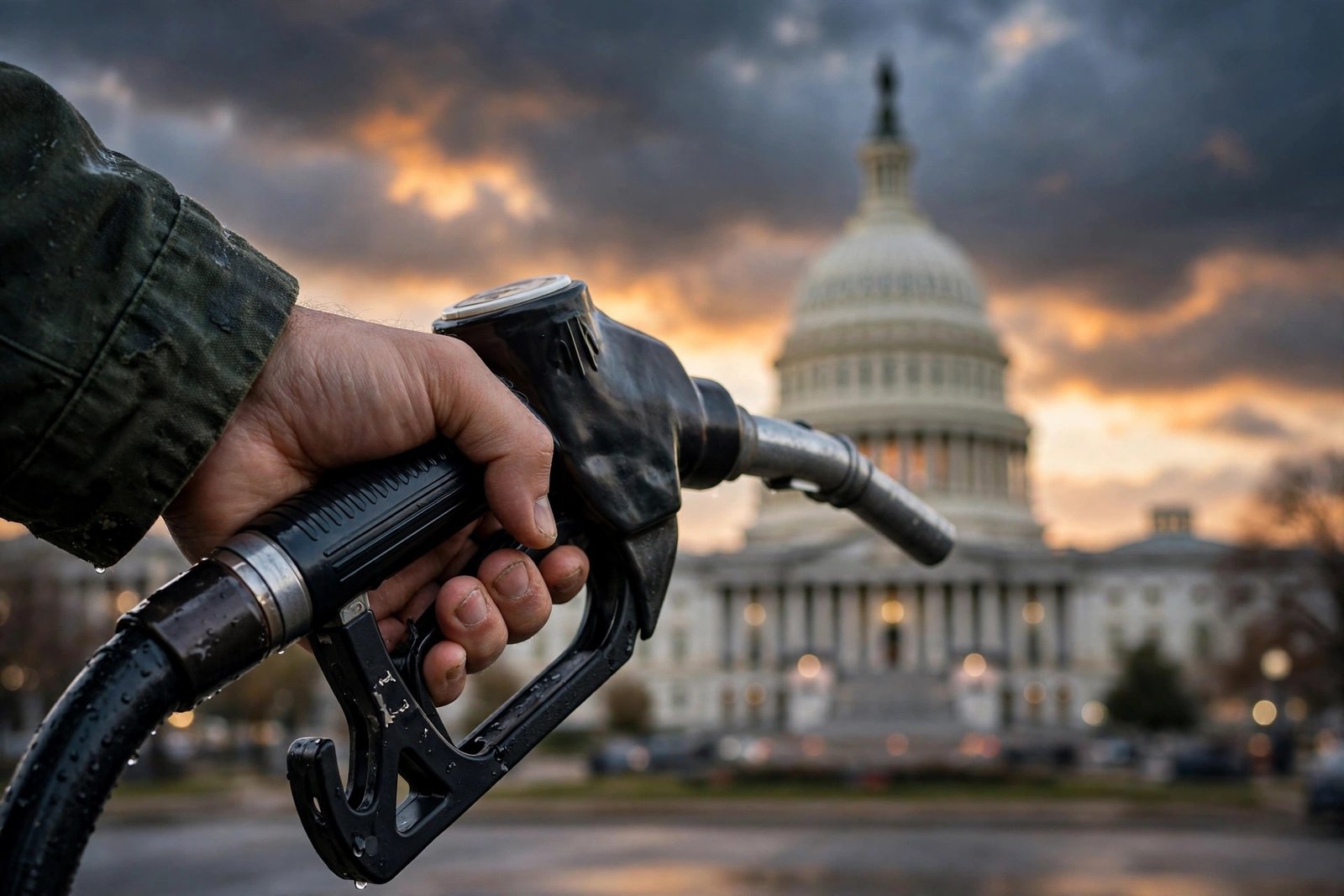
Foreign policy almost never decides an American midterm election. Yet with ten days to go before the November 3 vote, the Trump foreign policy pocketbook midterms story has turned that rule upside down: voters are not grading the president’s wars and tariffs as abstract world affairs, they are feeling them every time they fill a tank or pay for groceries. A new Reuters analysis published October 24 argues that Donald Trump’s war against Iran and his sweeping tariff campaign have fused into a single pocketbook issue, and that fusion is now imperiling Republican control of Congress.
The Trump foreign policy pocketbook midterms connection is unusually direct. Consumer prices accelerated in September as gasoline surged, the national average pump price sits near $4.27 a gallon, and a Reuters/Ipsos poll earlier this month found that about 78% of Americans blame Trump’s policies for rising prices that are outpacing their earnings. That is not a foreign-policy number. It is a cost-of-living number, attached to decisions made in Washington, Tehran, Moscow and Kyiv.
Below is what the Reuters analysis actually found in the Trump foreign policy pocketbook midterms debate, why the White House is making controversial moves to blunt the damage before Election Day, how some Republican candidates are already distancing themselves, and the extra context most coverage is missing: the last time a foreign war dominated a midterm this completely, and why even a Democratic Congress would struggle to rein in a president’s foreign policy after November 3.
- Trump Foreign Policy Pocketbook Midterms: The Verdict Voters Are Delivering at the Pump
- Trump Foreign Policy Pocketbook Midterms: 78% Blame His Policies for Rising Prices
- Trump Foreign Policy Pocketbook Midterms: Politics Driving Foreign Policy Before Election Day
- Trump Foreign Policy Pocketbook Midterms: Republicans Begin to Distance Themselves
- Trump Foreign Policy Pocketbook Midterms: Iran, Hormuz and the Price at the Pump
- Extra Knowledge: 2006 — The Last Time a War Swallowed a Midterm Whole
- Extra Knowledge: Why Congress Cannot Simply Switch Off a President’s Foreign Policy
- What’s Next
- Additional Details
Trump Foreign Policy Pocketbook Midterms: The Verdict Voters Are Delivering at the Pump
The central claim of the Trump foreign policy pocketbook midterms analysis is simple, and it cuts against decades of campaign wisdom. Midterm elections are historically referendums on the incumbent president, and the old Clinton-era adage still holds: “it’s the economy, stupid.” What has changed in 2026, Reuters argues, is that foreign policy has stopped being a separate category and started showing up inside the economy itself.
Voters rank foreign policy low when pollsters ask them to list their priorities. Yet the same voters, Reuters notes, clearly see Trump’s signature moves on the world stage — the Iran war and the tariffs — feeding into their higher costs. That distinction matters. Americans do not have to care about diplomacy in the abstract to punish a president whose diplomacy raises the price of fuel, food and freight.
The White House does not dispute that voters are making the connection. It disputes the blame. White House spokesman Matt Middleton told Reuters that Trump “has always been clear about temporary market disruptions as a result of the conflict in Iran,” adding that “the contrast between President Trump’s economic record and Democrats’ ruinous alternative is clear.” The word “temporary” is doing a lot of work in that sentence: the Iran war began nearly eight months ago, and for many households the disruption has not felt temporary at all.
Trump Foreign Policy Pocketbook Midterms: 78% Blame His Policies for Rising Prices
The single most damaging number in the Trump foreign policy pocketbook midterms debate is the 78% figure. In a Reuters/Ipsos poll earlier this month, about 78% of Americans said they blame Trump’s policies for rising prices that are outpacing their earnings. That is not a partisan split or a narrow plurality. It is close to four in five Americans drawing a straight line from presidential policy to their household budget.
The same polling environment produced a record-low approval rating for the president. A separate Reuters/Ipsos poll that closed October 19 put Trump’s approval at just 31%, the lowest of either of his terms, BusinessWorld reported, with Democrats leading Republicans 47% to 35% on the generic congressional ballot. For the full national picture, see StateLineDaily’s midterm predictions tracker.
Other surveys point the same way in the Trump foreign policy pocketbook midterms debate. The Chicago Council on Global Affairs said its latest nationwide survey “finds that most Americans believe the Trump administration’s foreign policy actions have negatively impacted America’s global standing and hurt national and household economic conditions.” When voters believe a foreign policy is hurting both America’s standing and their own wallets, the political damage compounds: it is no longer a debate about strategy, it is a debate about competence.
That is why the Trump foreign policy pocketbook midterms framing is so dangerous for Republicans. A voter who dislikes a war on principle might still vote on taxes or crime. A voter who believes the war is the reason groceries cost more has only one verdict to deliver, and the ballot is the place to deliver it.
Trump Foreign Policy Pocketbook Midterms: Politics Driving Foreign Policy Before Election Day
Reuters is blunt about what it sees happening inside the White House: with approval ratings touching historic lows, Trump “has left little doubt, despite his public claims to the contrary, that he sees the straight line voters are drawing between his foreign policy and their cost of living.” The Trump foreign policy pocketbook midterms pressure, in other words, is now shaping the policy itself.
Chief among the controversial moves, Reuters reports, was Trump’s lifting of sanctions on Russian diesel exports aimed at bringing down fuel prices. Critics, including some fellow Republicans, say the step reinforces the impression that he is increasingly siding with Moscow in its war in Ukraine. The politics are easy to see — cheaper diesel means cheaper freight, farming and heating — but the signal is awkward for a president who insists he is not soft on Russia. That is the Trump foreign policy pocketbook midterms calculation at work.
He has also pressed Kyiv to halt strikes on Russian refineries as he tries to shift blame for high gasoline prices, Reuters reports, even though experts say the surge in energy costs is mainly the result of the war he launched alongside Israel against Iran nearly eight months ago. And he has promised not to order any new attack on Iran before the midterms, even as the United States and Israel are widely reported to be preparing for a possible major escalation after the elections.
Put together, the pattern is a president trying to freeze the war’s political costs until after November 3: ease diesel sanctions, quiet the refinery strikes, promise no new attack yet, and tell voters gas prices will fall once the Iran war ends. For how that promise sounded on the campaign trail, see StateLineDaily’s report on Trump’s midterm rallies, where the same economic pitch collided with voters paying $4.27 a gallon.
Trump Foreign Policy Pocketbook Midterms: Republicans Begin to Distance Themselves
The Trump foreign policy pocketbook midterms squeeze is already visible down the ballot. Reuters reports that some Republican candidates have distanced themselves from Trump on matters ranging from the conflict in the Middle East to the trade war with Canada and his pressure campaign against Ukraine.
That distancing is the classic tell of a party sensing a wave. Candidates do not break with a president of their own party when the wind is at their backs; they break when internal polling shows the president’s brand is costing them votes in their own districts and states. The Canada example is instructive: just this week, the White House lifted some 50% tariffs on Canadian imports in a move widely read as relief for Maine Senator Susan Collins’ tight re-election race, as StateLineDaily reported.
Democrats, Reuters notes, are widely projected to gain control of the House of Representatives in the midterms, with the Senate also seen as increasingly in play in the Trump foreign policy pocketbook midterms contest. For Republicans, losing either chamber would complicate Trump’s agenda in the last two years of his second term — blocking legislation, launching investigations, and choking off confirmations and funding.
Yet the distancing has limits, and Republican candidates know it. The party’s base still turns out for Trump himself, and a candidate who attacks the president too loudly risks depressing the very turnout needed to survive a midterm. The result is a careful dance: praise the economy in the abstract, quietly disagree on the war and the tariffs, and hope voters blame the world rather than the party.
Trump Foreign Policy Pocketbook Midterms: Iran, Hormuz and the Price at the Pump
At the heart of the Trump foreign policy pocketbook midterms story is a waterway most American voters have never seen: the Strait of Hormuz. Reuters reports that Iran has sought to keep oil prices high and hurt Trump in the midterms by deploying new tactics to target ships transiting the strait and deliberately prolonging the diplomatic stalemate, according to senior Iranian officials who spoke to the news agency.
If that account is right, the Trump foreign policy pocketbook midterms stakes are clear: it means Tehran understands American midterm politics as clearly as Washington does. High oil prices are not just a side effect of the standoff for Iran; they are leverage. Every dollar added to crude flows through to diesel and gasoline, and every cent at the pump becomes an argument against the incumbent party on November 3.
Trump, for his part, has insisted Americans should accept temporarily higher gas prices so that he can block Iran from developing a nuclear weapon. Iran says its nuclear program is for civilian purposes, Reuters notes, and the UN nuclear watchdog and the US intelligence community have assessed that Tehran shuttered a nuclear weapons development program in 2003. Most voters, Reuters reports, oppose the war Trump initiated, despite his campaign promise to avoid new foreign interventions.
The inflation channel is what makes the war a domestic issue. When crude rises, transport costs rise, food costs follow, and the Federal Reserve’s job gets harder. For the September data that fed this squeeze, see StateLineDaily’s report on inflation jumping to 3.7% in September as gasoline surged. The Trump foreign policy pocketbook midterms chain — war, oil, pump, groceries, ballot — is short, visible, and easy for any voter to follow without a briefing book.
Extra Knowledge: 2006 — The Last Time a War Swallowed a Midterm Whole
Reuters draws an explicit historical parallel that deserves more attention than it got: not since 2006, when President George W. Bush’s Republicans lost both legislative chambers while he was mired in the unpopular Iraq war, has a US leader’s handling of international events appeared so central to shaping a midterm outcome. The comparison is closer — and more uncomfortable for Republicans — than a single sentence suggests.
In 2006, Democrats gained 31 seats in the House and six seats in the Senate, taking control of both chambers, Northeastern University’s midterm analysis notes. Bush’s approval rating had fallen to around 38%, driven by the Iraq war, rising energy costs and growing economic concern. Bush himself called the result a “thumpin’.” The parallels to 2026 are striking: a second-term Republican president, an unpopular war, high fuel prices, and an approval rating now even lower, at 31% in the latest Reuters/Ipsos poll.
But there is a difference that could limit the comparison, and it is one Republican strategists are counting on. In 2006, Democrats won as a national wave in districts drawn before the modern redistricting wars. In 2026, Northeastern’s analysis notes, a Republican-led redistricting effort could give the GOP an advantage in several competitive House races, cushioning the party against a wave. Democrats are still expected to flip roughly 18 to 20 House seats for a majority around 232, according to the same analysis, but the map is harder than it was twenty years ago.
The deeper lesson of 2006 is not just that wars cost seats. It is that voters punish a war most when they believe it was a choice, not a necessity, and when its costs arrive in their own lives. Iraq cost American lives and treasure; the Iran war, in the Reuters telling, is costing American households at the pump and the checkout. Different costs, same verdict mechanism — and that is why the White House is so eager to promise the pain is temporary.
Extra Knowledge: Why Congress Cannot Simply Switch Off a President’s Foreign Policy
The second piece of context most coverage skips is the one Reuters ends on: even if Democrats take the House, the Senate, or both on November 3, lawmakers “will have a hard time reining in Trump’s capacity to pursue foreign policy as he sees fit.” That is not punditry. It is constitutional structure, and it shapes everything that happens after Election Day.
Foreign policy is the one arena where the president acts with the most freedom and Congress with the least practical leverage. A new House majority can hold hearings, subpoena officials, refuse to fund specific programs, and pass bills — but the president can veto those bills, command the armed forces as commander-in-chief, negotiate with foreign leaders, and impose or lift sanctions under broad emergency and trade authorities. Overriding a veto needs two-thirds of both chambers, a bar no midterm wave in modern history has cleared for the president’s own party, let alone the opposition.
That is why Jon Alterman of the Center for Strategic and International Studies told Reuters that “for many presidents who feel politically constrained (at home), foreign policy is the area where they are able to act with relative freedom.” A president who loses Congress often turns outward, because outward is where he does not need Congress. The lame-duck phase after a midterm defeat can therefore be more, not less, dangerous on the world stage: a president barred from running again, freed from electoral consequences, and blocked at home may look abroad for legacy, leverage, or distraction.
Reuters sketches both paths: Trump could feel restricted or emboldened after November 3, could escalate against Iran, Russia, China or Cuba, could shift approach toward allies, or could simply lose interest and double down on domestic construction projects such as the White House ballroom. Voters choosing a Congress on November 3 are therefore not choosing a foreign policy directly. They are choosing how much friction the next two years will contain — and whether the president who emerges from a defeat turns inward to govern, or outward to act alone.
What’s Next
Will gas prices fall before November 3? That is the question the White House’s pre-election moves are designed to answer yes to, and the answer will depend less on sanctions tweaks than on crude markets, Hormuz shipping, and whether the promised post-midterm escalation stays only a promise until ballots are counted.
Will Republicans keep the House, the Senate, or both? Current projections favor a Democratic House gain, with the Senate increasingly in play, but redistricting, turnout, and the generic-ballot gap — 47% to 35% for Democrats in the latest Reuters/Ipsos poll — will all be tested against district-by-district reality on November 3.
What happens the morning after the election? Watch two signals: whether Trump treats a loss as a constraint or as a liberation on foreign policy, and whether Iran’s Hormuz tactics ease or intensify once the electoral incentive to hurt him has passed. The period between the election and the seating of the new Congress in January is, by the Reuters account, when the foreign-policy question becomes most unpredictable.
Does the 78% blame number move? If pump prices fall sharply before Election Day, the pocketbook case against the president weakens fast. If they rise, the Trump foreign policy pocketbook midterms argument becomes the closing argument of the campaign, made not by any party but by the price board at every gas station in America. That closing test is the Trump foreign policy pocketbook midterms question in its simplest form.
Additional Details
Description: Reuters’ October 24, 2026 analysis finds Donald Trump’s Iran war and tariff campaign have turned foreign policy into a pocketbook issue imperiling Republicans in the November 3 midterms, with 78% of Americans blaming his policies for rising prices, approval at a record-low 31%, and Democrats projected to gain the House — a dynamic not seen since the Iraq war cost Republicans both chambers in 2006.
- Source analysis: Reuters, “Analysis-Trump foreign policy hits voters in the pocketbook, imperiling Republicans in midterms,” by Matt Spetalnick, October 24, 2026.
- Key polls: Reuters/Ipsos, October 2026 — 78% blame Trump policies for rising prices; approval 31%, lowest of either term; generic ballot Democrats 47%, Republicans 35%.
- Key prices: National average gasoline about $4.27 per gallon; September consumer prices accelerated on a gasoline surge; September inflation 3.7%.
- Election date: November 3, 2026 — House and Senate control at stake, ten days from the October 24 analysis.
- Historical parallel: 2006 midterms — Democrats gained 31 House seats and six Senate seats amid the unpopular Iraq war; Bush approval near 38%.