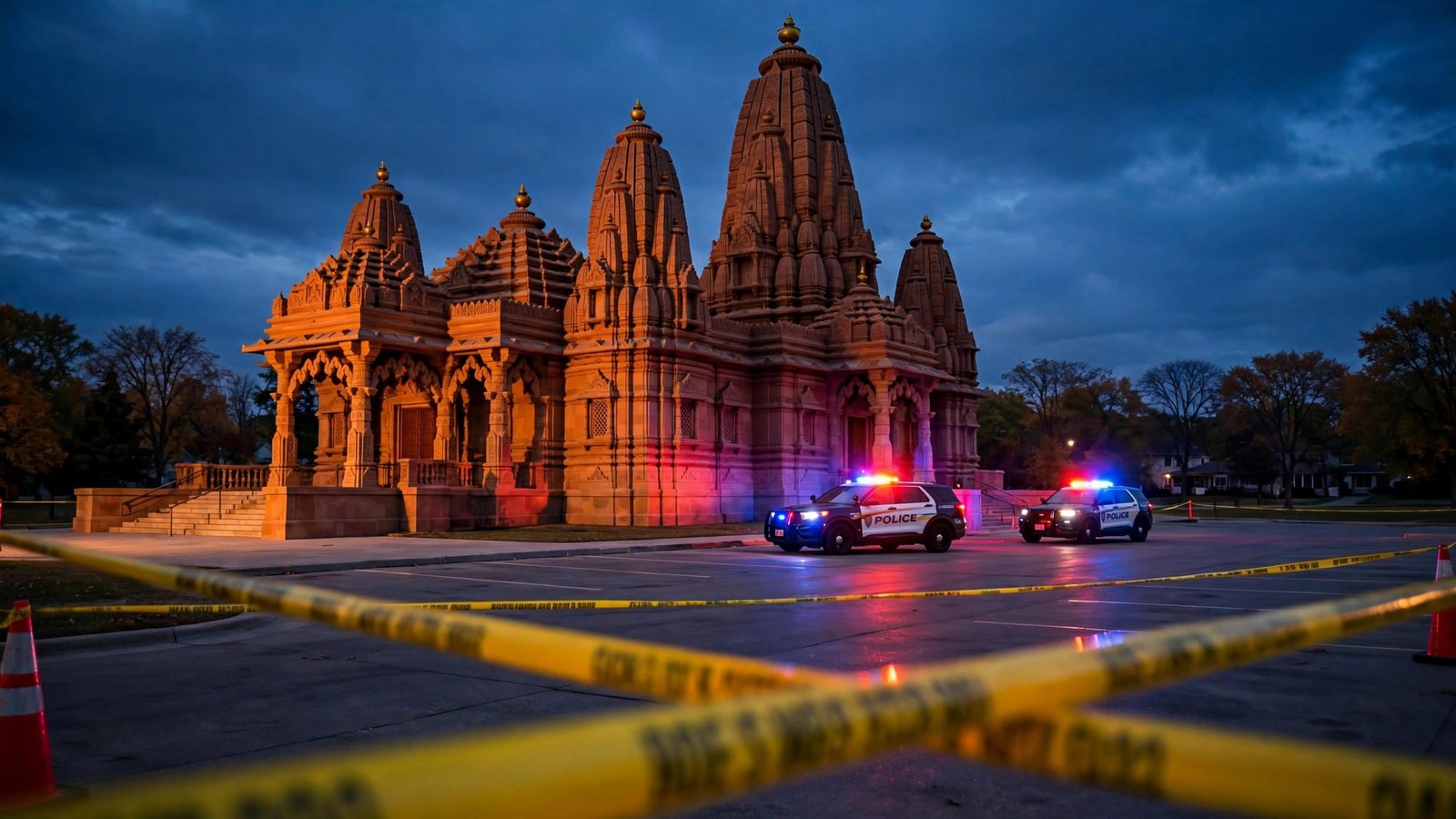
Authorities in Illinois say they stopped a mass shooting before it could happen. A 19-year-old man from the Chicago suburbs has been arrested and charged after police uncovered an alleged Hindu temple attack plot targeting a place of worship near Chicago, recovering a rifle, hundreds of rounds of ammunition, body armor, and a manifesto investigators say was filled with white supremacist views.
The suspect, Alexandros Paporakis of Palatine, Illinois, was taken into custody on Sunday, October 11, 2026, after two co-workers alerted police to his threatening communications and statements. Prosecutors say Paporakis had allegedly traveled to a Hindu temple in Aurora, about 40 miles southwest of Palatine, with the intention of carrying out a mass shooting — but fled undetected after his firearm malfunctioned. He is now being held without bond after a detention hearing on Wednesday, October 14, with his next court appearance scheduled for October 30.
The case — which investigators say involved an eight-page manifesto, an AR-style rifle, and months of preparation — has renewed urgent questions about extremist violence against houses of worship in America, coming just days after a deadly school shooting in Oregon and amid a string of FBI investigations into threats against public institutions ahead of the midterm elections.
- What Happened in Palatine: The Arrest of Alexandros Paporakis
- The Manifesto: “Why I Fought” and the White Supremacist Motive
- How the Hindu Temple Attack Plot Was Foiled
- What Police Found: Rifle, Ammunition and Tactical Gear
- Charges and Court Dates: What Comes Next for Paporakis
- EXTRA KNOWLEDGE: Illinois Gun Laws and the Assault Weapons Question
- EXTRA KNOWLEDGE: Rising Threats Against Houses of Worship — The Wider Pattern
- Officials React: Condemnation and Community Response
- What’s Next
- Additional Details
What Happened in Palatine: The Arrest of Alexandros Paporakis
The Hindu temple attack plot unraveled on Sunday, October 11, 2026, when the Palatine Police Department received intelligence about alarming electronic communications linked to Alexandros Paporakis, a 19-year-old resident of Palatine, a suburb northwest of Chicago. The warning came through the Mount Prospect Police Department after two of Paporakis’s co-workers at a local Taco Bell restaurant contacted authorities about his behavior and messages, according to investigators.
What those co-workers described was chilling. According to prosecutors from the Cook County State’s Attorney’s office, Paporakis had openly identified as a white supremacist while at work and told colleagues he “couldn’t wait” to kill Indian people. He had allegedly circulated a document detailing plans for a mass shooting, alongside photographs of a rifle, ammunition magazines, and tactical gear.
Prosecutors allege that Paporakis told a co-worker on Saturday, October 10, about plans involving a Hindu temple in Aurora, roughly 65 kilometers southwest of Palatine, and suggested that Sunday would be significant. The following day, he allegedly contacted a colleague about a malfunctioning firearm and sent photographs and messages showing an AR-style rifle, a tactical vest, and unsuccessful attempts to fire the weapon.
Police moved quickly. Paporakis was arrested as he exited his home, in a coordinated operation involving local law enforcement. He remains in custody pending further court proceedings.
The Manifesto: “Why I Fought” and the White Supremacist Motive
Central to the case against Paporakis is a document investigators describe as an eight-page manifesto titled “Why I Fought: A.K.A.: (Aurora Shooter’s Manifesto).” According to prosecutors and multiple news reports, the manifesto contains white supremacist views and explicitly references violence directed toward people of South Asian heritage, particularly those of Indian descent.
The document was allegedly shared with a co-worker, who helped bring it to the attention of police. Court records cited by NBC Chicago indicate that investigators also found references in the material to violence against Jewish and African American individuals, suggesting the alleged Hindu temple attack plot was part of a broader extremist worldview rather than an isolated grievance.
Investigators say Paporakis had spent months preparing for the assault, researching the temple online and documenting his intentions. The manifesto described his targets using derogatory language and outlined his desire to commit mass murder, according to authorities. Prosecutors say he had openly discussed his intentions at his workplace, where colleagues reported that he identified as a white supremacist and expressed hostility toward Indian people.
The Hindu temple attack plot manifesto places Paporakis in a disturbing lineage of attackers who document their extremist motives before attempting violence — a pattern law enforcement agencies say makes early intervention, often triggered by associates who report warning signs, the most effective line of defense.
How the Hindu Temple Attack Plot Was Foiled
Perhaps the most remarkable detail of the case is how narrowly the alleged attack failed. According to court records cited by NBC Chicago, Paporakis allegedly traveled to a Hindu temple in Aurora while it was occupied by devotees — but his firearm reportedly malfunctioned. After returning home, he allegedly looked up ways to repair the rifle and discussed his intentions with a colleague, who then contacted law enforcement.
In other words, the Hindu temple attack plot may have been thwarted by nothing more than a jammed gun — followed by the decision of a co-worker to take the threat seriously and call police.
Palatine Police Chief William Nord emphasized the gravity of the situation, with authorities stating that protecting places of worship remains a primary focus for local law enforcement. The Palatine and Mount Prospect police departments coordinated outreach to Hindu places of worship in the area, alerting them to the alleged threat. Authorities said they had not identified any known ongoing threat to the public linked to the incident.
The Federal Bureau of Investigation is assisting with the investigation, and authorities are working to determine the full scope of the plot and whether additional federal charges are appropriate. The specific intended location in Aurora has not been publicly confirmed and remains under investigation.
What Police Found: Rifle, Ammunition and Tactical Gear
The search of Paporakis’s residence painted a picture of an attack in advanced stages of preparation. During the search, detectives recovered a modified AR-style rifle, multiple loaded rifle magazines, hundreds of rounds of additional ammunition, and tactical equipment. Officers also found a tactical vest containing body armor with a patch displaying imagery associated with white supremacist extremism.
One charge relates specifically to the weapon’s configuration: authorities say the rifle had a barrel shorter than 16 inches, making it an unlawful weapon under the charges filed. Investigators also recovered gasoline cans from the suspect’s possession, according to some reports, raising further questions about the scale of the intended attack.
The electronic evidence was equally significant. FBI investigators reviewed electronic communications attributed to Paporakis, including the manifesto and messages showing photographs of the rifle, ammunition magazines, and tactical gear — along with, prosecutors say, documentation of his unsuccessful attempts to fire the weapon at the temple site.
Authorities said the combination of the weapons cache, the body armor, and the written plan indicated that the Hindu temple attack plot was not idle talk but an operational plan that had already moved into its execution phase.
Charges and Court Dates: What Comes Next for Paporakis
Paporakis faces felony charges including making a terrorist threat and unlawful possession of weapons. He appeared for a detention hearing on Wednesday, October 14, 2026, and a Cook County judge ordered him to remain in detention. His next court appearance is scheduled for October 30, 2026. It was not immediately clear whether he had legal representation at the time of the hearing.
The state charges may only be the beginning. The FBI is assisting the investigation, and federal prosecutors could pursue additional charges — including federal hate crime charges or charges related to the use of firearms in connection with a planned act of terrorism. Federal hate crime statutes, including 18 U.S.C. § 247, which covers violence and threats against religious property and worshippers, could come into play given the alleged targeting of a Hindu temple.
Legal experts note that the combination of a written manifesto expressing racial hatred, the alleged targeting of a specific religious community, and the weapons recovered gives prosecutors a strong foundation for hate crime enhancements if federal charges are filed.
EXTRA KNOWLEDGE: Illinois Gun Laws and the Assault Weapons Question
One of the most significant aspects of the Hindu temple attack plot is what it reveals about the gap between Illinois’s strict gun laws and the reality of illegal arsenals. Illinois has some of the toughest firearms regulations in the country — and the suspect’s alleged arsenal appears to violate several of them at once.
Illinois requires all gun owners to hold a Firearm Owner’s Identification (FOID) card, and the state has maintained a registry system that was designed to flag exactly this kind of dangerous accumulation of weapons. In 2023, Governor J.B. Pritzker signed the Protect Illinois Communities Act, a sweeping assault weapons ban that prohibits the sale and manufacture of assault-style rifles, including AR-style weapons, along with high-capacity magazines. The law survived legal challenges and remains in effect.
The rifle allegedly recovered from Paporakis’s home — described as an AR-style weapon, and in some reports as a modified short-barreled rifle with a barrel under 16 inches — would fall squarely under both state and federal restrictions. Short-barreled rifles are separately regulated under the National Firearms Act at the federal level, requiring registration and a tax stamp that a 19-year-old cashier is unlikely to have obtained.
How a teenager assembled such an arsenal despite these laws is a question investigators have not yet answered publicly. Prosecutors have not said whether the weapons were purchased, built from parts, or acquired through private sales. The answer matters: every illegal gun transaction in this case represents a potential enforcement failure that Illinois lawmakers will face pressure to explain, particularly with the midterm elections just weeks away and gun policy once again emerging as a defining issue for voters.
The case also highlights the limits of bans on paper. Illinois’s assault weapons ban grandfathered in weapons owned before the law took effect, required registration of existing assault-style firearms, and banned future sales — but enforcement depends on compliance. Investigators say the alleged Hindu temple attack plot shows how determined individuals can still stockpile illegal firepower outside the regulated market, a reality that both supporters and critics of gun restrictions are likely to cite in the weeks ahead.
EXTRA KNOWLEDGE: Rising Threats Against Houses of Worship — The Wider Pattern
The alleged Hindu temple attack plot did not happen in a vacuum. It arrives during one of the most alarming periods for threats against religious institutions in recent American history, and it follows other foiled plots that suggest a widening pattern of extremist violence.
Just days ago, StateLineDaily reported on the Oregon school shooting, in which a gunman killed three children and a teacher at an elementary school in Bend before being stopped. And in recent weeks, the FBI has been investigating suspicious packages sent to election offices and members of Congress — a separate wave of threats that federal authorities are treating as a serious escalation ahead of the midterms.
Federal data underscores the trend. The FBI’s annual hate crime statistics have shown persistent year-over-year increases in reported hate crimes, with religiously motivated offenses making up a significant share. Attacks and threats against synagogues, mosques, churches, and temples have become a recurring feature of the American threat landscape — from the 2018 Tree of Life synagogue massacre in Pittsburgh to the 2019 Poway synagogue shooting to the 2015 Emanuel AME Church shooting in Charleston.
What makes the Illinois case distinctive is the target: Hindu temples have historically faced less publicized threats than synagogues or mosques, but Hindu American organizations say hostility toward the community has been rising. The Hindu American Foundation welcomed the swift police response in Palatine, stating that it commended law enforcement for its action — a sign that the community is increasingly organizing around security concerns.
Security experts say the most effective prevention tool remains the one that worked in Palatine: people reporting warning signs. In case after case, attackers broadcast their intentions to co-workers, classmates, or online contacts before acting. The co-workers who reported Paporakis’s manifesto and threats may have prevented a massacre — a reminder that “see something, say something” is not an empty slogan but, in this instance, the mechanism that stopped an alleged mass shooting.
Officials React: Condemnation and Community Response
The alleged Hindu temple attack plot has drawn condemnation from lawmakers and community leaders. U.S. Congressman Raja Krishnamoorthi, who represents a Chicago-area district, condemned the reported targeting of Indian Americans, calling attention to the threat of racially motivated extremism. The Indian Consulate in Chicago acknowledged the authorities’ intervention and said it was monitoring developments in coordination with the local Indian community.
Hindu temples in the Chicago area stepped up security after the threat became public. Local police departments coordinated outreach to places of worship, and authorities said religious institutions in the jurisdiction had been notified to remain vigilant.
The case has renewed concerns about threats driven by racial hatred and extremism in the United States — and about the particular vulnerability of religious communities that may lack the security infrastructure of larger institutions. Community leaders have called for increased federal support for the Nonprofit Security Grant Program, which helps houses of worship fund security improvements, arguing that the program’s funding has not kept pace with the growing threat.
Civil rights advocates also point to the case as evidence that white supremacist extremism remains one of the most persistent domestic terrorism threats facing the country — a finding that federal law enforcement agencies have repeatedly confirmed in annual threat assessments.
What’s Next
When is Paporakis’s next court date?
His next court appearance is scheduled for October 30, 2026. He remains in detention after a Cook County judge ordered him held at his October 14 detention hearing.
Will he face federal charges?
Possibly. The FBI is assisting the investigation, and federal prosecutors are evaluating whether to bring additional charges, which could include federal hate crime charges given the alleged targeting of a Hindu temple and the manifesto’s white supremacist content.
Has the specific temple been identified?
No. Authorities have said Paporakis may have targeted a Hindu place of worship in the Aurora area, but the specific intended location has not been publicly confirmed and remains under investigation.
Is there an ongoing threat to the public?
Authorities said they had not identified any known ongoing threat to the public linked to the incident, and local police coordinated outreach to Hindu places of worship to keep them vigilant.
What does this mean for Illinois gun policy?
The case will likely intensify the midterm debate over gun restrictions. Illinois’s assault weapons ban and FOID system were designed to prevent exactly this kind of illegal arsenal — how the suspect assembled his weapons despite those laws will face scrutiny from lawmakers, advocates, and voters.
Additional Details
Description: Alexandros Paporakis, 19, of Palatine, Illinois, was arrested on October 11, 2026, over an alleged Hindu temple attack plot targeting a place of worship in Aurora. Authorities recovered an AR-style rifle, hundreds of rounds of ammunition, body armor, and an eight-page white supremacist manifesto. Paporakis faces felony charges of making a terrorist threat and unlawful weapons possession; he remains detained with his next court date set for October 30.
Category: US News
Tags: Illinois, Chicago, Hindu temple, Aurora, Palatine, Alexandros Paporakis, white supremacist, mass shooting plot, manifesto, FBI, hate crime, Cook County, gun laws