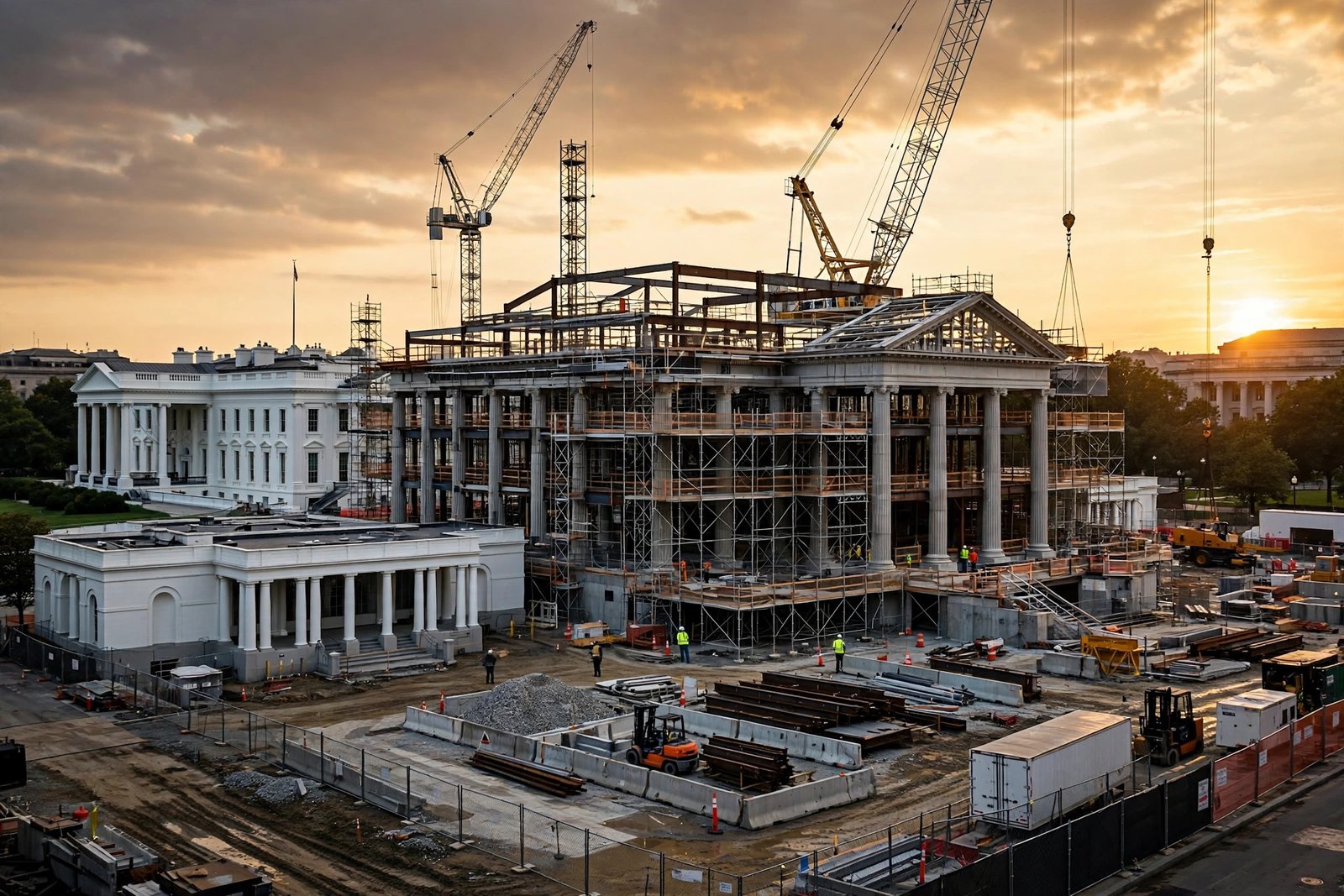
The Trump ballroom donor leak has ripped open one of the White House’s most closely guarded secrets. On Thursday, October 15, 2026, The Washington Post published a bombshell investigation based on a leaked internal fundraising spreadsheet that names every major donor behind President Donald Trump’s White House ballroom — and the numbers are staggering.
According to the leaked records, private donors have committed a combined $333 million to the ballroom project through 67 individual donations above $10,000. Tech giants Apple and Nvidia sit at the very top of the list, each committing $25 million — and President Trump himself is nowhere to be found on the list, despite his repeated claim that the project was “being paid for a hundred percent by me and some friends of mine.”
The revelations have ignited a firestorm of ethics questions in Washington, because the vast majority of the money came from companies and wealthy individuals with business pending before the federal government. The White House has furiously denounced the disclosure, vowing to hunt down whoever leaked the internal documents.
- The Trump Ballroom Donor Leak: What the Spreadsheet Reveals
- Top Donors: Apple, Nvidia, Adelson Family and Ergen Lead With $25 Million Each
- The Nvidia Timeline: $25 Million Came Three Months After China Chip Deal
- Ergen, Rocket and the Regulatory Coincidences
- The Money Pipeline Nobody Has to Disclose
- The $600 Million Question: Taxpayers vs. Private Money
- Denials and the White House Response
- What’s Next
The Trump Ballroom Donor Leak: What the Spreadsheet Reveals
The internal spreadsheet, obtained by The Washington Post reporters Jonathan O’Connell, Sarah Blaskey and Aaron Schaffer, tracks every contribution above $10,000 recorded as of late September 2026. It includes the source, date and amount of all 67 donations, along with payment arrangements and — critically — requests for secrecy from some of the biggest givers.
The total comes to $333 million in private commitments, a figure that aligns with what the administration has publicly claimed it raised. But the document exposes something the White House never volunteered: at least $77 million came from donors who asked to remain anonymous, and at least nine donors formally requested that their names be kept out of any public disclosure.
The White House had publicly named just 37 donors last October — without revealing a single amount. The leaked spreadsheet more than triples the transparency, showing who gave, how much, and when.
It also shows that several donors the administration named publicly do not appear on the internal records at all, including Hard Rock International, Tether America and housing executive Paolo Tiramani — who had publicly claimed a $10 million stock donation. In the other direction, the spreadsheet lists a $5 million pledge from AT&T that the company told the Post was included in error and that it had no plans to contribute.
The Post stressed that its investigation did not establish a direct link between any donation and a favorable government action. But the paper found that the overwhelming majority of the $333 million came from companies and wealthy people with active interests before the federal government — a pattern that has alarmed ethics experts, who warn that companies could be buying influence with the administration or feeling pressured to give. It is a controversy that echoes other White House battles StateLineDaily has covered, from the internal power struggles around Chief of Staff Susie Wiles to the administration’s fight with the press over White House media access.
Top Donors: Apple, Nvidia, Adelson Family and Ergen Lead With $25 Million Each
Four donors sit at the top of the leaked list with matching $25 million commitments: Apple, Nvidia, the Adelson Family Foundation — one of the Republican Party’s biggest donor dynasties — and billionaire Charles Ergen, the co-founder and chairman of Dish Network.
Just below them, Google committed $22 million, paid through a trust holding settlement funds from Trump’s YouTube lawsuit, according to the leaked records. The Laura and Isaac Perlmutter Foundation gave more than $20 million. Microsoft, Lockheed Martin, Palantir and RHI II LLC each pledged $10 million, while Comcast gave $7.5 million. Amazon, Meta, Cisco, T-Mobile and ServiceNow each committed $5 million.
The cryptocurrency industry also showed up in force, contributing $18.1 million in total — including $5.1 million from the Winklevoss twins, the billionaire crypto investors and longtime Trump allies. Other notable names include Small Business Administration chief Kelly Loeffler and her husband, who promised $5 million, and Commerce Secretary Howard Lutnick’s son Brandon, who donated stock worth more than $2.5 million.
Microsoft’s $10 million is particularly notable given what GeekWire reported: the White House had publicly named Microsoft, Amazon and T-Mobile among the ballroom’s donors last October but deliberately concealed the amounts. With Microsoft and Amazon ranking among the federal government’s largest technology providers, their silence on the dollar figures looks, in retrospect, like a strategic choice.
The Nvidia Timeline: $25 Million Came Three Months After China Chip Deal
The detail drawing the most scrutiny involves Nvidia, the chipmaking giant at the center of the global AI race. According to the leaked records, Nvidia’s $25 million donation came nearly three months after the company struck a deal with Trump to sell advanced microchips to China — one of the most consequential technology policy decisions of his second term.
Nvidia firmly denied any connection. Company spokesman John Rizzo told the Post that as an American company its support for the United States was paramount and independent of any business interests, adding that the firm was proud to donate to what he described as a nonpartisan trust serving all Americans.
But the timing has fueled criticism from politicians and civic groups, because Nvidia sits at the intersection of two of the federal government’s hottest policy battles: export controls on advanced semiconductors and the race to build AI infrastructure. Microsoft and Palantir — both $10 million donors — play similarly central roles in government AI projects and federal contracts. As CNBC noted in its coverage of the leak, concerns are growing that federal policy decisions could become entangled with corporate interests.
The Post was careful to note that it found no direct evidence of a quid pro quo. Still, ethics experts quoted in the reporting pointed out that the appearance alone is the problem: when the two companies competing for the most sensitive federal approvals in the country hand $25 million and $10 million checks to a presidential project, the line between patriotism and influence becomes nearly impossible for outsiders to see.
Ergen, Rocket and the Regulatory Coincidences
Several other donations in the leaked spreadsheet landed with awkward timing. Charles Ergen committed his $25 million in two installments around the same period that the Federal Communications Commission and the Justice Department approved the sale of EchoStar wireless licenses to AT&T — following the closure of an FCC investigation into his company. Ergen and EchoStar declined to comment on the sequence of events.
A subsidiary of mortgage lender Rocket committed $10 million — weeks after a federal agency approved its acquisition of Mr. Cooper. A Rocket spokesperson insisted the two events were unrelated, and ServiceNow, which pledged $5 million following a government agreement, similarly described its business dealings as separate from its charitable donation.
Perhaps the most eyebrow-raising entry involves Isabela Herrera, the daughter of banker Julio Herrera Velutini. She committed $2.5 million in September 2025 — a month after her father secured a plea agreement reducing his bribery charges to a misdemeanor. Records show she paid an initial $835,000 installment that October. Trump then pardoned her father in January 2026. The White House has described his prosecution as politically motivated; neither father nor daughter responded to the Post’s questions.
A Pentagon official, asked about the pattern — including questions about a multi-billion dollar contract awarded to Salesforce, whose CEO and company had made financial commitments to the project — emphasized that political connections play no role in Department of Defense funding decisions.
The Money Pipeline Nobody Has to Disclose
One of the least understood — and most consequential — revelations in the Trump ballroom donor leak is how the money actually moves. This is the structural detail competitors have largely glossed over, and it explains why the public learned so little about a third of a billion dollars in corporate giving until a spreadsheet leaked.
The contributions flow through the Trust for the National Mall, a nonprofit, before reaching the government and a White House account that the president directly controls. Donors were given pledge documents in the name of the “Donald J. Trump Ballroom.” Crucially, these gifts are not subject to campaign finance limits or public disclosure requirements — the normal guardrails that would let Americans see who is giving millions to a sitting president simply do not apply here.
An agreement between the government and the Trust goes further still: it requires donor anonymity to be maintained to the extent allowed by law and bars any public recognition of donors without written authorization from White House Executive Residence staff. In other words, the secrecy was not an accident — it was designed into the system.
That architecture is exactly why at least $77 million arrived from anonymous donors and why the White House was able to name 37 donors publicly last October while hiding every dollar amount. The money goes through a nonprofit, into a White House account the president controls, with anonymity contractually protected — a pipeline that keeps the contributions legally invisible unless someone leaks the spreadsheet. Compare that to the world of campaign finance, where a $2,800 check gets your name in a public database within days, and the scale of the loophole becomes clear.
The $600 Million Question: Taxpayers vs. Private Money
The leak also refocuses attention on a second mystery: how much this project actually costs — and who is really paying for it. The numbers have moved in only one direction since the White House announced the project on the site of the demolished East Wing in July 2025.
The administration first put the price at $200 million, calling it “a private thing” that donors would cover. By March 2026, the figure was $400 million, declared “taxpayer-free” with “no taxpayer putting up 10 cents.” But internal documents reviewed by the Post showed the contractor, Clark Construction, had told the White House on March 5 that the job would actually cost $600 million — and that roughly half of it could land on taxpayers. As late as this week, the administration was still publicly describing a $400 million project.
The internal records broke down the $600 million into about $307 million from public accounts — $155 million from the Secret Service, $149 million from the White House Military Office and $3 million from the Executive Residence — against roughly $293 million in private money. The Post has also reported that taxpayer money has already covered some construction costs, despite the administration’s emphasis on private financing.
There is a further credibility wrinkle. In August 2026, the administration told the Supreme Court that construction of the new East Wing was “65% finished” — using that figure to argue the work had gone too far to halt. But the Post reported that public appropriations data contradicted the claim: as of the end of July, the White House budget office had approved only $144 million from the East Wing account, which would represent barely a quarter of the $600 million the contractor estimated. The same filing said the government had spent “around $200 million” — which, against a $600 million budget, would be just 33% complete.
(The Supreme Court in August 2026 allowed above-ground construction to continue while the broader legal dispute proceeds.)
And then there is the president’s own wallet. Trump has repeatedly claimed he was bankrolling the project personally, telling reporters last year that it was “being paid for a hundred percent by me and some friends of mine.” The leaked spreadsheet shows no contribution from Trump himself. That absence does not prove he gave nothing — the records track reported commitments, not every possible form of support — but they provide no evidence of a personal financial contribution from the president.
With private commitments at $333 million, the fundraising total still sits below Trump’s own $400 million target.
Denials and the White House Response
The White House response to the leak was swift and combative. Spokesman Davis Ingle dismissed the ethics concerns as fabricated, describing the contributors as a broad collection of American businesses and generous individuals supporting improvements to the presidential residence. “The same critics who are alleging fake conflicts of interest would also complain if American taxpayers were footing the bill for these long-overdue renovations,” he told the Post.
Ingle saved his sharpest language for the leak itself, accusing the newspaper of publishing stolen internal records and declaring that the administration would, as he put it, relentlessly pursue those responsible while continuing to protect the donors who wished to remain anonymous.
Donors who responded to the Post’s reporting denied any connection between their financial support and favorable government actions. Nvidia, Rocket and ServiceNow each insisted their donations were unrelated to their business before the government. Ergen, EchoStar, and Salesforce did not respond.
What none of the denials address is the structural reality the Trump ballroom donor leak exposed: a fundraising pipeline engineered for anonymity, fed overwhelmingly by companies and billionaires with live interests before the federal government, flowing into an account the president personally controls. Whether or not any single donation bought a specific favor, the Trump ballroom donor leak has given the public its first real look at how the most expensive White House construction project in modern history is actually being financed — and who is financing it. For a White House already juggling midterm-season scandals from mega-donor spending fights to cabinet turmoil, the leak lands at the worst possible moment.
What’s Next
Will anyone be charged over the leak?
The White House says it will relentlessly pursue whoever leaked the spreadsheet, but no investigation details have been disclosed. As with most internal leak probes, identifying the source inside a fundraising operation with dozens of staff and donors could take months — and previous Trump-era leak hunts have rarely produced public results.
Could Congress investigate the donor list?
Democrats have already seized on the Trump ballroom donor leak revelations, and with the midterm elections on November 3, 2026, the donor list is likely to become a campaign weapon. Hearings would require committee action, and the current House leadership has shown little appetite for probing the administration. But a shift in power in the midterms could open the door to subpoenas targeting the Trust for the National Mall’s books.
Will the anonymity agreement survive?
The agreement between the government and the Trust for the National Mall requires donor anonymity — but the Trump ballroom donor leak has already pierced it for the biggest names. Expect litigation and pressure from watchdog groups arguing that the public has a right to know who is funding a president’s personal construction project through a nonprofit pipeline.
Will the project actually hit $600 million?
Internal contractor estimates say yes; the administration still publicly says $400 million. Private fundraising stands at $333 million against a $400 million target, meaning tens of millions — possibly much more — must still come from somewhere. Watch the appropriations data for the East Wing account: if public money keeps flowing, the “taxpayer-free” claim will face its hardest test yet.
Additional Details
Description: The Trump ballroom donor leak exposes a leaked Washington Post investigation revealing $333 million in private commitments to President Trump’s White House ballroom, with Apple and Nvidia giving $25 million each, at least $77 million from anonymous donors, and the president himself absent from the donor list — plus details on the nonprofit money pipeline, regulatory timing questions, and the disputed $600 million true cost.