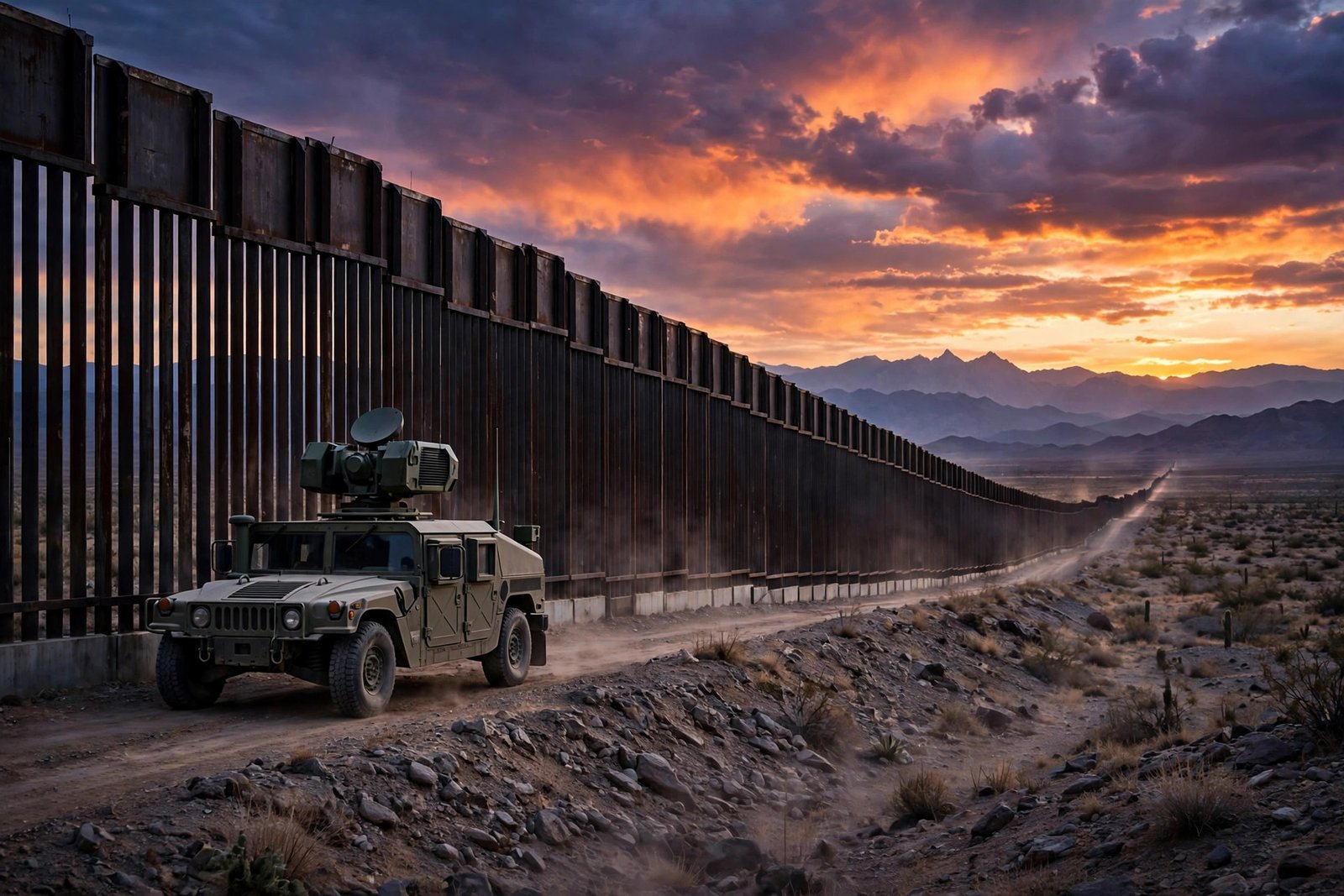
The Pentagon has quietly cleared the Department of Homeland Security to test a military-grade “heat ray” for potential use along the southern U.S. border, according to a memo signed by Defense Secretary Pete Hegseth last month and obtained by CNN. The decision, first reported on October 21, hands one of the American military’s most unusual directed-energy weapons to a domestic law enforcement agency for the first time in a potential operational setting.
The device, officially known as the Active Denial System, is a nonlethal weapon that fires an invisible beam of electromagnetic waves reaching a little more than half a mile. The Pentagon heat ray causes an intense burning sensation when it touches human skin — which Pentagon officials have previously compared to the blast of heat felt when opening a hot oven. Military officials say the resulting “tingling effect” lasts between 10 and 15 minutes but also generates “an instinctive and irresistible urge to run from the effect.”
The Pentagon heat ray arrangement takes the form of a seven-month temporary loan of a single Active Denial System that began in September 2026. But the memo’s fine print does something remarkable: it shifts nearly all responsibility for the weapon onto DHS, explicitly barring Defense Department personnel from operating it. Border security advocates and civil liberties watchers are already calling the loan an unprecedented step — even for an administration that has made immigration enforcement one of its top priorities.
- What the Pentagon Heat Ray Actually Is: The Active Denial System Explained
- The Hegseth Memo: A 7-Month Pentagon Heat Ray Loan With a Careful Liability Shift
- How the Pentagon Heat Ray Works: The Physics of 95 Gigahertz
- Years of Quiet Pentagon Heat Ray Talks: Border Crowd Dispersal
- The 2018 Precedent: When a DHS Secretary Rejected the Pentagon Heat Ray
- Even Border Agents Question the Pentagon Heat Ray Plan
- Legal and Sovereignty Questions Over the Pentagon Heat Ray
- What’s Next
- Additional Details
What the Pentagon Heat Ray Actually Is: The Active Denial System Explained
The Pentagon heat ray at the center of the memo is not a prototype. The Active Denial System is a mature military technology developed in the 2000s for crowd-control purposes. It fires a focused beam of millimeter-wave energy that rapidly heats the surface of human skin, creating a sensation the Pentagon has long described as deeply uncomfortable but temporary — by design.
Unlike conventional firearms or even rubber bullets and tear gas, the system is built around a simple principle: deter or disperse people without firing a projectile. Its effects are meant to stop the instant a person moves out of the beam’s path. The beam reaches a little more than half a mile, according to the U.S. military, giving it far more standoff distance than any conventional crowd-control tool available to federal agents.
The U.S. military briefly deployed the system to Afghanistan nearly two decades ago but ultimately declined to use it during active combat operations. Military officials also considered using the system for crowd control at U.S. facilities abroad where terrorist detainees were being held at the time, but declined to employ it for that purpose as well, according to a source familiar with those internal considerations cited by CNN.
The Hegseth Memo: A 7-Month Pentagon Heat Ray Loan With a Careful Liability Shift
The memo at the heart of the story was signed by Hegseth in September 2026. It authorizes the “temporary loan” of one Active Denial System to DHS for seven months, a period that began in September — meaning the Pentagon heat ray trial runs roughly through April 2027.
What stands out most in the memo is its liability language. The document states that the system “shall not be operated by DoW (Department of War) personnel” — a reference to the rebranded Defense Department — and places sole responsibility for “system employment, use and development of tactics, techniques and procedures” with DHS. In other words, the Pentagon is lending out the weapon while appearing to absolve itself of any responsibility for how the directed-energy system may ultimately be deployed.
At the end of the seven-month loan period, DHS can submit an additional request for further use of the Pentagon system in border operations based on need, a defense official told CNN. That extension mechanism means this test period could easily become a long-term arrangement.
Crucially, the DHS request did not specify where or how the weapon would be tested, and it said nothing about how the Pentagon heat ray might eventually be used in actual operations. When asked for comment, the Pentagon referred questions to DHS. A Customs and Border Protection spokesperson told CNN that “CBP is continually evaluating new technologies, especially those that enhance operational effectiveness and strengthen mission capabilities” — but offered no testing plan.
How the Pentagon Heat Ray Works: The Physics of 95 Gigahertz
One reason the Pentagon heat ray keeps drawing interest from security officials is the unusual physics behind it. The Active Denial System operates in the millimeter-wave band, reported at 95 gigahertz — a frequency deliberately chosen because its energy is absorbed almost entirely in the outermost layer of human skin, roughly 1/64 of an inch deep, without penetrating into deeper tissue.
That shallow absorption is the entire point of the weapon’s design: the beam agitates water molecules in the skin’s surface, producing the searing sensation, but the energy does not reach muscles, organs, or the nervous system below. The system also includes an automatic limit on beam duration to reduce the risk of lasting injury, and the effect is designed to fade within 10 to 15 minutes once a person leaves the beam.
The demonstration record is extensive. Past demonstrations exposed hundreds of volunteers with only a small number of burns reported, according to reporting on the system’s test history. That track record is a major reason its backers describe the Active Denial System as the most thoroughly safety-tested nonlethal directed-energy weapon in the American arsenal — though critics note that controlled demonstrations on volunteers are very different from deploying the beam against migrants at a chaotic border crossing.
Years of Quiet Pentagon Heat Ray Talks: Border Crowd Dispersal
The October memo did not arrive out of nowhere. Over the years, there have been internal discussions about potentially using the Pentagon heat ray for crowd dispersal along the U.S.-Mexico border, according to current and former Customs and Border Protection officials cited by CNN. Customs and Border Protection officials have previously entertained the idea of using the system in areas with a high concentration of illegal crossings, and border officials have occasionally discussed it as a crowd dispersal tool — but it has never been deployed.
One of the most detailed evaluations happened years ago in the El Centro sector, which covers around 70 miles along the U.S.-Mexico border, when Rodney Scott helmed that sector, according to a CBP official. Scott now serves as CBP commissioner, which gives the old evaluation new significance. At the time, officials were discussing whether the system might help agents with an influx of illegal crossings along the nearby river — discouraging people from trying to cross in that area, or pushing them to get out of the water.
That river scenario exposed one of the technology’s darkest practical risks. “Even if they’re chasing people back to the river, you don’t want them to go in and drown,” a former CBP official told CNN. One of the considerations at the time was whether the system might result in more rescues if people were incapacitated by the technology — though it remains unclear why the system wasn’t deployed then.
U.S. officials had also considered deploying the system during moments of domestic unrest, including at the end of President Donald Trump’s first term when protests erupted over the murder of George Floyd, according to a former U.S. official familiar with those discussions. The idea was never put into practice — but the fact that it reached serious discussion is now central to the controversy.
The 2018 Precedent: When a DHS Secretary Rejected the Pentagon Heat Ray
The most revealing piece of the Pentagon heat ray story may be what happened the last time it was seriously proposed. In 2018, prior to the midterms, CBP officials also weighed using the system against migrants — and then-Homeland Security Secretary Kirstjen Nielsen shot it down.
“The issue was treating immigrants and citizens like enemy combatants,” a former DHS official familiar with those previous discussions told CNN. “Thematically, inhumane treatments typically get rejected.”
That 2018 rejection is now the measuring stick for the 2026 loan. Eight years ago, a Republican administration’s own DHS secretary concluded that aiming a military directed-energy weapon at migrants crossed a line. Now, a memo from that same institutional lineage — signed by Hegseth with careful liability disclaimers — is reopening the door. The contrast raises an unavoidable question: what changed? The technology hasn’t. The legal framework around it hasn’t. What changed is the administration’s willingness to test the boundary.
Read StateLineDaily’s full breakdown of ICE ERO ONE, the $100 million domestic surveillance program putting 142 intelligence agents in 26 U.S. cities — another piece of the administration’s fast-expanding enforcement apparatus.
Even Border Agents Question the Pentagon Heat Ray Plan
Perhaps the most surprising reaction to the Pentagon heat ray loan has come from inside the border enforcement community itself. Some Border Patrol agents have more recently cast doubt over whether they need the tool at all, amid low border crossings and an increase in personnel, according to another former CBP official cited by CNN.
Deploying the heat ray at the U.S. border would be an unprecedented step, even for the Trump administration, which has made border security and clamping down on immigration a top priority. A former CBP official put the practical skepticism bluntly: “For the cost, for the training and for the policies you’re going to create, is the juice worth the squeeze?”
See StateLineDaily’s coverage of the Trump deportation numbers falling far short of the 1 million goal — 660,000 deported last fiscal year — for context on the enforcement push the heat ray loan fits into.
Legal and Sovereignty Questions Over the Pentagon Heat Ray
Officials who have studied the Pentagon heat ray for border use ran into hurdles over legalities, use of force, effectiveness, and potential issues over sovereignty — particularly if the system was deployed on people in Mexico who had not yet crossed into the United States. Chief among those concerns was whether people could be harmed, either directly or indirectly, by the weapon.
The sovereignty question is thorny: a beam that reaches more than half a mile from the border could easily touch people standing on Mexican soil. Using a U.S. military weapon against people who have not crossed the border — and against Mexican nationals in Mexico — raises questions that no test plan has yet answered, because no test plan has been disclosed.
For the broader picture of federal enforcement escalation, read StateLineDaily’s report on the California voter fraud bust and Operation Protect the Vote, where federal agents made 28 arrests as midterms approach.
What’s Next
Has the Pentagon heat ray actually been deployed at the border?
No. The memo authorizes only testing and tactics development during a seven-month loan that began in September 2026. DHS has not disclosed where or how the system will be tested, and CBP declined to describe a testing plan.
What has DHS said about the plan?
A CBP spokesperson said the agency is “continually evaluating new technologies, especially those that enhance operational effectiveness and strengthen mission capabilities.” The Pentagon referred all questions to DHS.
Could the heat ray be used against U.S. citizens?
Officials previously considered deploying the system during domestic unrest at the end of Trump’s first term, amid the protests over the murder of George Floyd. It was never used — but that internal discussion shows the system’s potential uses were never limited to the border.
When does the loan period end?
Roughly April 2027. At that point, DHS can submit an additional request for further use of the system in border operations based on need, according to a defense official — so the test could become permanent.
What are the biggest unanswered questions?
Where the testing will happen, who will operate the weapon (DHS personnel, since Pentagon staff are barred), what tactics DHS develops, and what legal framework — if any — governs aiming a military directed-energy weapon at people near or across the border.
Additional Details
Description: The Pentagon heat ray deal gives DHS a seven-month loan of the military’s Active Denial System — a nonlethal 95 GHz directed-energy weapon — for potential border testing under a memo signed by Defense Secretary Pete Hegseth. The loan revives an idea DHS Secretary Kirstjen Nielsen rejected in 2018, raises legal and sovereignty questions, and even has some Border Patrol agents asking whether the tool is needed at all.
- Weapon: Active Denial System (ADS) — nonlethal directed-energy heat ray
- Beam: Invisible millimeter-wave energy (reported at 95 GHz); range a little more than half a mile
- Effect: Intense burning/tingling sensation lasting 10–15 minutes; “instinctive and irresistible urge to run”
- Memo signed by: Defense Secretary Pete Hegseth, September 2026
- Loan terms: One system, seven months, temporary loan; DHS may request extension
- Who operates it: DHS only — “shall not be operated by DoW (Department of War) personnel”
- Test location: Not specified; no test plan disclosed
- History: Developed in the 2000s; briefly deployed to Afghanistan ~2010, never fired in combat; considered for detainee facilities abroad, declined
- 2018 precedent: CBP weighed using it against migrants; DHS Secretary Kirstjen Nielsen rejected the idea
- 2020 discussions: Officials considered deployment during George Floyd protests; never used
- Agency response: CBP says it is “continually evaluating new technologies”; Pentagon referred questions to DHS