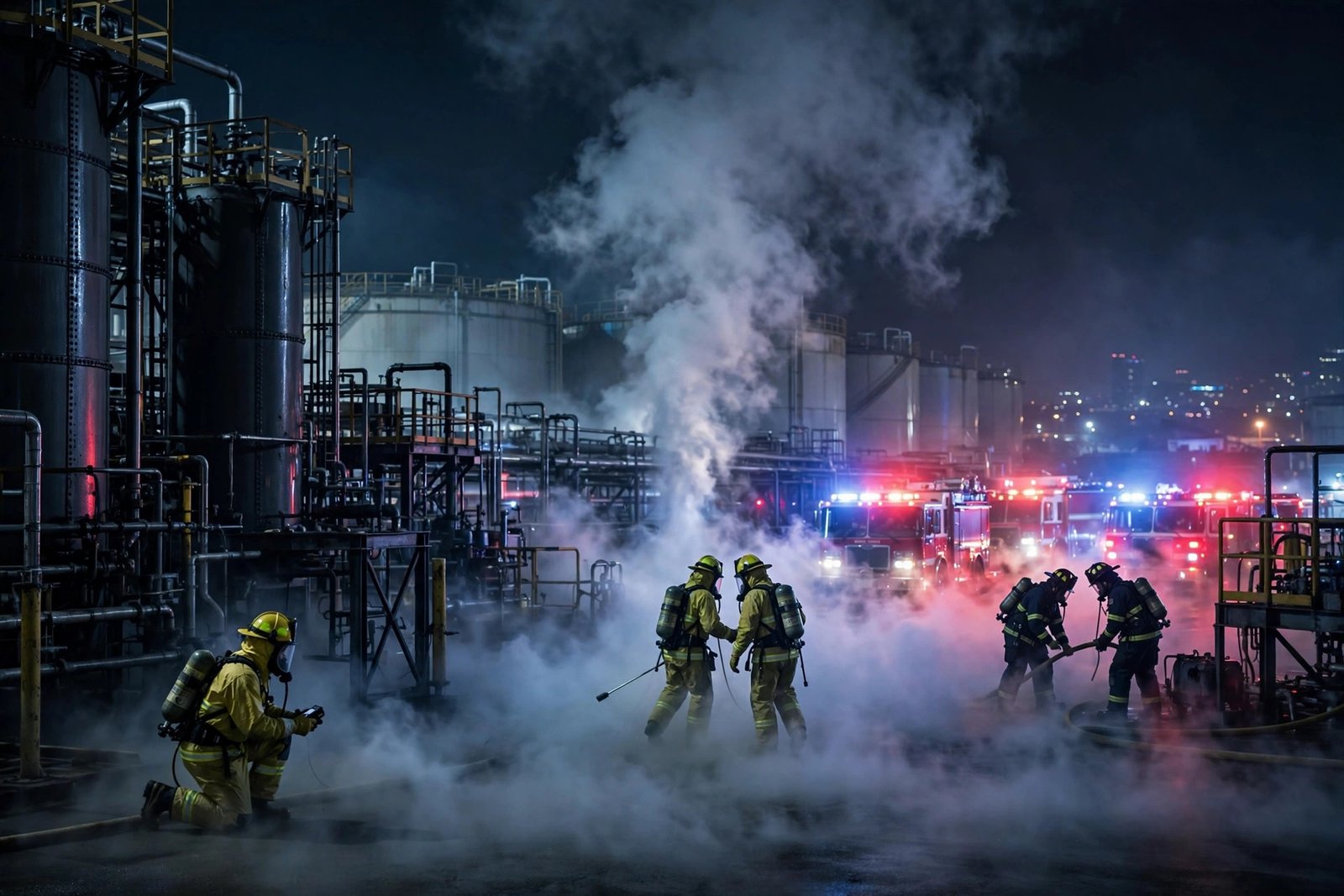
Nearly 1,000 residents were ordered to flee their homes late Tuesday night after a Toledo chemical leak released a hazardous industrial chemical into the air in North Toledo, Ohio — and by Wednesday morning, officials had widened the danger zone dramatically, telling everyone within three miles to shelter indoors.
The release of glycidyl methacrylate from the MC Tank Terminal on Progress Avenue triggered one of the largest hazmat evacuations in the city’s recent history, with fire crews, the U.S. EPA, and specialized response teams still working to bring the leak under control as of Wednesday afternoon.
The Toledo chemical leak began around 9:30 p.m. on Tuesday, October 20, when a tank at the MC Tank Terminal at 1266 Progress Ave. started venting the chemical into the surrounding neighborhood.
Toledo Fire & Rescue issued a mandatory evacuation order at approximately 10:48 p.m. for everyone within a one-mile radius — an area home to roughly 983 people — and at 4:24 a.m. Wednesday expanded emergency precautions, directing residents within a three-mile radius to shelter in place, close their windows, and shut off ventilation systems that pull in outside air.
The orders have since stretched across the state line, with Michigan communities including Bedford and Erie Townships issuing their own shelter-in-place guidance, according to reporting citing The Guardian.
One Lucas County sheriff’s deputy sought hospital treatment after falling ill during the emergency response, and residents across the zone have reported eye and throat irritation, the Associated Press reported via the Daily Caller News Foundation. As of Wednesday afternoon, city officials said the Toledo chemical leak had not fully stopped and the evacuation and shelter-in-place orders remain in effect — with an estimated six to sixteen more hours before updated guidance could be issued.
- Toledo Chemical Leak: What Happened Tuesday Night
- The Chemical Behind the Toledo Chemical Leak: Glycidyl Methacrylate
- Evacuation and Shelter-in-Place Orders in Toledo
- Explosion Fears and the Transfer-Error Finding
- Officials Respond to the Toledo Chemical Leak
- Toledo Chemical Leak: What Residents Should Do Right Now
- Extra Knowledge: Ohio’s Haunted History of Chemical Emergencies
- Extra Knowledge: Why Chemical Transfers Are the Most Dangerous Moment
- What’s Next
- Additional Details
Toledo Chemical Leak: What Happened Tuesday Night
The Toledo chemical leak unfolded over a frightening overnight timeline that caught a sleeping city off guard. According to the Daily Caller News Foundation, the Toledo chemical leak began around 9:30 p.m. Tuesday at the MC Tank Terminal on Progress Avenue in North Toledo, when a tank holding glycidyl methacrylate began discharging the chemical into the air.
By 10:48 p.m., Toledo Fire & Rescue had ordered everyone within a one-mile radius of the facility to evacuate immediately.
The scale of the overnight response to the Toledo chemical leak was massive. Shoreland Elementary School was opened as a temporary shelter for displaced residents, while American Red Cross personnel and Toledo Area Regional Transit Authority buses were stationed near a Meijer parking lot off East Alexis Road to assist evacuees, the DCNF reported.
Several schools canceled or delayed classes Wednesday as emergency personnel continued monitoring the Toledo chemical leak, the Associated Press noted.
By 4:24 a.m. Wednesday, officials escalated: residents within a three-mile radius were directed to shelter indoors — stay inside, shut windows and doors, switch off ventilation that pulls in outside air, and keep pets inside, per the City of Toledo’s guidance reported by Fox Weather.
Dense fog complicated the entire response to the Toledo chemical leak. Toledo Fire & Rescue warned residents in an emergency advisory that the Toledo chemical leak could not be distinguished from ordinary fog by sight alone. “You can’t tell fog from the release by looking, so please don’t rely on how the air looks,” the department said — a warning that took on added urgency as local news stations reported a plastic-like odor lingering in the air across the city.
FOX Weather storm tracker Brandon Copic, who lives near the site, recorded video of a fast-moving vapor cloud late Tuesday while a Dense Fog Advisory was in effect. Copic described smelling the chemical and experiencing a burning sensation in his lungs, Fox Weather reported. Unverified posts on social media claimed air-quality readings as high as 805 on the Air Quality Index — but the city has not confirmed any such reading, and residents should treat those figures as unconfirmed.
The Chemical Behind the Toledo Chemical Leak: Glycidyl Methacrylate
The substance at the center of the Toledo chemical leak is glycidyl methacrylate, identified by both the City of Toledo and MC Tank Transport Inc. in company statements. According to Fox Weather, MC Tank Transport described it as an industrial chemical used to make certain plastics, paints and coatings perform better. The DCNF reported that the chemical is stored as a liquid but was released into the air as a gas — which helps explain why it traveled so far beyond the facility fence line.
City health officials describe the chemical as primarily an irritant — but one that demands respect. According to a safety document published by the city, glycidyl methacrylate can cause burning of the eyes, nose, mouth and skin, with overexposure potentially triggering headaches, dizziness, fatigue, nausea and vomiting, the DCNF reported. Lucas County health commissioner Karim Baroudi told reporters the chemical is “mostly an irritant at this point,” J News Network reported.
The facility reportedly housed a tank capable of holding 5,500 gallons, though the amount of chemical actually discharged had not been established as of Wednesday afternoon.
Officials warned that the Toledo chemical leak could pose an explosion risk while emergency crews worked to stabilize the facility — a concern serious enough that hazmat teams were kept back from the tank for hours.
Evacuation and Shelter-in-Place Orders in Toledo
The Toledo chemical leak produced a two-tiered emergency footprint. The mandatory evacuation zone covers everyone within one mile of 1266 Progress Ave. — about 983 people, according to city figures reported by J News Network. The shelter-in-place zone extends three miles in every direction, covering tens of thousands more residents. Evacuees were directed to Shoreland Elementary School or the Meijer parking lot off East Alexis Road, where Red Cross workers and TARTA buses were stationed to provide shelter.
The disruption rippled across the region’s daily life. Toledo Public Schools and Washington Local Schools canceled classes for Wednesday, The Columbus Dispatch reported, and traffic cameras showed hazmat activity and lingering haze around the terminal district through the morning, with traffic moving on I-75 and I-280.
The cross-border reach of the plume pushed Michigan communities — including Bedford and Erie Townships — to issue their own shelter-in-place orders, according to reporting citing The Guardian.
Large-scale residential evacuations are among the hardest operations in emergency management. See StateLineDaily’s coverage of the Norte Fire evacuations in Orange County, where 16,000 residents fled a fast-moving wildfire — a reminder of how quickly ordinary neighborhoods can become emergency zones, and why officials draw wide protective perimeters even when the visible danger seems distant.
Explosion Fears and the Transfer-Error Finding
One of the most confusing threads of the Toledo chemical leak has been the question of whether anything exploded. At Wednesday’s news conference, Mayor Wade Kapszukiewicz described the initial event as an explosion of the chemical tank — but a city spokesperson later clarified that no explosion occurred, J News Network reported. The city’s official guidance was equally direct: no explosion, only a release.
The explosion-risk warning, however, was real. The mayor said the tank could remain explosive for up to 12 hours after the incident, which is why hazmat crews could not approach it until about 9:30 a.m. Wednesday.
That 12-hour standoff window explains the long overnight hours of uncertainty: responders could monitor from the perimeter but could not get close enough to stop the Toledo chemical leak at its source.
As for the cause, the Ohio Environmental Protection Agency reportedly linked the Toledo chemical leak to an error during a chemical transfer, the DCNF reported — though authorities had not publicly established the precise circumstances that triggered the emergency.
MC Tank Transport Inc., a subsidiary of The Kenan Advantage Group, confirmed in a statement to Fox Weather that equipment associated with its operations was involved in the Toledo chemical leak, said it was cooperating with authorities, and said it had mobilized specialized emergency response resources.
America’s industrial infrastructure — the terminals, pipelines and transfer stations that move chemicals through communities every day — is aging, and the stakes of each transfer keep rising. See StateLineDaily’s report on the race to rebuild U.S. infrastructure in 2026 for the broader picture.
Officials Respond to the Toledo Chemical Leak
Toledo’s leadership has been candid about how much remains unknown. “We don’t know what caused this. We just know we’re responding to it,” Democratic Mayor Wade Kapszukiewicz said during Wednesday’s news conference, according to The Blade via the DCNF.
Rachel Hart, the city’s chief of communications, gave the clearest operational picture Wednesday afternoon: “Toledo Fire & Rescue crews continue to monitor the scene. The US EPA is overseeing air monitoring around the perimeter of the evacuation zone. We are seeing signs of improvement, but until the release has fully stopped, evacuation and shelter-in-place orders remain in effect.” Hart added that the city had no exact timeline but estimated “it could be another 6-16 hours before we issue updated guidance,” telling residents: “Keeping neighbors safe is our top priority, and we appreciate everyone’s patience and cooperation as we work to resolve this situation.”
The federal response to the Toledo chemical leak is significant: the U.S. EPA is overseeing perimeter air monitoring, while the Ohio EPA is involved in the cause investigation. One first responder — a Lucas County sheriff’s deputy — was injured and took himself to a hospital; the extent of the deputy’s injuries had not been released, though officials described them as non-life-threatening, the Associated Press reported.
Toledo Chemical Leak: What Residents Should Do Right Now
For anyone inside the affected zones, the city’s guidance is specific and worth following exactly. If you are within one mile of 1266 Progress Ave., evacuate — do not wait. Go to Shoreland Elementary School or the Meijer parking lot off East Alexis Road, where the Red Cross and TARTA buses are stationed. If you are within the three-mile shelter-in-place zone: stay indoors, close all windows and doors, turn off ventilation that draws in outside air, and keep pets inside.
The city’s health guidance draws a clear line between mild and serious symptoms. People with mild irritation should shower or rinse the affected area and contact a medical professional. Anyone with serious symptoms — difficulty breathing, nausea and vomiting, dizziness or confusion — should go to an emergency room or call 911. Health questions can go to the Toledo-Lucas County Health Department at 419-213-4100, and officials ask residents to call 911 only for true emergencies, Virginia Times Now reported.
Perhaps the most important warning: do not trust your eyes. “You can’t tell fog from the release by looking, so please don’t rely on how the air looks,” Toledo Fire & Rescue said. A clear-looking street can still carry the chemical. For a refresher on emergency basics that apply well beyond storms, see StateLineDaily’s hurricane preparedness guide — evacuation and shelter-in-place discipline saves lives in every kind of disaster.
Extra Knowledge: Ohio’s Haunted History of Chemical Emergencies
What most national coverage of the Toledo chemical leak is missing is the context: Ohio has been here before, and the scars are still fresh. In February 2023, a Norfolk Southern freight train derailed in East Palestine, Ohio, forcing the evacuation of the village and a controversial controlled burn of vinyl chloride that sent a towering black plume over the Ohio-Pennsylvania border — an incident that drew national scrutiny of rail safety, chemical transport rules, and the adequacy of emergency response in small industrial communities.
The parallels are uncomfortable. Both emergencies involved the sudden airborne release of an industrial chemical in an Ohio community; both forced overnight evacuations; both unfolded amid confusion about exactly what was in the air and how dangerous it was. East Palestine’s aftermath reshaped the national conversation about chemical safety — Congress debated rail-safety legislation, the EPA expanded its oversight posture, and residents spent years disputing whether the official “all clear” came too soon.
The Toledo chemical leak involves a different chemical, a different kind of facility, and — so far — a more contained footprint. But the underlying lesson of East Palestine applies directly: in the first hours of a chemical release, the gap between what officials know and what residents fear is where trust is won or lost, and transparent, frequent communication is the only bridge.
There is another Ohio echo worth noting. The state sits at the crossroads of America’s chemical and freight infrastructure — refineries, tank terminals, rail yards and transfer stations threaded through residential neighborhoods in Toledo, Cleveland, Cincinnati and beyond.
Facilities like the MC Tank Terminal exist precisely because the region is a logistics hub. That economic geography is also a risk geography, and every transfer, every tank, every valve is a point where a single error can put a thousand people out of their homes by midnight.
Extra Knowledge: Why Chemical Transfers Are the Most Dangerous Moment
The Ohio EPA’s early finding — that the Toledo chemical leak was linked to an error during a chemical transfer — points to the single most dangerous phase of industrial chemical handling, and it is a detail most breaking-news coverage will glide past.
A chemical sitting quietly in a sealed tank is relatively safe. The moment of maximum risk is the transfer: when liquid or gas is moved from one vessel to another through hoses, pumps and valves, every connection is a potential failure point, and pressure, temperature and human procedure all have to align.
Safety engineers have a grim shorthand for this: the transfer is when the system is “open.” Valves are cycled, hoses are coupled and decoupled, pumps start and stop, and the chemical is briefly outside the passive safety of a sealed container. A misaligned valve, a failed gasket, an overpressurized line or a simple sequencing error can turn a routine operation into an uncontrolled release in seconds — which is consistent with a sudden nighttime discharge that nobody at the scene could immediately explain.
The mayor’s early “explosion” description, later walked back, likely reflected how violent and sudden such a release can look and sound to witnesses: a high-pressure discharge of chemical vapor can roar like a blast even when nothing detonates.
This is also why the 12-hour explosive-potential window mattered so much. A tank involved in a transfer gone wrong may be left in an unstable state — pressurized, partially vented, or containing reactive vapor mixtures — and responders cannot safely approach until the chemistry settles. That forced standoff is standard hazmat doctrine, but for the evacuated families watching from a school gymnasium at 3 a.m., it feels like abandonment. It isn’t; it’s the reason hazmat teams train for exactly this scenario, and the reason the evacuation perimeter was drawn so wide.
What’s Next
When will the evacuation and shelter-in-place orders be lifted?
Not yet. As of Wednesday afternoon, the release had not fully stopped, and city communications chief Rachel Hart estimated another 6 to 16 hours before updated guidance. The orders stay in effect until officials confirm the release has fully stopped and perimeter air monitoring — overseen by the U.S. EPA — shows the area is safe.
What caused the Toledo chemical leak?
The Ohio EPA has reportedly linked the incident to an error during a chemical transfer, but authorities have not publicly established the precise circumstances. MC Tank Transport says it is cooperating with the investigation and has mobilized specialized emergency response resources. Expect a fuller account once hazmat crews can safely access and inspect the tank.
Was anyone seriously hurt?
One Lucas County sheriff’s deputy was hospitalized after falling ill during the response; officials described the injuries as non-life-threatening. Some residents reported eye and throat irritation. No fatalities have been reported.
Could the Toledo chemical leak reach more neighborhoods?
The plume has already demonstrated cross-border reach, with Michigan townships issuing shelter-in-place orders. Dense fog and light winds — the same conditions that made the release hard to see — also slow its dispersal. Residents anywhere downwind should follow official guidance and not rely on how the air looks.
Will there be long-term health or environmental consequences?
Too early to say. The chemical is described by officials as “mostly an irritant,” but the full discharge amount is unknown and air-monitoring data has not been publicly released. The Ohio EPA investigation and any federal follow-up will determine whether enforcement action follows — and residents with persistent symptoms should document them and seek medical advice.
Additional Details
Description: Toledo chemical leak forces nearly 1,000 Ohio residents to evacuate as glycidyl methacrylate escapes from the MC Tank Terminal in North Toledo. Live timeline of the evacuation and 3-mile shelter-in-place orders, health risks of the chemical, the transfer-error finding, official statements, safety guidance for residents, and extra context on Ohio’s history of chemical emergencies — updated October 21, 2026.
This is a developing story. StateLineDaily will update this article as officials release new information. Last updated: October 21, 2026.