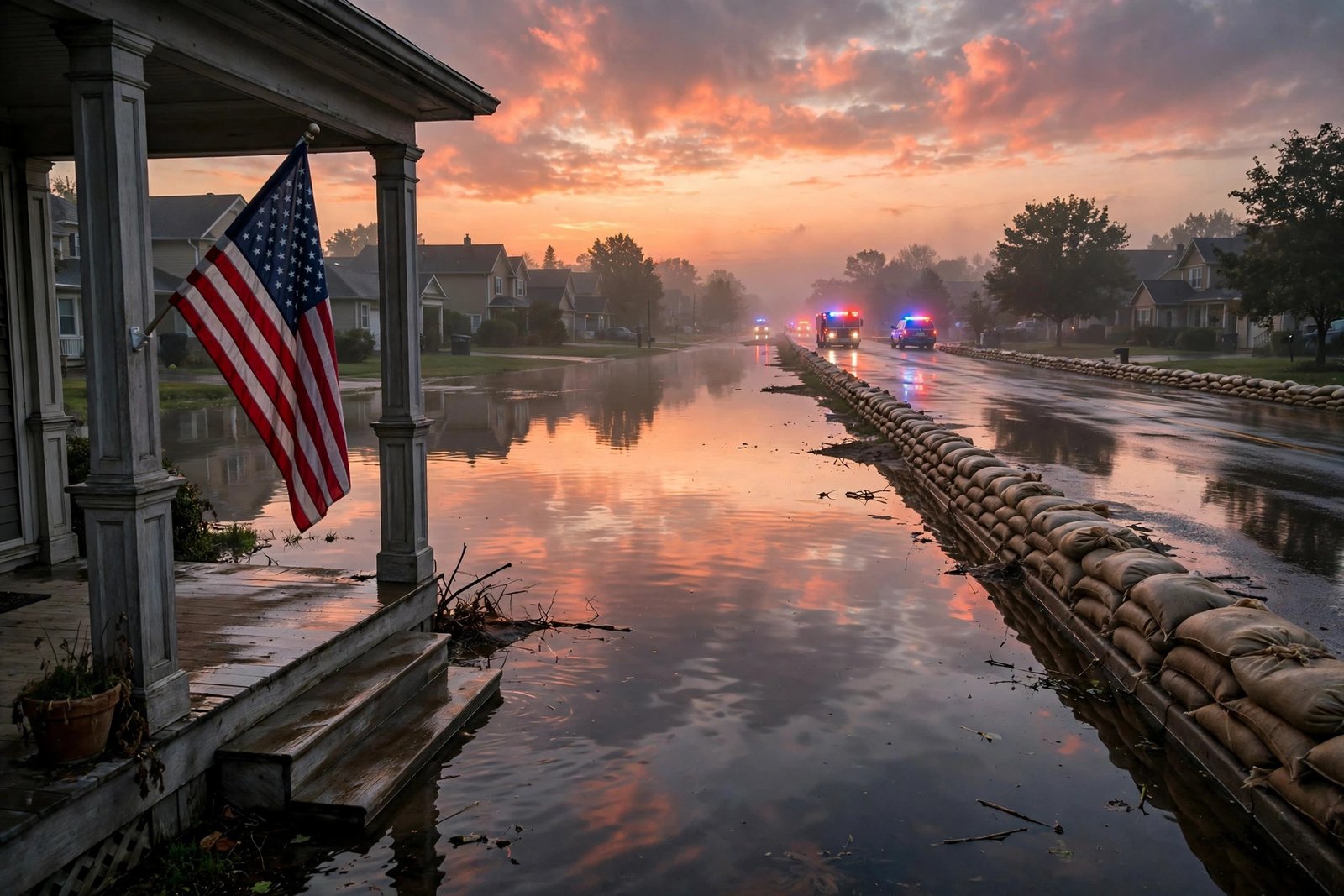
A New York Times report out Thursday says the Trump disaster aid midterms strategy has crossed a line that used to be untouchable in American politics: federal emergency relief is being used as leverage in the fight for Congress. “The White House is using federal disaster relief as leverage while Republicans fight to keep power in Washington, with President Donald Trump saying on one occasion that voting for Democrats could mean less money for states,” the Times reports.
The report, published just 12 days before the November 3 midterms, lands on top of weeks of accumulating evidence. Since early October, Trump has repeatedly intertwined disaster declarations with campaign endorsements — announcing millions in FEMA funding in the same breath as his “Complete and Total Endorsement” of Republican candidates, joking that a state could lose its recovery money if a GOP candidate loses, and signing a “special” disaster declaration the day before a campaign rally while leaving 15 other requests pending. The emerging Trump disaster aid midterms controversy now sits at the intersection of emergency management and electoral politics. The White House insists none of it is political.
Disaster survivor advocates and emergency-management experts say the Trump disaster aid midterms pattern threatens the foundation of the federal relief system itself. “Recovery isn’t partisan,” said Sierra Lindsey-Kos, co-founder and co-executive director of Extreme Weather Survivors, an advocacy nonprofit. “Neighbors help each other without asking who anyone voted for, and that’s exactly the way it should be.” With a major hurricane barreling toward the U.S. Gulf Coast and the midterms approaching, the fight over whether disaster aid is help or leverage is now a campaign issue in its own right. See StateLineDaily’s 2026 midterm predictions hub for how the races shaping this fight are trending.
Contents
- The NYT Report: Disaster Aid as Midterm Leverage
- Wisconsin: $17.9 Million Announced With a Gubernatorial Endorsement
- North Carolina: The “I’m Only Kidding” Remark About Helene Money
- Ohio’s “Special” Declaration — While 15 Other Requests Sat Pending
- The Trump Disaster Aid Midterms Numbers: 75% vs. Under 50%
- Endorsements Intertwined With Disaster Announcements
- The White House Denies It: “No Politicization”
- Extra Knowledge: The Law Doesn’t Actually Ban Political Discrimination in Disaster Aid
- Extra Knowledge: Why Congress Built the System to End Disaster “Logrolling”
- What’s Next
- Additional Details
The NYT Report: Disaster Aid as Midterm Leverage
The New York Times report published Thursday morning is the bluntest account yet of the Trump disaster aid midterms dynamic. According to the Times, the White House is actively using federal disaster relief as leverage in the closing stretch of the midterm campaign — and the president himself has told at least one audience that electing Democrats could cost their state disaster money.
The report also describes Vice President JD Vance joining the pattern. As one account summarized, “President Trump and Vice President JD Vance have dangled FEMA money to disaster-struck states during recent campaign rallies,” according to coverage of the Times reporting. The allegation is not that disaster declarations have stopped being issued — FEMA continues to operate — but that the timing, targeting, and public framing of the aid now carries an unmistakable electoral signal.
The Times report builds on an Associated Press investigation published October 7 by Gabriela Aoun Angueira, which documented how Trump had “turned emergency relief into a campaign talking point in the final sprint to the midterm elections, approving disaster declarations in consequential states and coupling endorsements with funding announcements.” The AP noted the moves arrived as the country braced for a major hurricane barreling toward the U.S. Gulf Coast — a moment when the integrity of the disaster system matters most.
What the Times adds is the leverage framing: not just rhetoric that looks political, but an account of the White House treating disaster money as an instrument of the campaign. With Trump’s approval at a record-low 33% in a Washington Post poll and Democrats needing only a handful of seats to take the House, every lever of federal power is now part of the midterm fight — part of a broader strategy of leaning into executive authority as the election approaches.
Wisconsin: $17.9 Million Announced With a Gubernatorial Endorsement
The clearest example in the Trump disaster aid midterms record comes from Wisconsin. On October 7, Trump posted on Truth Social that he had spoken to Rep. Tom Tiffany, “who has my Complete and Total Endorsement to be the next Governor of the Great State of Wisconsin” — and told him that $17.9 million in disaster funds were coming to the state to help with recent storms. “18 Million Dollars should help, A LOT,” Trump wrote, the AP reported.
The announcement stunned Wisconsin’s own government. A spokesperson for Democratic Gov. Tony Evers said their office had not been informed about the money — the federal government had told the Republican candidate before telling the state’s sitting governor. Evers responded on social media: “Clearly, President Trump and Congressman Tiffany are continuing to play politics with emergency aid that’s meant to help communities recover in the wake of disasters like tornadoes and floods.”
The race itself is one of the cycle’s marquee contests: Tiffany is up against Democratic nominee David Crowley in Wisconsin’s governor’s race, with early voting already underway. FEMA later confirmed that Trump had approved a disaster declaration for Wisconsin — along with West Virginia and Guam — though he did not announce those others on social media. The selective announcement pattern, critics said, is exactly what makes the Trump disaster aid midterms approach different from routine disaster politics: the aid follows the endorsement, not the other way around.
North Carolina: The “I’m Only Kidding” Remark About Helene Money
At a September 16 rally in Gastonia, North Carolina, for Republican Senate candidate Michael Whatley, Trump acknowledged that the state was still waiting for billions of dollars in federal recovery funds for Hurricane Helene, which devastated the western part of the state two years ago. Then he said this: “Now if Michael loses, I’m not sending it,” before adding, “No, I’m only kidding, you’re getting it.”
The crowd laughed. But disaster survivors in western North Carolina, where whole towns are still rebuilding from Helene, did not all find it funny. “That just doesn’t strike me as a person or administration that’s taking the conditions on the ground here seriously, and taking the responsibility to the American taxpayer seriously,” said Jon Council, who works for the organizing group Down Home North Carolina, according to the AP.
Republican Jennifer Balkcom, a congressional candidate in a western North Carolina district, later defended Trump’s comments to WLOS ABC News 13: “I don’t know if he was being funny. I think he was trying to persuade voters to vote for Michael Whatley.” That defense is itself revealing — it concedes the remark was aimed at moving votes, even if its defenders call it a joke. The Trump disaster aid midterms pattern, critics argue, works precisely through this ambiguity: say the quiet part out loud, then retreat behind “only kidding,” while the message lands.
Ohio’s “Special” Declaration — While 15 Other Requests Sat Pending
The day before an October 3 campaign rally in Vandalia, Ohio, with Sen. Jon Husted — who is locked in a tight reelection race against Democrat Sherrod Brown — Trump approved a disaster declaration for the state. At the rally, held in a high school gymnasium, Trump told supporters he had signed a “special” disaster declaration for Ohio after severe August weather.
“You had some bad storms, and Jon and everybody wanted me to help, and I took care of it,” Trump said, referring to Husted. The declaration authorized direct assistance to residents of seven of the 23 counties requested by Republican Gov. Mike DeWine. What Trump did not mention: at the time he signed it, 15 other disaster requests from states, tribes and territories were still pending — including two from Hawaii, which had been hit by back-to-back hurricanes in August and September.
Nor did Trump answer those pending requests before rallying in two other Republican states the same week with less consequential races, Oklahoma and Nebraska. The sequence — approval the day before a rally in a swing Senate race, silence for pending requests elsewhere — is now a central exhibit in the Trump disaster aid midterms case, cited by both the AP investigation and the new Times report.
The Trump Disaster Aid Midterms Numbers: 75% vs. Under 50%
The anecdotes sit on top of a striking statistical pattern. An Associated Press analysis in July found that Trump had approved more than three-quarters of the disaster requests from states that voted for him in the 2024 election — but less than half of the requests from states that did not. The gap is large enough that it cannot be explained away by storm geography alone, and it predates the current midterm sprint.
Andrew Rumbach, a senior fellow at the Urban Institute who tracks presidential disaster declarations, told the AP that politicians “have always tried to use disasters to their advantage.” But, he said, this White House’s behavior has been “unusual and frankly concerning.” The Trump disaster aid midterms numbers are what turn individual rally remarks into a systemic question: when three out of four red-state requests get approved and fewer than half of blue-state requests do, the system starts to look less like emergency management and more like a patronage operation.
Politics has also seeped into FEMA’s own communications. A September agency news release about preparations for a nor’easter listed 18 Republican members of Congress with whom it said agency leadership was “working closely” during the weather event — omitting any mention of Democrats, even though the states mentioned were Democrat-led. A FEMA spokesperson did not address questions about why only Republican representatives were named.
Endorsements Intertwined With Disaster Announcements
The Wisconsin episode is not an outlier in the Trump disaster aid midterms pattern — it is the template. Trump has frequently mentioned disaster support in Truth Social posts about the midterms, sometimes announcing new funding in conjunction with reminders of endorsements for Republican candidates like Ashley Hinson in Iowa and Andy Barr in Kentucky.
The formula is consistent: a post opens with the endorsement — “Complete and Total Endorsement” — and closes with the money. The disaster funding functions as both a policy announcement and a campaign prop, delivered to the candidate’s supporters as evidence of what loyalty to Trump produces. For survivors waiting on aid in states without a competitive Republican race to boost, the Trump disaster aid midterms message is equally legible: your recovery depends on your vote.
That perception is precisely what emergency-management professionals say is so corrosive. Even creating the perception that disaster relief and votes are connected has traditionally been “out of bounds,” said Rafael LeMaitre, who served as FEMA spokesperson under former President Barack Obama. “It diminishes the integrity of the disaster management system and it erodes trust in the way the government addresses disasters generally,” LeMaitre said. Trust is the currency of disaster response: if survivors believe aid depends on politics, they may not apply, may not evacuate, may not believe the next warning.
The White House Denies It: “No Politicization”
The White House has rejected every accusation that the Trump disaster aid midterms pattern is political. “There is no politicization to the president’s decisions on disaster relief,” spokesperson Lauren Bis said on October 6. A FEMA spokesperson said the same week that “any suggestion that disaster decisions are politically motivated does not reflect how this process works or how FEMA carries out its mission.”
The administration’s defenders make three arguments. First, that the president has broad discretion over disaster declarations and that approving them quickly is good governance, not politics. Second, that the rally remarks — the Whatley “joke,” the “special” Ohio declaration — are campaign-trail humor being taken out of context. Third, that disaster declarations have continued to flow to Democratic-led states too, including the unannounced approvals for West Virginia and Guam.
Critics counter that the defense misses the point. The issue is not whether any single declaration was justified — most were — but the pattern of timing, targeting, and public framing. Announcing $17.9 million to a Republican candidate before informing the sitting governor; joking about withholding billions in Helene money; signing a declaration the day before a rally while 15 requests wait: each can be explained away individually, but together they form what the Times calls a Trump disaster aid midterms leverage strategy. And as LeMaitre noted, even the perception of a connection does the damage — trust, once eroded, does not come back with a press release.
Extra Knowledge: The Law Doesn’t Actually Ban Political Discrimination in Disaster Aid
Here is something most coverage of the Trump disaster aid midterms fight has missed: the federal law governing disaster relief does not explicitly prohibit political discrimination. The Robert T. Stafford Disaster Relief and Emergency Assistance Act — 42 U.S.C. § 5151 — requires that “the distribution of supplies, the processing of applications, and other relief and assistance activities shall be accomplished in an equitable and impartial manner, without discrimination on the grounds of race, color, religion, nationality, sex, age, disability, English proficiency, or economic status,” according to the statute’s text. Political affiliation is not on the list.
That gap is not theoretical. Senator James Lankford (R-Okla.) introduced the Stopping Political Discrimination in Disaster Assistance Act to add political affiliation to the Stafford Act’s protected categories, cosponsored by an unusual bipartisan coalition: Thom Tillis (R-N.C.), Rick Scott (R-Fla.), Ted Budd (R-N.C.), Jon Ossoff (D-Ga.), Roger Marshall (R-Kan.), Jacky Rosen (D-Nev.) and Gary Peters (D-Mich.). “Discrimination based on political affiliation has no place in federal disaster relief,” Lankford said. “The Stafford Act already requires that disaster assistance be provided impartially, without discrimination based on race, religion, or other factors. Adding political affiliation to this list ensures that relief is given fairly, regardless of a person’s beliefs.”
The bill’s backstory is its own irony: Lankford said “no one had considered a need for a bill like this until President Biden’s FEMA intentionally withheld assistance from disaster victims that were Trump supporters” — a reference to the 2024 controversy over a FEMA supervisor who directed workers to skip homes with Trump signs after hurricanes in Florida. The legislation, introduced in the House as H.R. 1342 in February 2025, was referred to subcommittee and has not advanced. So the legal shield against exactly the kind of political sorting at the heart of the Trump disaster aid midterms allegations is, at this moment, a bill that never became law.
Extra Knowledge: Why Congress Built the System to End Disaster “Logrolling”
The second thing competitors have missed is why the disaster system exists in its current form at all. In 1970, Congress passed the Disaster Relief Act — later amended and renamed the Stafford Act — for an explicit reason: to end what lawmakers called “logrolling,” the practice of trading political favors and attaching earmarks to individual disaster bills.
As research by Harvard Law School’s Environmental and Energy Law Program documents, the old system of disaster-by-disaster legislation “led to significant delays and variability in the types of assistance survivors received.” By nationalizing one federal disaster relief framework, Congress sought to ensure that all disaster survivors have the same access to assistance “regardless of who is in the White House or the politics of the impacted area.”
The Harvard researchers add a warning with direct relevance to the Trump disaster aid midterms debate: much of the current administration’s plans for FEMA — from the summary dismissal of agency staff to calls for abolishing the agency outright — rest “at best, on shaky legal ground.” The report concludes the president likely cannot abolish FEMA via executive order, because the president “lacks authority to undo or amend statutory or regulatory mandates via such a method.” In other words, the system Congress built to take politics out of disaster relief is protected by statute — but only if the statutes are enforced.
The history reframes the current controversy. The norm Trump is accused of breaking — that disaster aid must not be wielded as political leverage — is not just a nicety of good governance. It is the founding purpose of the modern disaster system, written into law more than half a century ago precisely because Congress had watched disaster relief become a political favor bank and decided to end it.
What’s Next
Will the Times report trigger congressional action? Democrats, already suing the administration over election interference, are likely to add disaster-aid politicization to their oversight targets if they win the House. Expect hearing requests for FEMA’s declaration decision memos and the communications behind the Wisconsin, Ohio, and North Carolina announcements.
Could Lankford’s bill be revived? The Stopping Political Discrimination in Disaster Assistance Act has bipartisan cosponsors and a ready-made news hook. If the Times reporting generates enough pressure, leadership in either chamber could fast-track it — though with 12 days until the election, any action would almost certainly wait for the lame-duck session.
What happens when the Gulf hurricane hits? The AP noted the country was bracing for a major hurricane toward the Gulf Coast even as this controversy built. How the White House handles the next major disaster declaration — its speed, its targeting, and above all its public framing — will be scrutinized as the real-time test of whether the Trump disaster aid midterms pattern is rhetoric or policy.
Will it move votes? The strategy assumes disaster aid buys gratitude in red and swing states. But the backlash risk is real: voters in Helene-ravaged western North Carolina who heard their recovery money joked about may not reward the joke-teller. With early voting underway in much of the country, the electoral verdict on politicized disaster relief will arrive fast.
Additional Details
Description: The New York Times reports the Trump disaster aid midterms strategy uses FEMA relief as election leverage — from a $17.9 million Wisconsin announcement paired with a gubernatorial endorsement, to a joked threat over Hurricane Helene funds in North Carolina, to a “special” Ohio declaration signed the day before a campaign rally. The White House denies politicization; the Stafford Act’s own nondiscrimination list doesn’t include political affiliation.
The core facts: NYT report published October 22, 2026 (12 days before the November 3 midterms); AP investigation by Gabriela Aoun Angueira published October 7, 2026; Wisconsin $17.9M/Truth Social/Tom Tiffany/David Crowley/Gov. Tony Evers; North Carolina September 16 Gastonia rally/Michael Whatley/Hurricane Helene billions/”Now if Michael loses, I’m not sending it”; Ohio October 3 Vandalia rally/Jon Husted/Sherrod Brown/”special” declaration/7 of 23 counties/15 pending requests/Hawaii;
July AP analysis of declaration approval rates (75%+ for 2024 Trump states, under 50% for others); White House spokesperson Lauren Bis denial; FEMA spokesperson denial; critics Sierra Lindsey-Kos, Rafael LeMaitre, Andrew Rumbach; FEMA September nor’easter release naming 18 Republicans; 42 U.S.C. § 5151 text; Lankford Stopping Political Discrimination in Disaster Assistance Act and cosponsors; Harvard EELP report on logrolling and FEMA abolition limits.